
Contact us today:
(847) 934-4500
tdaro@bernardandcompany.com
Contact us today:
(847) 934-4500
tdaro@bernardandcompany.com
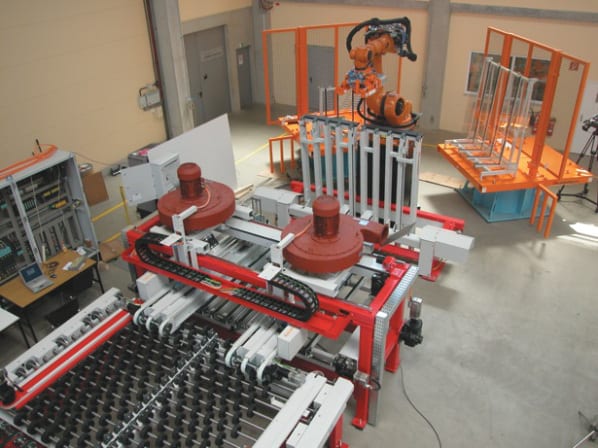 Grenzebach automates new High-Speed Stacker with Siemens SIMOTION motion control and SIMATIC PLCs fully integrated into one system, for increased throughput, reduced production costs, better finished glass quality and improved safety.
The float glass industry is facing multiple challenges, not the least of which is a growing array of applications requiring a broader offering of products and sizes, and competition from offshore producers.
The need for more flexibility and speed in the production process has never been so important. Similarly, the necessity to reduce production costs and optimize profit margins has never been so critical. Smart glass producers are finding that replacing manual functions with streamlined automation is not only meeting these objectives, but also has become a requirement for long-term stability and success.
Of all the functions on the float glass line, stacking remains the most labor intensive, and therefore a key target for automation. Glass producers have been looking for a more efficient, reliable and cost-effective method to stack the expanding selection of glass sizes they manufacture. Some producers have automated their stacking, but have experienced difficulties with speed of throughput, because of glass stacking displacement causing breakage.
But many more float glass producers are still handling stacking manually without the aid of any controls automation.
Fully automated cold-end line
Effectively streamlining the uniformity and quality in the making of plate glass – a new generation of glass-handling equipment has emerged, which is destined to change the landscape of cold-end line process efficiencies. Developed by Grenzebach, in tandem with Siemens, a new line of glass-handling equipment is being released featuring integrated controls systems that provide a fully automated solution to the handling of finished float glass. Every function of the cold-end line is being integrated into one controls automation platform – including take-over of the glass from the lehr, cutting the glass ribbon into sheets of optimum size, glass snapping, rejection of faulty glass sheets, sorting according to size and quality, and stacking into glass racks with robotics.
The cold-end line requires that multiple, continuously-operating functions be precisely and sequentially connected. Grenzebach and Siemens have effectively brought each of these functions into one complete and totally integrated automation controls system, with the net effect of reducing production costs and increasing throughput. This package of automation controls is equally applicable to individual machines in the line, so additional line equipment can easily be added to the system at the discretion of the plant.
Grenzebach
Grenzebach is a pioneer in float glass cold-end equipment. In 1974, the company developed the world’s first processing systems for automated float glass production. In addition to machines for transport and handling operations, and cutting and breaking lines, systems for identifying flaws, glass quality control and optimization of material yield have also been created.
Grenzebach Corporation is the U.S. subsidiary of Grenzebach Maschinenbau GmbH of Hamlar, Germany, which is a global manufacturer of production equipment for the flat glass and construction material industries. It is recognized as an international mechanical engineering company, with development and production facilities in Germany, the United States and China. Worldwide, the Grenzebach Group has some 1,400 employees.
High-Speed Stacker
The first piece of Grenzebach equipment to exclusively utilize this advanced automation technology is the company’s new High-Speed Stacker. Designed to increase glass manufacturer’s efficiency and flexibility, it was developed for stacking small glass formats with high cycle times, and is currently the only device which can stack glass sheets in less than a one-second cycle. The new system is the world’s most flexible glass stacker.
It is a robot-assisted float glass stacker, which reaches its speed from quickly forming sub-packs of glass and achieves its flexibility by stacking the sub-packs with a robot. The system improves employee working conditions and stacking accuracy and efficiency, while decreasing product damage and ultimately costs. The High Speed Stacker is an ideal answer to today’s flexibility and speed demands in the glass manufacturing industry.
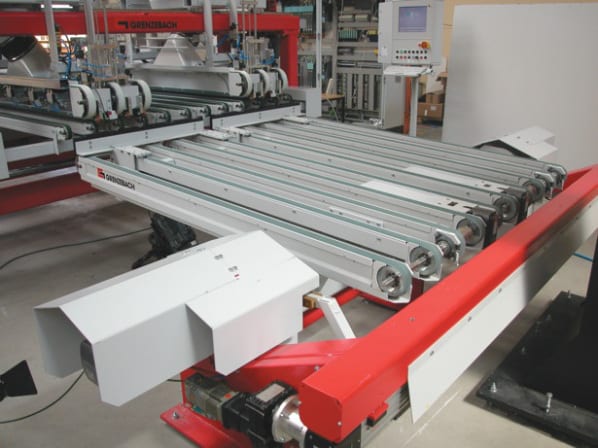
The High-Speed Stacker stacks glass formats from 12” x 18” up to 73” x 97”, and then transports glass sheets by a suction belt into a packet frame, where each sheet is placed successively until a sub-pack has been created. Next the packet is transported to a robot for take-off, either from above or from the side, to be stored on a glass rack that is used to transport the product to other facility locations or to end customers.
The system’s six-axis robots are capable of correcting the stacking alignment and creating precise glass stacks. For small glass sheets, two packets are built up and stacked parallel. Using this production method, up to 80 glass plates per minute can be taken off and stacked. The robots have a payload capacity of up to 220 lbs. and also feature integrated energy supply systems to reduce floor space.
The stacker can stack multiple sizes of glass with varying orientation – landscape or portrait, tin side in or tin side out with accuracy and speed. The High-Speed Stacker offers manufacturers the flexibility to adapt to product variations and rack and equipment changes. Feeding can be performed in a double stream, so that two packets are built up and stacked in parallel. It can be integrated into existing side-legs, but also demonstrates its stacking qualities in off-line cutting operations.
High-Speed Stackers can automate the entire packing capacity of a typical float glass production line, and can completely eliminate manual packing of glass.
Ideally, the angle of the glass rack is known and accurate. Since glass is heavy and the racks are being exposed to rough handling during regular operations, this angle can change over time compromising the structural integrity of the rack. As a result, a conventional stacker would not stack the glass in an optimal manner and glass breakage could occur. The robot of the Grenzebach High-Speed Stacker scans the rack for dimensional and angular discrepancies and adjusts its stacking program according to the actual geometry of the rack.
“Our customers have been demanding a better solution for stacking the many different glass sizes that they manufacture,” says Gerald Haas with Grenzebach Corporation. “Until now, they have had to rely on manual labor for their stacking operations. With the High-Speed Stacker, not only do they improve their employee’s working conditions, but they increase their operational efficiency and flexibility.”
 Totally Integrated Automation
Grenzebach’s totally automated cold-end line, and specific application to the High-Speed Stacker, is functionally based on Siemens’ concept of Totally Integrated Automation (TIA). TIA is characterized by its unique continuity. It provides maximum transparency at all levels with reduced interfacing requirements. It encompasses the field level and production control level, up to the corporate management level.
It also provides maximum interoperability, covering the controller, HMI and drives, up to the process control system. This reduces the complexity of the automation solution in the plant.
Motion Control, PLCs and Tech functions in one system
Central to Siemens’ TIA system in place with the Grenzebach line and High-Speed Stacker is SIMOTION®, Siemens latest generation of motion controller. SIMOTION, which includes a palate of high-tech control system components which are optimally harmonized.
Most machines require motion control (positioning, synchronous operation), PLC functionality and technology tasks (i.e. pressure control and temperature control).
The fusion of these functions into one system – as with SIMOTION – has a number of advantages, such as lower engineering costs, higher machine performance, the elimination of time-critical interfaces between individual components and simple, uniform and transparent programming and diagnostics for the entire machine with a single tool. The focus here is placed on a simple and flexible solution for numerous motion control tasks.
The motion controller, the drives and the motors encompass the scope of the Grenzebach cold-end line needs. This was a very big step forward technologically for Grenzebach, in terms of the wiring, drive integration and motion control. Taking standard, off-the-shelf Siemens technologies and applying them to a machine solution presented significant advantages to Grenzebach as an OEM.
Integrated with SIMOTION is Siemens SIMATIC® S7-300 automation system. Applicable for centralized and distributed configurations, it has the ability to integrate powerful CPUs with Industrial Ethernet/PROFINET interface. It can be set up in a modular configuration without the need for slot rules with I/O modules.
The Siemens SIMOTION motion control and SIMATIC controller provide a fusion of motion control, PLC and technology functions in one unit. This means that the new sophisticated stacking robots in use with the High-Speed Stacker can now be more easily controlled and operated.
Improved safety
A critical requirement of machine manufacturers and operators is seamless safety between humans and machines.
A truly safety-integrated system is a complete and consistent safety portfolio, which covers all tasks to be accomplished in the field of safety technology – ranging from detecting through evaluating, to reacting. In float glass production, safety is a critical concern. The automation built into the Grenzebach system greatly increases safety with handling sheet glass, resulting in far less accidents and injuries.
The Siemens S7 controllers are SIMATIC Safety Integrated, which provide the highest level of safety for humans, machines and environ¬ment. They are used to prevent accidents and damage resulting from a fault or mal¬function. The safety SIMATIC controllers monitor themselves, detect faults autonomously and immediately change into or remain in a safe mode when a fault occurs. They are optimized for use in production engineering and provide air-tight safety for all operations.
Fail-safe CPUs have been exercised for safety-oriented applications with the Grenzebach High-Speed Stacker and all other equipment on the cold-end line. The PROFIsafe profile for safe communication via PROFIBUS and PROFINET allows the integration of safety-related functions into standard automation environments.
Automation for a changing market
“We are making the SIMOTION and SIMATIC technology available to float glass producers so they can benefit from its system-wide controls capability and streamline their cold-end line production,” says Chad Shaffer with Siemens.
“This totally-integrated solution has been successfully applied to many other industries, but it is quite unique to float glass production until now.”
“Siemens has teamed with Grenzebach to help effect production efficiencies in the glass industry,” continues Shaffer. “More efficient equipment, safer production systems and a better bottom line for glass producers are our objectives.”
As glass producers deal with the influence of an increase in cheaper off-shore glass being imported and a more diverse product mix, production automation is more important than ever before. With new equipment providing better solutions, like the High-Speed Stacker equipped with a truly integrated controls package, glass fabricators stand in a much better position to operate their plants more efficiency and maintain a more competitive stature in the market.
Grenzebach Corporation can be reached by contacting: www.grenzebach.com
Grenzebach is a pioneer in float glass cold-end equipment. In 1974, the company developed the world’s first processing systems for automated float glass production. In addition to machines for transport and handling operations, and cutting and breaking lines, systems for identifying flaws, glass quality control and optimization of material yield have also been created.
The first piece of Grenzebach equipment to exclusively utilize this advanced automation technology is the company’s new High-Speed Stacker. Designed to increase glass manufacturer’s efficiency and flexibility, it was developed for stacking small glass formats with high cycle times, and is currently the only device which can stack glass sheets in less than a one-second cycle.
OR
SIEMENS INDUSTRY, INC.
Drive Technologies — Motion Control
390 Kent Avenue
Elk Grove Village, IL 60007
Phone: 847-640-1595 Fax: 847-437-0784
Web: www.usa.siemens.com/motioncontrol
Email: SiemensMTBUMarCom.industry@siemens.com
Attention: John Meyer, Manager, Marketing Communications
HAN-KWANG INTRODUCES THREE NEW LASERS
Korean giant enters U.S. market with big splash at recent FABTECH show
PL Machine
At the recent FABTECH show in Chicago, the largest builder of laser machines in Korea introduced three new CO2 lasers for metal fabrication, including two plate/sheetmetal machines and one tube/pipe cutter. Reaction from the attendees was very positive and interest quite high, as all three machines ran continuously throughout the show.
Details on the machines follow here:
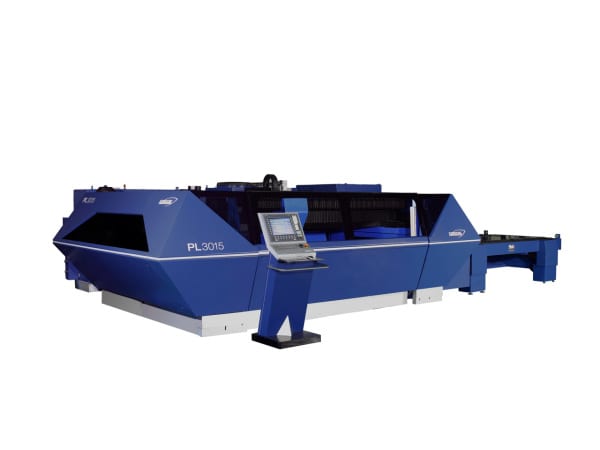
Han-Kwang takes the next step in its technology development with the introduction of the Series PL laser system. Incorporating our unique Beam Radius Control (BRC) and Constant Beam Delivery System (CBDS), Series PL also features the newest Han-Kwang laser technology, our S5 High-Speed Cutting Head, which significantly increases the cutting speeds on all sheet metals, up to 1120 IPM for 20ga mild steel and 790 IPM for 16ga stainless. In addition, the practical machine design and highly functional, ergonomic controls make the Series PL the new benchmark in long gantry laser systems.
Features
• BRC-Beam Radius Control
Through optimizing the beam diameter for each different material and thickness, cut quality is greatly increased.
• CBDS-Constant Beam Delivery System
By keeping the entire length of the beam delivery constant over the work area, beam quality at the cutting focal point is enhanced.
• S5 High Speed Cutting Head
Adopting the new generation of the sensing board and the cutting head means cutting speeds for sheet metals such as mild steel, stainless and aluminum are dramatically increased.
• PMU-Plasma Monitoring Unit
Constantly monitors cut error such as plasma and restart with faster piercing and more stable cutting quality.
• LCS-Lens Crack Sensor
Built-in LCS monitors the status of lens contamination to give maintenance personnel instant alerts for replacement.
• Rotary axis for tube cutting
Cuts tubes up to 12” OD to give your operation substantial flexibility in work strategies
• Siemens SINUMERIK 840D with 15” touch screen
Use of the highest powered CNC, with open architecture and simplified set-up with plain language commands, plus full interface to your shop programming/monitoring network, means greater productivity at the machine and overall in your operation
• Onboard high-efficiency air filter & dehumidifier with monitoring window
Utilizing its own power supply, this unique Han-Kwang system guarantees contamination-free cutting and unmatched consistency.
—————————————————————–
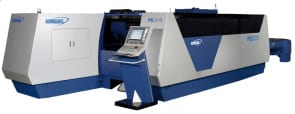
PS Machine
Han-Kwang takes the next step in its technology development with the introduction of the Series PS laser system. Incorporating our unique Beam Radius Control (BRC) and Constant Beam Delivery System (CBDS), Series PS also features the newest Han-Kwang laser technology, our S5 High-Speed Cutting Head, which significantly increases the cutting speeds on all sheet metals, up to 1120 IPM for 20ga mild steel and 790 IPM for 16ga stainless. In addition, the practical machine design and highly functional, ergonomic controls make the Series PS the new benchmark in short gantry laser systems.
Features
• BRC-Beam Radius Control
Through optimizing the beam diameter for each different material and thickness, cut quality is greatly increased.
• CBDS-Constant Beam Delivery System
By keeping the entire length of the beam delivery constant over the work area, beam quality at the cutting focal point is enhanced.
• S5 High Speed Cutting Head
Adopting the new generation of the sensing board and the cutting head means cutting speeds for sheet metals such as mild steel, stainless and aluminum are dramatically increased.
• PMU-Plasma Monitoring Unit
Constantly monitors cut error such as plasma and restart with faster piercing and more stable cutting quality.
• LCS-Lens Crack Sensor
Built-in LCS monitors the status of lens contamination to give maintenance personnel instant alerts for replacement.
•Siemens SINUMERIK 840D with 15” touch screen
Use of the highest powered CNC, with open architecture and simplified set-up with plain language commands, plus full interface to your shop programming/monitoring network, means greater productivity at the machine and overall in your operation
• Onboard high-efficiency air filter & dehumidifier with monitoring window
Utilizing its own power supply, this unique Han-Kwang system guarantees contamination-free cutting and unmatched consistency.
—————————————————————–
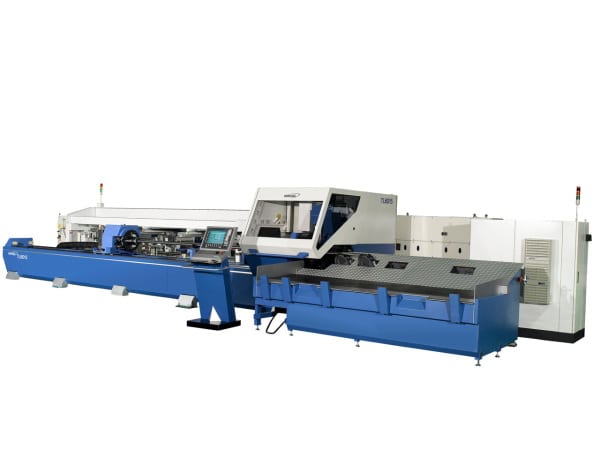 Han-Kwang takes the next step forward in fully automated tube cutting systems with the introduction of the new Series TL. All our experience in tube cutting technology has joined with our expertise in the design and engineering of materials handling systems to offer users a very affordable yet superior quality and highly flexible system for virtually non-stop production of tubes and shapes. Coupled with our exclusive Han-Kwang ProDesign 3D CAM/CAM software and fully controlled by a single CNC workstation, Series PL will provide unmatched productivity to your operation.
Highlight of the Series TL is our highly advanced S5 cutting head, which combines superior measurement and sensing mechanisms to change from signal size to pulse monitoring, resulting in optimum cutting conditions. This new cutting head design is further enhanced by Han-Kwang’s quick piercing nitrogen-injection technology. Smaller holes, quicker ambient area cooling and a substantial reduction in hole-to-hole cutting time will all benefit your production and your bottom line.
Features
• BRC-Beam Radius Control
• CBDS-Constant Beam Delivery System
• Magazine-fed bundle tube loading system
• Tube V-support system
• Rotary chucking system
• Completely enclosed safety workstation with automatic doors and light barrier system
• Panasonic 2500W resonator
• Cutting capability to 21’ long x 6” diameter
• Material thicknesses to 0.25” mild steel and 0.2” stainless
• Siemens SINUMERIK 840D, the highest-powered CNC on the market for maintaining complete processing cycle control by a single operator, using touchscreen and simple language commands
• ProDesign 3D CAD/CAM enabling fast adjustments to the production scheduling to yield maximum productivity from the system
• Unique Han-Kwang air filtration and dehumidifying system for cleaner cuts and more operator-friendly environment
For more information on this emerging new player in the laser machine market, please contact:
Robert Won, Director/North American Sales
HANKWANG USA, INC. Web: www.hankwang.com
Agency contact: Tim Daro Bernard & Company www.bernardandcompany.com
I had a speaking engagement today where I spoke about Social Media to a Human Resource association. I was discussing how Twitter, blogging and YouTube work best when they go hand-in-hand with each other. This topic came up here at work recently and this is how I put it into perspective:
When you develop a great video presentation and bring it to a trade-show or conference, you don’t just set it up on a table and leave it playing in a loop all by itself. You don’t just start the presentation and leave it unattended do you? Instead, you are there ready to greet people who show any interest in the presentation you are running. You are there to answer questions, make conversation and interact with others. As we all know, this is called networking. Likewise social media, when used correctly establishes this same type of interaction. Videos on YouTube need to be associated with a website, or a blog where someone interested can go and interact and ask questions. Once a connection is made and a conversation is started, it is just like you are standing together at the trade-show, or in the conference room. Here, in the discussion that evolves, whether it be virtual or in person, you will decide whether continuing a business relationship or not is in your best interest. So in both scenarios (virtual or in person) the same objective is being met.
Likewise, it’s important that once you post something on YouTube you have methods in place to draw traffic to the video. This is where your website, Facebook, Twitter and blog will play their part in this dance of getting your online presence noticed. Social Media needs to work together and be in harmony with each other. Working together is the key to the success of your social media campaign as well as your overall marketing plan.
We have a client who posts videos on YouTube, at the end of their Print Ads in the trade magazines we print: “see our videos on YouTube”… how is that for the evolution of the ad/PR world? We now have our traditional print ads referring potential clients (and anyone else who is interested) to our client’s online presence. At least for right now, it seems you can’t effectively have one without the other.
-Wendy
Continue reading I have seen many businesses that looked at social media as a passing phase… at least they were crossing their fingers and hoping it was. Others felt it wasn’t relevant to their type of business. This way of thinking has led to them simply “dabbling” in social media. Ultimately, they end up neglecting it and concluding “it doesn’t work”. When a business chooses to simply dabble or chooses to outsource social media negative results are almost always a certainty.
It is very common for us to hear “My son (or daughter) set up our Facebook page (twitter account, blog etc) but nothing ever came of it.” You cannot have an “if you build it, they will come” mentality when it comes to social media.
Your online presence needs to be built, given life and then it needs to be nurtured so it stays alive and grows bigger and stronger.
 Twitter or posting a blog once in a while. It’s not about someone who already has a full time job at your company spending a few minutes each week, “checking things out“. Here is the truth about social media: the beginning, the setting it up is actually the least time consuming and the easiest part. Why? because no one has found you yet and no one has started to communicate and interact with you yet. You are also not developing content, researching what’s being said and what are good, relevant things for you to be talking about. Getting content out into the world takes time. What are people interested in and talking about? How do you or your clients contribute to that conversation? This is not about selling products it is about participating in a conversation so you become the “go to” person for information and guidance in the world that your business is part of. I hear people say all the time, “what’s the big deal? I’ll just throw some things up on twitter once in a while and blog once in a while.” Sure, that is great if you want to use social media as an outlet for your daily ponderings… but if you want to get paying clients out of it, it’s a whole different ball-game.
 In the PR/ad world, we need to maintain this knowledge for our business to grow, but we also need to be a source and knowledge base for our clients so they can to look to us for expertise and guidance. How do we do this? We need to know about, speak about and write about anything and everything that is relevant to our world as well as theirs. We also need to know where our clients need to have a presence in order for social media to work for them. They look to us for knowledge and guidance and as their ad/PR agency; we better know what we are talking about.
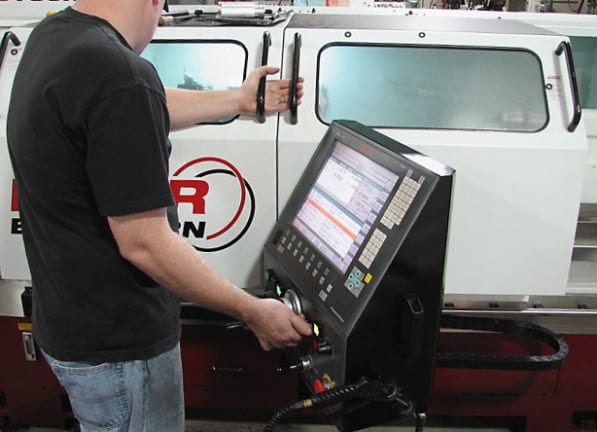 Fryer Easy Turn Combination Lathe with Siemens SINUMERIK 840D sl CNC lets operators at Continental Machine program, set-up and run faster; critical for one-off operations
By definition, says Josh Johnson, vice-president, Continental Machine, Rockford, Illinois, his prototype and short-run production shop must constantly run lean. There can be no tolerating excessive programming, set-up or machining time of any kind, otherwise the shop loses and, in this economy, Johnson notes, that is simply unacceptable.
Continental Machine is a seven-person, 13,000 square-foot facility that houses a variety of CNC milling, turning, wire EDM, hole popping and grinding machines, as well as various sheetmetal and plastic injection molding machinery. Therefore, the shop is well positioned to produce a wide variety of metal and plastic prototypes used by its diverse customer base, which spans markets such as window hardware, bicycle components, automotive parts, chemical processing, medical devices and foodservice equipment. Materials processed here are just as wide-ranging, including aluminum, CRS, tool steels such as A2 and D2, zinc, brass, copper, bronze, titanium and a variety of engineered plastics such as glass-filled Delrin.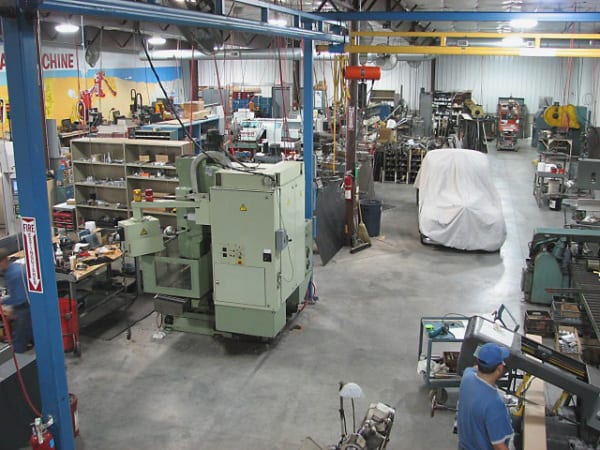
Recently, this job shop purchased a Fryer Easy Turn-21 CNC Combination Lathe, controlled by a Siemens SINUMERIK 840D sl numerical control. The two operators responsible for this machine upgrade at Continental had limited experience with CNC and none whatsoever with the Siemens protocol, as this was the first of its kind at the shop.
The Easy Turn-21 was particularly appealing to Josh Johnson, who comments, “The set-up is extremely easy. Teaching the tools, altering the lengths and diameters is kept very simple. After the initial learning curve, which took only a few days, the operators picked up on the conversational programming, right away. Also, one of the best features on the machine was that you could still turn the parts by using the electronic handwheel and just one function, such as hogging off material automatically or putting on a tapered thread.” He noted this feature was not only more comfortable for the operators, but it also allowed them to quickly and efficiently prove out part programs. Johnson commented that this would not have been possible on previous machines, owing to the flexibility of the control onboard the Fryer. The result has been a minimum 20% improvement in the overall cycle time on most part programs run at Continental. For this primarily prototype job shop, that fact translates into a substantial increase in the work product possible here.
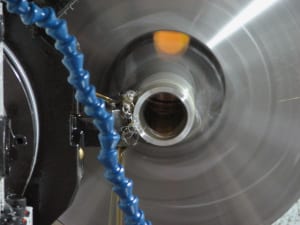
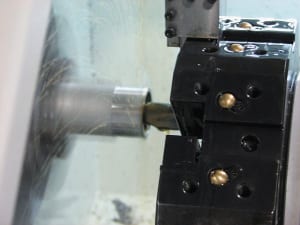
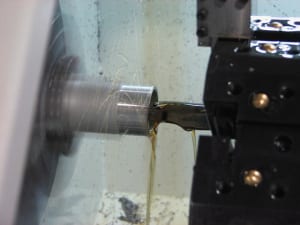
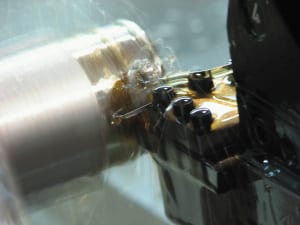
Echoing this sentiment, Sue Ostrander, sales manager, Fryer Machine Systems, explained the process that led her company to select the SINUMERIK 840D sl numerical control for all its milling and turning machines, a move that was recently formalized by the company and announced to the trade.
“Since its inception 26 years ago, family-owned Fryer Machine Systems has based its operation on three core principles: build a quality product, price it fairly and provide quality service. This philosophy has allowed Fryer’s business to grow even in challenging times,” she said.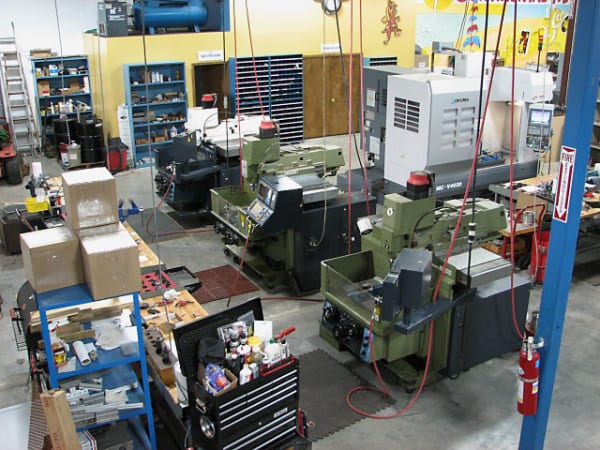
Fryer manufactures a diverse line of over 50 models of high-quality CNC machine tools in its 50,000 square-foot facility in Patterson, New York. Over the years, Fryer has become well-respected for its quality and innovation, throughout the job shop and production machining market segments.
“Moving to the Siemens 840D sl platform was the next step in Fryer’s ongoing commitment to provide our customers with the most innovative machine tools available in the market today,” Ostrander continued. “The Siemens solution allows machine tool end-users to achieve higher productivity through easy and intuitive features and step-by-step, on-screen programming. This enables them to dramatically reduce set-up, programming, and tooling times, while significantly increasing output.”
“The SINUMERIK 840D sl modular design allows us to take full advantage of the superior mechanical features in our machines,” continued Larry Fryer, president and CEO, Fryer Machine Systems. “Fryer has always been known for our easy conversational controls and the move to Siemens has allowed us to greatly enhance this feature,” Fryer noted. “The 840D sl menu-driven system combines an advanced geometry calculator that displays the part while the operator is programming it. Sophisticated solid model graphics allow the operator to verify the part program with more clarity than ever before,” he said.
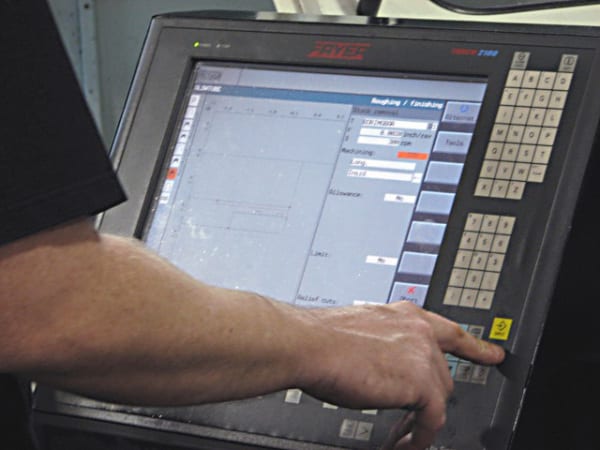 Larry Fryer has also been impressed with the automatic tool set-up and easy part set-up, made possible by the Siemens CNC. Fryer explained that auto-run mode is where many operators experience difficulty. Siemens and Fryer Machine Systems worked together to create an electronic handwheel run mode that gives the operator a safer way to prove out program execution, both forward and backward, using a standard electronic handwheel.
Fryer further stated, “Siemens provides us with a highly flexible solution that is critical to our ability to meet the specific needs of each customer. Our enhanced capability to offer the same control for both turning and milling gives Fryer machines a unified platform that is very important to customers both in the short-term and for long range expansion. Coupled with Siemens quality and reliability, they are invaluable to us in competing in today’s aggressive marketplace.”
Johnson added this comment on the service and training received by his operators at Continental. “Siemens has been helpful and very thorough in their training and after-sale service. The ShopTurn program, being integral to the control, now enables us to accurately determine tool path, potential collisions, tool changes and real world run time. This makes our operators’ jobs much easier, with the added benefit of allowing us to estimate much more accurately than ever.” Johnson further noted the CNC has substantial hard drive space, thus allowing most programs to be stored directly on the machine, though the company does maintain a back-up system.
For more information on this story, please contact:
CONTINENTAL MACHINE CO.
Email: conmach@onecommail.com
FRYER MACHINE SYSTEMS, INC.
Web: www.fryermachine.com
SIEMENS MACHINE TOOL BUSINESS
John Meyer
Manager, Marketing Communications
Siemens Industry, Inc.
(847) 640-1595
www.usa.siemens.com/cnc
SiemensMTBUMarCom.industry@siemens.com
Follow us on Facebook: www.facebook.com/SiemensCNC or Twitter: www.twitter.com/siemens_cnc_us.
—
Siemens Industry Sector is the world’s leading supplier of innovative and environmentally friendly products, solutions and services for industrial customers. With end-to-end automation technology and industrial software, solid vertical-market expertise, and technology-based services, the sector enhances its customers’ productivity, efficiency and flexibility. With a global workforce of more than 100,000 employees, the Industry Sector comprises the Industry Automation, Drive Technologies and Customer Services Divisions as well as the Metals Technologies Business Unit. For more information, visit http://www.usa.siemens.com/industry.
The Siemens Drive Technologies Division is the world’s leading supplier of products, systems, applications, solutions and services for the entire drive train, with electrical and mechanical components. Drive Technologies serves all vertical markets in the production and process industries as well as the infrastructure/energy segment. With its products and solutions, the division enables its customers to achieve productivity, energy efficiency and reliability. For more information, visit http://www.usa.siemens.com/drivetechnologies.
Continue reading In this struggling economy, we have clients who’ve actually gone back to Marketing 101 and decided that tough times require more aggressive presence in the market.
Old customers and prospective new ones are being courted more often, both in print ads, direct mail (making a nice comeback as it’s now unique!) and online via blast email, regular newsletters and the inexpensive if rather impersonal vid conference.
The impact of such activity has had the collateral if unintended consequence of making our agency quite busy, this year. So thanks for that, clients!
Much more important is the fundamental tenet of marketing being applied here. They can’t buy from you if they don’t know you’re on the planet, to be blunt.
And, whether they’re currently buying or not, the ones who’ll stay in business are the targets of our messages for clients.
Having lived through four major recessions in business in my time, the theory has been proven true, time and again. Namely, companies who continue to maintain a presence in their market, by whatever means, come back faster and stronger than those who don’t. This is a fact and we have the evidence to prove it, for anyone interested.
TD
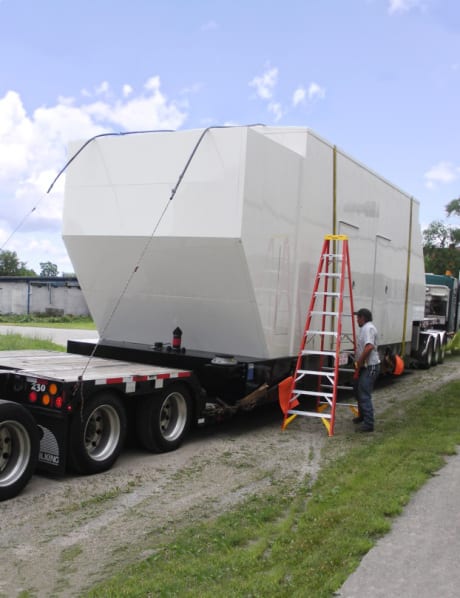
Hennig custom enclosures on generators provided through W.W. Williams to huge dairy products processing plant in Michigan.
Machesney Park, IL-On a recent installation at the Ovid, Michigan processing plant of the Michigan Milk Producers Association (MMPA), the standby power generation system supplier, W.W. Williams (WWW) of Dearborn, Michigan, required an increased level of sound and environmental protection on the three generating stations, in accordance with the specs received from their customer’s architectural firm. They turned to their enclosure suppliers for assistance, as the challenges were many. For the complete package, the project was awarded to Hennig. As WWW’s Brunswick, Ohio-based project manager on the job, Al LaManna, puts it, “We’d begun to see Hennig as our go-to guys on enclosures, owing to the continued satisfaction we’d experienced with their levels of quality, engineering and especially responsive service.”
The Ovid facility of MMPA processes over three million pounds of milk per day, specializing in the production of liquid dairy blends, dry powders and bulk butter. These dairy ingredients are offered in spray-dried, liquid, condensed and instantized forms. Fluid products are typically loaded for bulk tanker or 55-gallon drum delivery, while powders are packed in 50 lb. bags, 25 kg bags or one-ton totes. Butter is produced in 25 kg cubes. Such production processes place substantial load on the local utility company’s power generation system and also create ambient dust contaminant challenges for the plant’s equipment.
During the construction process on the three enclosures needed for the standby power generators, extra attention was given to the insulation, silencers and electrical controls for the unit, to ensure proper functioning, sound attenuation and minimized environmental impact. These enclosures and fuel tank assemblies further required additional features, as mandated by the Michigan Department of 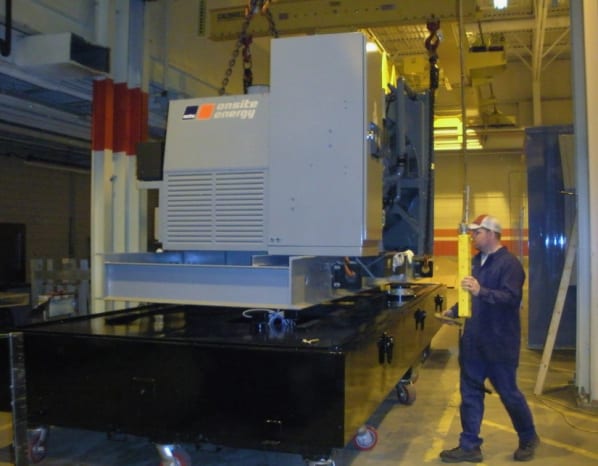 Environmental Quality, including overflow protection valves with a spill box for fuel containment on the remote filling apparatus, fill panel alarm system with level switch, extended vents above the roof line, a special mastic coating on the bottom of the fuel tank and stainless steel fuel supply and return lines.
Following the submission of the complete specification and winning the job, Hennig engineers Christian Grobe and Robin Moore, as well as sales rep Matt Sopchyk, led the team that produced the enclosures at the company’s manufacturing/fabricating facility in Rockford, Illinois. Al LaManna had occasion to visit the plant during the construction and was impressed by the efficiency of the vertical integration. Hennig performs all metal fabrication, finishing and the rigorous testing to UL standards in-house. “Even a midstream specification change by our customer was handled at Hennig with no upset in the production schedule,” notes LaManna.
 Founded in Columbus, Ohio in 1912, W.W. Williams has evolved from one of the nation’s largest industrial distribution, repair and service companies to a highly diversified solutions provider. They provide solutions to customers with technical / mechanical service and repair, remanufacturing, warehouse / supply chain management and service a varied customer base. Their products and services include diesel engines, transmissions, heavy duty truck repair, refrigeration, power generation and third party supply chain logistics services. Their customers comprise on-highway trucking, off-highway equipment, Department of Defense OEM’s, vehicle OEM’s, U.S. Military and marine enterprises. The company represents the MTU Onsite Energy group and specializes in gas and diesel engine systems, fuel cell systems, gas turbine systems and gen-drive engines, to provide primary, standby and continuous power.
As Territory Manager for the company, Todd James Rundhaug, observes, “We are constantly looking for quality component suppliers to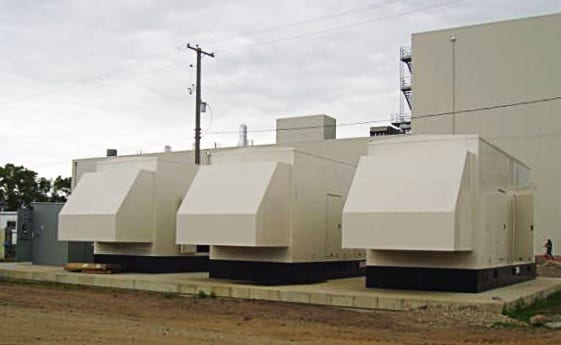 complement our MTU Onsite Energy power generating equipment. We began our relationship with Hennig in 2008 and have been extremely satisfied with the quality, workmanship, delivery and especially the after-sales sales support on their enclosures and fuel tanks. Due to a variety of factors, our types of equipment require highly specialized enclosures and UL Rated fuel tanks. The total service package from Hennig on these products has been excellent.” LaManna agrees, noting his customers’ repeat satisfaction with the full package supplied by Hennig. On this Michigan Milk Producers job, Hennig supplied the enclosures, each equipped with a heater, overhead lights, powered louvers, battery back-up lighting with NiCad battery power and GFI wall outlets.
 Point man on the job for Hennig Enclosure Systems was Matt Sopchyk, who noted there were three enclosures needed for the onsite generators on this project. Each generator is a 2000 KW unit, with a sub-base fuel tank holding 3480 gallons of diesel. “Hennig design standards for this application included our complete in-house powder coating process for the enclosure walls, doors and roof sections over the all galvanealled steel construction. This job was finished in MTU gray, matching their gensets.”
The UL142 approved steel fuel tanks are finished with a phosphoric pretreatment high-pressure wash and then a 2-step polyurethane process. Hennig enclosures are of a semi-monocoque design, meaning the structural integrity and inner strength are engineered and built into every panel and roof section. This allows for clean and functional design, without the need for separate framing or additional substrate supports of any kind. Also, the Hennig fuel tanks are engineered and built in a similar way, with full interior baffling and sub-structure integrity to support the genset without the need for surface mounted I-beams to support the genset or the need for an additional, costly raised floor above the tank top. The tank top is the floor within the genset.
To learn more about Hennig products & services, visit www.hennigworldwide.com or call contact:
Tim Waterman
Hennig Inc.
9900 N. Alpine Rd.
Machesney Park, IL 61115
(815) 316-5277
info@hennig.ame.com
www.hennigworldwide.com
Connect with Hennig online: 


—
Hennig, Inc., at www.hennigworldwide.com, has been designing and producing custom machine protection and chip/coolant management products for state-of-the-art machine tools for over 50 years. Hennig products are designed to protect against corrosion, debris and common workplace contaminants. Hennig has manufacturing facilities in the U.S., Germany, Czech Republic, France, Brazil, India, Japan, China and South Korea. Its North American repair centers are located in Machesney Park, Ill.; Chandler, Okla.; Livonia, Mich.; Blue Ash, Ohio; Mexico City, Mexico; and Saltillo, Mexico.
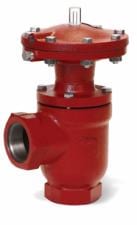
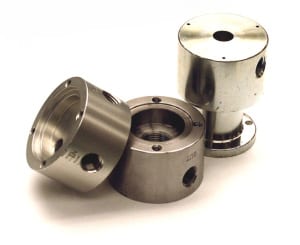
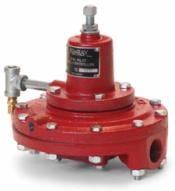
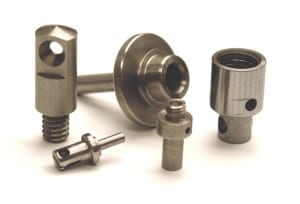
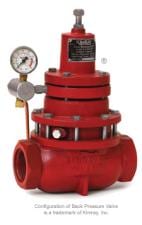
Continue reading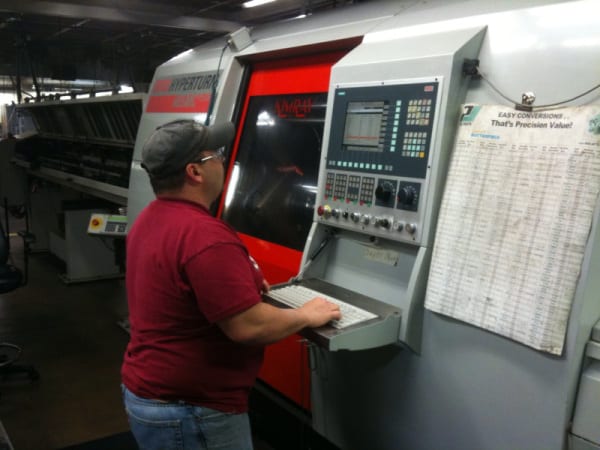 Kimray, Inc., an Oklahoma City-based manufacturer of control valves and related equipment for oil and gas producing companies, reports an 83% increase in their machining efficiency, achieved largely as the result of recently acquired CNC production equipment.
Founded in 1948 by Garman Kimmell, Kimray operates a 274,000 sq. ft. facility and employs over 400 people to serve its expanding customer base of oil and gas producing companies. Kimray machines iron, steel and aluminum, as well as thermoplastic materials, to build its comprehensive line of control valves, thermostats, energy-exchange glycol pumps, gas-operated pilots and other process control devices. Their products are used to control vessel and lead line temperatures, liquid level inside pressurized vessels, pressure drops and liquid/gas flow.
The company maintains a turnkey manufacturing facility, including dozens of lathes, grinders, turning, milling, sawing and bore finishing/honing machine tools, nearly all with CNC systems onboard. Originally, two machines were purchased, an Emco Maier EMCOTURN 420 MC PLUS and HYPERTURN 665 MC PLUS Lathes, each equipped with Siemens SINUMERIK 840D CNCs and SIMODRIVE 611D drive packages. As their productivity greatly increased, Kimray decided to purchase two more Emco Maier machines to keep up with increased demand for their products.
 The company operates a host system for file storage and back-up on all part production data. As one operator of these lathes observed, “I liked the Fanuc 18i-T CNC we used on other machines in the shop, but, with the SINUMERIK 840D, you can do so much more, such as instant programming and cut and paste operations, while the machine is running or stopped. Each screen allows you to be very detailed about what you’re doing, such as separating your mains from your subs with your part and workpiece programs. I use the Siemens CNC for axis and spindle movements on both machines (Emco Maier 420 Dual Main and Counter spindle Machine and the 665 Main and Counter Spindle Machine). My programs and data can be recessed easily and transferred back to the machines (from the company’s main host system), as needed. I can run my programs out of workpieces and sub-spindles, including milling and stenciling out of the sub-programs. I use the parts program as my way to transfer files and folders to the main system and back again.”
He further commented on the controls, “On a typical set-up, I like the sensitivity of the CNC. Being able to move the axis only a ten thousandth at a time to a hundred thousandth at a time comes in very handy for me. I also like the program test feature, especially on new programs. Each tool has its own geometry page and up to four offsets, making things much less complicated.”
Lastly, regarding the machine builder, this operator noted, “I received lots of good advice and training from the folks at Emco Maier, especially Doug Poling. He’s also assisted me a few times by phone, when needed.”
 In the manufacture of its oil and gas production controls, Kimray typically machines bar stock of 303, 304, 310, 316 and 17-4 stainless, as well as D-2 tool steel, 6061-T6 aluminum, brass, Delrin and Teflon. Cast iron, ductile, steel, stainless and aluminum are also machined here. The 83% increase in machining efficiency has been achieved, due to these four Emco Maier machines with Siemens CNCs, according to Kimray sources and company production data.
In determining the increase in overall machining efficiency at Kimray, VP of Operations David Hill commented, “Our commitment to run CNC machine tools has long been in place and the addition of the Emco Maier lathes with Siemens controls onboard are the latest steps in this process. We’ve literally had no problems with these machines, the CNC’s or the drives. When Kimray operators can keep running and producing parts in such a way, the impact on our overall efficiency is immediate and substantial.”
Mike Morris, Kimray’s Plant Engineer, added that “the control is strong and easy for the operators to use”. Over the years, the CNCs have been virtually bulletproof.”
From the builder’s perspective, Emco Maier shares Kimray’s appreciation for the performance of its CNC/drive package supplier.
“Our 420 machine enables simultaneous production of two parts without interruption or collision. The digital drives (Siemens SIMODRIVE 611D) produce dynamic performance in both the main spindle and X/Z axes,” commented the company’s Director of Sales Support Operations for Emco Maier USA. “Plus, programming is just the same as on any CNC lathe. Only one program is generated. The program for the second workpiece is simply transferred to the bottom system by means of a selector switch. No additional programming is necessary. As we like to say, twice as nice.”
The 665 Hyperturn machine enables true 4-axis machining plus full c-axis capability on both the main and counter spindles. The 665 uses some of the same programming features, plus the same digital drive system as the 420, but in a larger package.
For more information on this story, please contact any of the following individuals:
KIMRAY, INC.
Web: www.kimray.com Email: info@kimray.com
EMCO MAIER CORP.
Web: www.emcomaier-usa.com
SIEMENS MACHINE TOOL BUSINESS
John Meyer
Manager, Marketing Communications
Siemens Industry, Inc.
(847) 640-1595
www.usa.siemens.com/cnc
SiemensMTBUMarCom.industry@siemens.com
Follow us on Facebook: www.facebook.com/SiemensCNC or Twitter: www.twitter.com/siemens_cnc_us.
—
Siemens Industry Sector is the world’s leading supplier of innovative and environmentally friendly products, solutions and services for industrial customers. With end-to-end automation technology and industrial software, solid vertical-market expertise, and technology-based services, the sector enhances its customers’ productivity, efficiency and flexibility. With a global workforce of more than 100,000 employees, the Industry Sector comprises the Industry Automation, Drive Technologies and Customer Services Divisions as well as the Metals Technologies Business Unit. For more information, visit http://www.usa.siemens.com/industry.
The Siemens Drive Technologies Division is the world’s leading supplier of products, systems, applications, solutions and services for the entire drive train, with electrical and mechanical components. Drive Technologies serves all vertical markets in the production and process industries as well as the infrastructure/energy segment. With its products and solutions, the division enables its customers to achieve productivity, energy efficiency and reliability. For more information, visit http://www.usa.siemens.com/drivetechnologies.
Continue reading Several clients have appointed designated hitters for the internet blogs and especially the engineering chat areas of publication websites.
We applaud this action, especially in this economy.
One client said to me, during a meeting where I was encouraging this tactic, “Tim, how can I take a very busy engineer or sales guy away from customers and quoting to play on the internet?”
After I calmed down, I explained to him that:
Seriously, since very little is new under the sun, this is just the new version of that longtime and revered guy at every company, the one people flocked to see at trade shows.
Two quick examples:
We had a client (sadly passed away) who invented polymer quenchants for commercial heat treating. This ancient industry used water and oil, mostly, as it had for literally centuries. People would come to the trade shows and actually wait in line to see the guy. Then, with almost papal severity, he would lean into them, listen to their quenching problem, ponder it for a moment and then put his finger in their chest and say, “OK, here’s what you do…”
We have a current client who runs what is arguably the finest gear company on the planet. He’s also a world-class fly fisherman. He stands in the aisles and goes “casting for customers,” as he says. When he arrives at a show or conference, you’d think Ghandi had walked into the room…with Mother Teresa on his arm! Talk about drawing a crowd. His theory evokes the old John Kennedy line that a rising tide lifts all boats. He actually shows customers, prospects AND his competitors his operation and his p&l. His company currently exports high-precision gears worldwide, including to China!
The internet guru at your company can be a powerful force for growth and a true agent of change for your business and the industry as a whole. Don’t overlook the possibilities or think that it’s just playtime! When a “social” network has a tangible business upside, that’s a game we’d all like to join!
TD
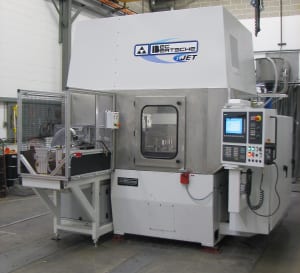
Bertsche iJet waterjet deburring system built for Linamar combines waterjet deburring with part cleaning for one inline system.
Canadian automotive part supplier realizes significant gains with Bertsche-designed multi-function system in its plant
With factory floor space at a premium and capital equipment funds scarce, Linamar, a Tier One Canadian automotive part supplier, turned to Bertsche Engineering recently for an all-in-one part deburring, final rinse and drying solution.
Typically, complex machined automotive parts with multiple intersecting holes require feature-specific part deburring to insure that parts are burr-free. After deburring, parts also need a final cleaning/washing to insure removal of microscopic particles that might adversely affect performance. They are then preserved with a rust or oxidation inhibitor and dried for shipment (transport) to be assembled. Usually, this involves separate pieces of equipment linked by conveyors or robots to transport parts to each machine.
To solve the problem of densely filled factory floor space, Bertsche Engineering developed a machine that handles all these processes in one machine, in one deburring cycle. The machine takes oil and chip contaminated parts, previously machined on CNC milling centers and mill/turn machines, then selectively deburrs critical features using high pressure water, blasting chips out of internal cavities, knocking off all feather-edge burrs and fan washing the outside of the part, using a CNC for full cycle control.
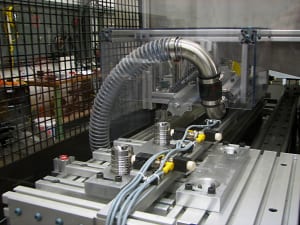
Close-up shows parts infeed and outfeed station, where considerable space savings were realized by the customer, Linamar, a major Canadian Tier One automotive parts supplier.
This process is accomplished by a series of rotating lance nozzles that probe small diameter internal holes in order to blast feather edge burrs clean at intersection points and wash chips out of dead-end passages. External features are then blasted with a series of direct nozzles that release up to 10,000 psi of water at the burr while tracing the part edges. The part is then washed with high-pressure rotating fan nozzles. Note: When required, additional mechanical wire and filament brush tooled deburring stations can be incorporated into the Bertsche system to mechanically remove burrs.
The same machine moves the deburred part to an agitated wash and rinse station, where the part is rinsed, cleaned and preserved with an aqueous rust inhibitor (providing up to 24-day protection) and is finally dried. The part is then ready for final assembly.
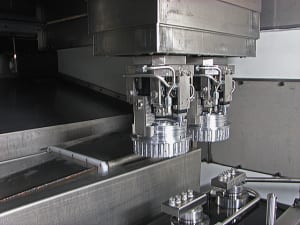
Close-up shows parts being indexed over high-pressure (10,000 psi) waterjet nozzles for full wash cycle and rust-inhibiting aqueous coating process
For more information on this application, please contact:
BERTSCHE ENGINEERING CORPORATION www.bertsche.com
PR agency contact: Tim Daro Bernard & Company www.bernardandcompany.com
Release: BERTSCHE ENGINEERING CORPORATION
Date: December 28, 2009