
Contact us today:

(847) 934-4500
tdaro@bernardandcompany.com
Contact us today:
(847) 934-4500
tdaro@bernardandcompany.com
 During the last two years, AME’s Speedcut Division has invested in new production and measuring equipment and concentrated heavily on R & D and saw blade innovations to improve the tool life of carbide- and cermet-tipped circular saw blades.
We are very pleased to announce the promotion of Christian Schedler to the Product Manager position at this division.
In his new role, Christian will oversee P&L responsibility for the division, including its sales, application engineering, product management and project management functions.
Christian’s distinguished career has encompassed R&D, Engineering and Product Manufacturing. He has a broad assembly and service experience on machine tools and knows the market’s needs for productivity improvements. Prior to this promotion, he worked in service as a Global Service Rep for a German machine tool company and as a Designer of carbide saws at Advanced Machine & Engineering. Christian has the experience, energy and judgment necessary to lead the division to continued success, insuring its future growth objectives are achieved.
Advanced Machine & Engineering Co., is a manufacturer located in Rockford, IL, serving the Machine Tool Industry with precision components and accessories, including spindle interface components, workholding devices, and, through our sister company, Hennig, machine enclosures, chip removal and filtration systems. The Fluid Power – Safety markets are served with cylinder rod locks and safety catcher devises; and the Production Saw market with our Amsaw carbide saw machines and Speedcut blade products. AME has manufacturing partners and customers around the world and across the U.S. To learn more, visit www.ame.com.
Hennig, Inc. design and produces custom machine protection and chip/coolant management products for state-of-the-art machine tools. Hennig products are designed to protect against corrosion, debris and common workplace contaminants. Manufacturing facilities located in the U.S., Germany, Brazil, India, Japan, China and South Korea. Repair centers are located in Machesney Park, IL; Chandler, OK; Livonia, MI; Blue Ash, OH; Mexico City, Mexico and Saltillo, Mexico. To learn more, visit www.hennigworldwide.com.
For more information, contact:
Tim Waterman
ADVANCED MACHINE & ENGINEERING CO.
2500 Latham St.
Rockford, IL 61103
Phone: 815-316-5277
Fax: 815-962-6483
E-mail: info@ame.com
Connect with AME online: 


Steps to take for avoidance of imperfections in the aesthetics and surface integrity of gearworks
Roscoe, IL-Forest City Gear recently disseminated the following tips to its employees and would like to share these ideas with the gearmaking community, as well as users and assemblers of gearworks. This information is provided for reference only and any further questions or comments should be directed to author Fred Young, CEO of Forest City Gear. He welcomes all feedback.
BY: Fred Young, CEO
TO: All Forest City Gear Employees
Recently and historically, we have had issues with gears that suffered from the above conditions, after heat treat. These issues can also appear during hot and humid times, as well. We previously had a sand/vapor blast unit that was used to clean off debris and contamination from gears, prior to further processing.
My suggestions for future handling, based on experience and a reading of the current technology, include the following:
I welcome all your suggestions to further our desire for achieving “Excellence without Exception.” (This is the company motto at Forest City Gear.) I think that if all hands are on the lookout to address the corrosion, discoloration, contamination and pitting issues and address corrective procedures prior to further processing-gear grinding, cylindrical grinding or other machine operations- this will help minimize our overall cost. It is very difficult to address these issues after grinding has occurred, as you all know.
The September/October (2009) issue of Gear Technology had an article starting on page 60 entitled, “Gear Corrosion During the Manufacturing Process,” which focused on issues of pitting caused by corrosion, which can be very serious and ultimately lead to gear failure in operation.
While the article discussed the REM Chemical process of isotropic superfinishing in particular, much of the information is germane to the points above and will contribute to your understanding and resolution of these problems. I encourage you to read it. The watchword at Forest City Gear is that all of us are responsible to be on the lookout and take steps to prevent this situation from future occurrence, to the greatest degree possible. It will be prudent to gather some examples and point out exactly what we are trying to prevent from going out the door, by reviewing it with all hobbing/secondary, shaping and grinding department personnel, at the earliest opportunity.
For more information on this announcement, please contact: FOREST CITY GEAR CO., INC. Web: www.forestcitygear.com
Editor Note: Please send any publication-generated inquiries from this article to Wendy Young at Forest City Gear, wyoung@forestcitygear.com. Thanks much.
PR agency contact: Tim Daro Bernard & Company 847-934-4500 tdaro@bernardandcompany.com
Release: FOREST CITY GEAR CO., INC.
Date: January 26, 2010
Continue readingBy combining careful engineering and high-functionality motion control components from Siemens, R.A. Jones produced a high-speed, high-flexibility cartoner that had the customer coming back for seconds.
By: John Ryan, Packaging Industry Consultant, Siemens Industry, Inc.
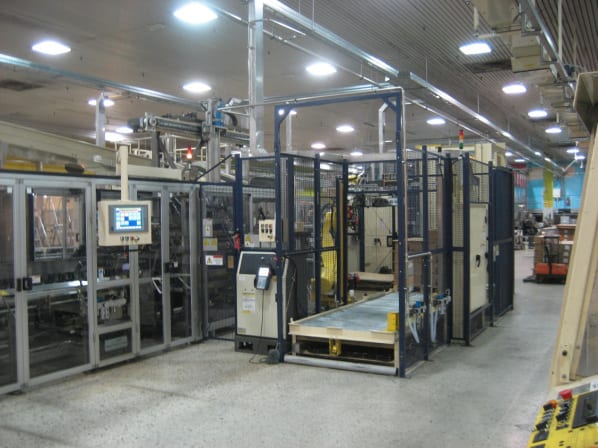
The HMI (left center) operates the cartoning line (silver and black enclosure at left), which is capable of packaging 330 bottles per minute, the result of Siemens motion control technology and R.A. Jones engineering. The enclosure at center right holds empty cardboard cases after the carton blanks are removed. Photo credit: R.A. Jones
There is a saying in retail that the package sells the product. While this might not be true across the board, for OEM machine builder R.A. Jones, located in Covington, Ky., the package does indeed sell the product—the company builds packaging machines and cartoners for a wide range of applications. When a U.K.-based spirits distiller changed to a new carton for its high-end Scotch, it turned to R.A. Jones for a cartoning solution. With the help of Siemens motion control components, software and engineering support, the resulting machine was so successful that the company ordered a second version even while the first was being commissioned.
One of the challenges of this project was the speed required¾the process needed to run at 300 bottles per minute with a 10 percent surge capability. The machine had to separate the incoming bottles, transfer each into an article bucket, bring the bucket into the machine, erect the carton, transfer the bottles from bucket to carton, close the carton, stand it up, then discharge it from the machine. This complex sequence had to be performed at a rate of five times per second.
Additionally, the project had very stringent quality requirements. Because the product was a high-end Scotch, there was virtually zero tolerance for any marks on the bottle, the label or the box. The customer wanted the ability to reject individual cartons, individual bottles or cartons with no bottles in them, all without derating the line. The line needed to be able to switch rapidly and easily among packaging 700 ml, 750 ml, and 1 L bottles for two premium brands. To further complicate the process, the bottling plant is located in Scotland, while R.A. Jones is based in the United States.
R.A. Jones has a standard line of product platforms, but where it really shines is in customization for challenging applications. “In general, we are known for high speed and flexibility,” says William Kaup, Technical Sales Manager at R.A. Jones. “While we have standard product lines, many customers come to us for custom or complicated projects.” Often, the OEM machine builder develops a solution by making a few modifications to an existing platform. That was not the case for this project, however. The engineering team nominally started with R.A. Jones’ Meridian cartoner design, but instead of augmenting 80 percent standard platform with 20 percent customization, the project followed the opposite ratio. “We knew it would be an engineering-heavy, custom application,” says Kaup. “The high number of axes required for this project, in and of itself, placed this system at the high end of the complexity scale that we see.”
Getting smart with SIMOTION
The cartoner incorporates 27 axes powered by Siemens servo motors and Sinamics S120 drives. Although much of the machine leverages what Kaup characterizes as fairly standard coordinated motion, some aspects required more. To address all these needs, the engineering team chose the Simotion D445, which integrates the capabilities of a PLC and a motion controller to offer significant intelligence and processing power in a compact form factor.
“The D445 works with compiled code versus assembled code, so it is faster,” says Jason Barter, Application and Development Engineer at R.A. Jones. The Simotion D445 provided all the processing muscle for the cartoner, allowing the team to use the Sinamics S120s as passive drives. “This solution worked well,” Barter adds. “For a 27-axis machine with one processor, the overall throughput of the machine was very efficient.”
To connect the drives to the D445, the team used Siemens’ Drive CLiQ. An Ethernet backplane based on a 100 Mb/s serial interface, Drive CLiQ automatically captures nameplate data and validates components, simplifying device integration and replacement by maintenance staff. After all, plug-and-play operation only works if the right device is being plugged in. “Basically, [Drive CLiQ] recognizes that the correct motor and drive for that particular axis have been connected, so someone would not be able to put in the wrong size motor or wrong size drive,” says Barter. “It helps the client get the right components in the right place.”
Maintaining continuous operation at 300 bottles per minute required an automated carton-loading system to ensure a steady supply of packaging materials. In the carton-loading system, a robotic arm from an outside vendor picks up cases of carton blanks from a pallet, inverts them, and sets them, case and all, in the magazine of the cartoner. The Jones flexbot, a two-axis pick-and-place unit powered by Siemens servo motors, lifts the case off of the stack of blanks and sets the empty case on a trash conveyor. The two-axis pick-and-place unit was controlled from the cartoner’s D445 controller as part of the 27 axes. The Siemens support staff developed custom function blocks to allow the R.A. Jones team to more easily program the equipment.
With a system consisting of a 27-axis cartoner, the robotic-arm carton loader and a pallet handling system, the number of connections added up. “We had two racks of Siemens ET200S I/O on the cartoner,” says Barter. “It was quite an extensive machine.” The pallet handler and de-palletizing robot formed a system by themselves. The pallet handling system was controlled by a Simotion D425, which interfaced with the robot controller over Profibus. The design team integrated the pallet handling system with the cartoner by way of a Profibus connection between the D445 and D425. “We interfaced the robot controller with the Siemens D425 controller just to get some [communications] back and forth and also interfaced that controller to the cartoner,” Barter continues. “We connected the D425 to the main cartoner machine controller (the D445) over Profibus, and then ultimately those two machine controllers communicated with one HMI over Ethernet.”
Although the interface between the D425 and the robot was straightforward, having two machine controllers communicating with a single HMI provided more of a challenge. The Siemens engineering team stepped in to help. “Between Siemens and our distributor, we had quite a bit of support to ensure that we could progress through the development and factory acceptance test of the equipment as rapidly as possible,” Kaup notes.
Troubleshooting at a distance
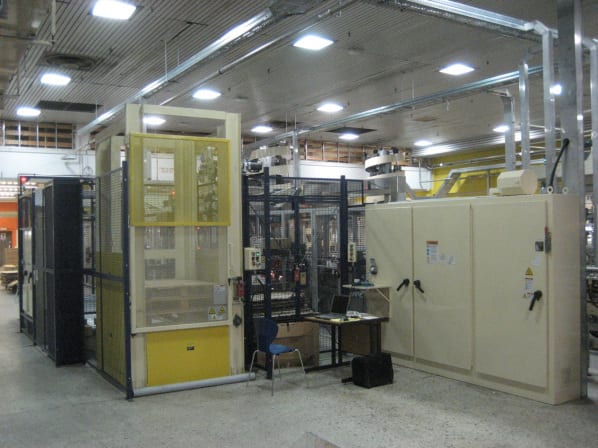
This upstream view of the cartoner shows the pallet stacker of the robotic system (yellow-paneled enclosure) and the main electrical panel (right). Photo credit: R.A. Jones
In addition to the performance specifications, the customer wanted to incorporate remote access to allow R.A. Jones support engineers in the United States to be able to access the machine online. Here, too, Siemens supplied a solution: the Scalance S612 security module, an industrial-Ethernet switch that provides secure remote access through Internet gateways. Using the Scalance security module and standard Siemens engineering software, R.A. Jones engineers can troubleshoot the machine as though they were standing right in front of it.
The approach not only saves the cost of flying in support staff, it reduces the downtime spent waiting for them to arrive. On a packaging line that processes high-end spirits at 300 bottles per minute, this is an important benefit¾an hour of downtime alone can add up to hundreds of thousands of dollars. The Scalance S612 has already been used to resolve minor issues, Kaup says. As an important side benefit, R.A. Jones engineers have also been able to combine that connectivity with the machine network to access the robot arm on the pallet handling system, even though it is not a Siemens product.
The finished cartoner was shipped from the R.A. Jones facility to the spirits distiller’s plant in Scotland on nine full-sized pallets packed into three freight airplanes. With its combination of hardware, software, and engineering, the machine has achieved a maximum speed of 330 cartons per minute, which meets specification with the required 10 percent surge. “The machine is running well, with only a few application specific issues to be resolved,” says Barter. Based on the success of the first machine, a second one was ordered.
“Although we had used the Siemens Simotion D on several of our other standard product lines, there was a learning curve [with the first machine] because this project was on a much larger scale than we had previously done,” says Kaup. “The second machine went much more smoothly.”
The success of the project came from a combination of quality components, careful design and a tight engineering collaboration. “I think the engineering support provided by Siemens and our local distributor, C&E Sales, was vital to the success of the project,” says Kaup. “I do not think the development could have been done in the timeframe required without that assistance.”
The package may sell the product, but in this case the product sold the packager and the result was repeat business, a satisfied customer and a new set of tools to use for success.
About the author
John Ryan is a Packaging Industry Consultant at Siemens Industry, Inc., Drives Technologies, Motion Control, Production Machines, John.Ryan3@siemens.com.
For specific product information and inquiries, call (800) 879-8079 ext. Marketing Communications or send an e-mail to: SiemensMTBUMarCom.industry@siemens.com.
Continue reading No. 922 is an electrically-heated 500°F(~260°C) cleanroom cabinet oven from Grieve, currently used for drying precision parts in baskets at the customer’s facility. 30KW are installed in Incoloy sheathed tubular heating elements to heat the load. Workspace dimensions are 36”wide x 36” deep x 51” high.
The unit has 4” insulated walls, aluminized steel exterior, type 304, 2B finish stainless steel interior with continuously backwelded seams, while the exterior is finished in white epoxy paint with a #4 brushed finish stainless steel door cover and control panel face. The oven is also equipped with double doors and positive latching door hardware.
A 1500 CFM, 2-HP recirculating blower provides horizontal airflow to the oven and two 30” x 24” x 6” thick stainless steel high temperature HEPA recirculating filters further purify the air. The ductwork is easily removable to expose filters for inspection or replacement.
Controls onboard No. 922 include a digital indicating temperature controller, manual reset excess temperature controller with separate contactors, recirculating blower airflow safety switch and solid state contactors.
For more information, please contact:
THE GRIEVE CORPORATION
500 Hart Road
Round Lake, IL 60073-2898
Phone: (847) 546-8225
Fax: (847) 546-9210
Web: www.grievecorp.com
Email: sales@grievecorp.com
Attention: Frank Calabrese, VP
 Coast Composites Inc, part of the UK-based Hampson Industries Plc, is a major supplier of Invar tooling, as well as resin transfer molds and mandrels used in the composite lay-up and manufacture of today’s advanced flight critical aerospace structures. On the large, long bed CNC gantry mills used at its main facility in Irvine, California, the company is achieving an unprecedented accuracy on even the longest wing skins, as a result of two complementary technologies that have been combined here.
On the largest CNC mill at Coast, a German-built Handtmann five-axis machine that uses twin Siemens Sinumerik 840D numerical controls, the Siemens Volumetric Compensation System (VCS) acts in tandem with a proprietary temperature compensation system devised and implemented by Coast engineers. By combining these technologies with ongoing laser calibration, Coast achieves and maintains accuracies to +/- 0.003” on its longest runs. The Handtmann gantry mill can accommodate structures to 22’ wide x 75’ long x 84” high.
In operation, Siemens VCS factors all the machine kinematics of its various axes of motion, as well as pitch, yaw and roll, to precisely adjust the orientation of the tool tip to the workpiece. Simultaneously, the Coast temperature compensation system, developed over the company’s years in Invar tooling production for composite parts, further adjusts the machine’s accuracy to compensate the expansion of the machine and the workpiece for ambient temperature variations over a 24-hour period. While other companies in the industry typically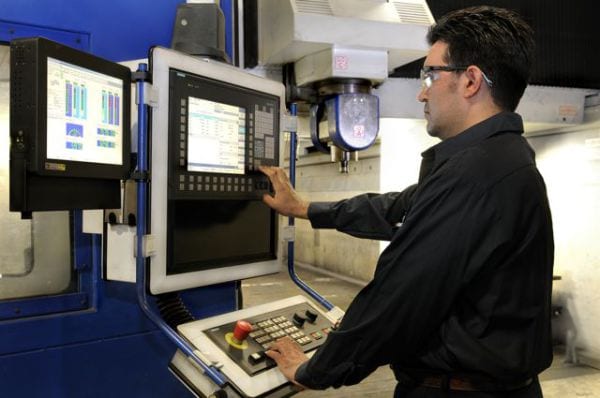 run such machine tools in a completely air-conditioned environment, Coast Composites has devised its temperature compensation system to overcome these variables in ambient factory conditions and still maintain an accuracy that often exceeds the customer specification, regardless of the material being machined.
Invar tooling is the industry standard for composite lay-up, owing to its low coefficient of thermal expansion, but, as Coast President Paul Walsh explains, “While the material is a high nickel-iron alloy, which gives it great stability, the bottom line is you still get thermal growth over the long distance runs we process. The system we developed was the result of a lengthy analysis on all our long bed machine tools here.” Coast Composites runs the Handtmann mill at its Irvine facility, as well as Henri Liné five- and six-axis mills, plus SNK and Amura gantry and bridge mills. A 15-year-old Nicolas Correa five-axis gantry mill was recently retrofitted with a new Siemens CNC, motor and drives package, improving both its accuracy and speed, according to Walsh.
Coast Composites founder and current Director of Best Practices, Jerry Anthony, adds, “We knew the Siemens Volumetric Compensation System had substantial merit for our operation when it was first introduced to us, precisely because of the workpiece sizes we run and the corresponding thermal growth during machining, even on Invar tools. We had developed our temperature compensation system to adjust the go-to points from the control for real-time temperature on the machine and the workpiece. The data covered all aspects of our machining, from material composition to acceleration/deceleration mapping and the temperature variations over the largest pieces and longest machine cycles we had performed.” He notes that Coast 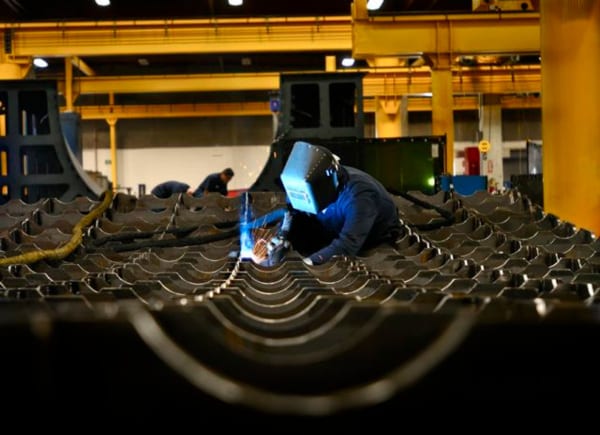 Composites runs many grades of aluminum, plus A36, P20, stainless, monolithic graphite, carbon fiber composites and other materials, in addition to Invar 36 and 42. The evolution of tooling materials processed by Coast corresponds, Anthony points out, to the changes in the aerospace industry, as the majority of formerly metal parts and structures are now produced by hand lay-up carbon fiber, machine applied carbon reinforced fiber tape, resin infusion processing, filament winding and other manufacturing technologies.
Expanding on the Coast Composites temperature compensation system, Anthony details the on-machine inspection of the workpiece and how the Siemens CNC is actually used to complete this process. “We have used laser tracking in tandem with our Valisys inspection software for some time now, having had a Siemens CNC engineer in Elk Grove Village, Illinois write the machine tool inspection interface software for us. In this way, we were and are now still able to use the power of the CNC to run real-time inspections and data analysis that have been extremely useful as an in-process inspection system for any tool manufactured by Coast.” He muses that the Coast system, “…essentially turns every machine tool here into its own CMM (coordinate measuring machine).” By developing this system at Coast Composites, Jerry Anthony concludes, the laser tracker is now used primarily for final checking, as the in-process monitoring produces what he suggests “…might be the highest accuracy machining standard in the aerospace industry.”
Walsh further comments on the evolution of composites in the commercial sector of the aerospace industry and at Coast. “Composites were only being used in non-critical applications but have now emerged on the fuselage, wings, vertical tail and control surfaces, to a much greater degree. As one of the earliest players in the commercial composites arena, we have been responding to market conditions quite successfully and continue this trend today.” Coast Composites supplies tooling for the B777, B787, F-22, F-35, A380, A350 XWB, A320 and other aircraft. On a recent A350 XWB job, the final Coast center wing box section tooling was loaded on an Antonov An-225, the world’s largest aircraft built to date, for transport from Long Beach, California to France. This tool is the first tooling delivery for the A350 XWB program.
On the massive Handtmann five-axis gantry mill, application engineering and training assistance were provided to Coast Composites by the machine tool builder’s local representative, Bryan Wilson of BD Technology, as well as personnel from the Siemens Aerospace Center of Competence.
Coast Composites is ISO 9001-2000 registered and AS-9100 Certified and holds numerous customer quality accreditations, including Boeing, Airbus, Northrop Grumman, Lockheed, Kawasaki, GKN and Mitsubishi, among others.
Coast Composites also builds tooling for the construction of such end products as satellite reflectors, used in the telecom and military markets.
HOW THIS MARRIAGE WORKS
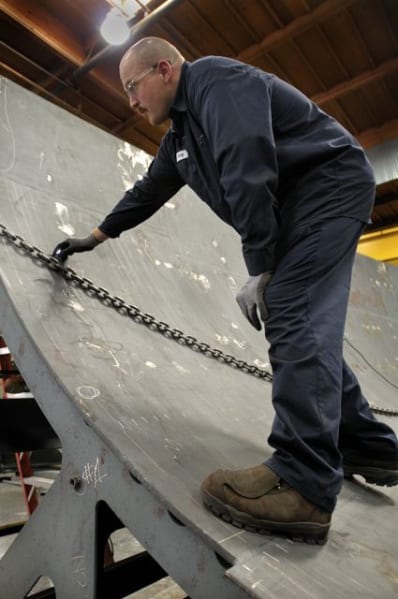 In his role as company founder and current Director of Best Practices at Coast Composites, Jerry Anthony has taken great interest in the development of the company’s temperature compensation system, especially when it was recently “married” to the Siemens Volumetric Compensation System (VCS). The key point of interface for such a system is within the algorithms of the CNC, acting to compensate the signal before sending commands to the motors and drives for adaptive action on the machine tool.
In a typical long machining cycle on the very large parts produced at Coast, temperature variations in the workpiece material combine with the naturally occurring thermal expansion in the machine tool to create serious dimensional issues. This is true for whatever material is being run on the machine, even the Invar high nickel-iron alloy used extensively at Coast for producing composite lay-up tooling, fiber tape mandrels and other structures. While Invar has an extremely low coefficient of thermal expansion, the length of the machine cycle invariably (the word from which Invar got its name) results in sufficient thermal movement of the machine, which adversely affects the tool tip position.
In the Siemens VCS, the CNC compensates for 21 error factors of machine axes, pitch, yaw and roll. The true workpiece coordinates, rather than the programmed tool tip position, determine the actual cutting path. In conjunction with the highly advanced Siemens cutter path contouring, this compensation process results in a smoother finish on the part surface and a very high degree of machining accuracy.
In the Coast application, they have further enhanced this process by combining its proprietary temperature compensation system with the VCS inside the CNC to produce a highly accurate cutting path that takes into account the thermal expansion rates for the particular material being run as well as the machine itself.
The standard NC program assumes a 20ºC (68ºF) normal operating condition. This would be the norm for a CMM. The CNC incorporates the Coast temperature compensation system software, while the DNC runs the Valisys software, reading off the Renishaw touch probe data from the workpiece surface. Thus, the temperature compensation is within the machine control, resulting in real-time adjustments to the machine movement and an overall improved surface finish with superior accuracy, according to Anthony. “We have run enough material types and enough cycles to develop an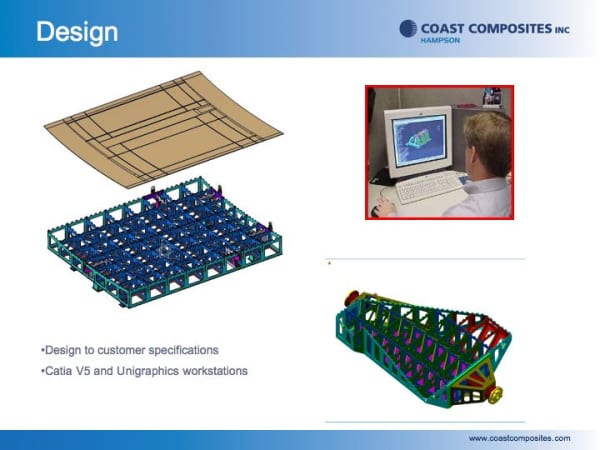 impressive data base of averages over time. Our algorithms are the key and, when married to the Siemens power onboard the CNC, result in the old adage that says the whole really is greater than the sum of the parts.”
Siemens Aerospace Center of Competence engineers worked closely with the on-staff engineers at Coast Composites to consummate this marriage and, according to Anthony, the results have been beneficial for both parties.
“The relationship between the Siemens Aerospace Center of Competence and Coast Composites began seven years ago and has progressed to a true partnership, as the two companies have worked together consistently, merging advanced theoretical technologies with experiential knowledge. This has been and continues to be a very dynamic synergy between our companies. Siemens is proud to work with such a leader in the aerospace segment,” according to the Siemens account manager for Coast Composites.
For more information, please contact:
Coast Composites Inc. Tooling Division
Web: www.coastcomposites.com
Email: info@coastcomposites.com Attention: Jerry Anthony or Paul Walsh.
Siemens Industry, Inc. Drive Technologies — Motion Control (Machine Tool)
Aerospace Center of Competence Web: www.usa.siemens.com/cnc
Siemens Machine Tool Business
John Meyer
Manager, Marketing Communications
Siemens Industry, Inc.
(847) 640-1595
www.usa.siemens.com/cnc
SiemensMTBUMarCom.industry@siemens.com
Follow us on Facebook: www.facebook.com/SiemensCNC or Twitter: www.twitter.com/siemens_cnc_us.
—
Siemens Industry Sector is the world’s leading supplier of innovative and environmentally friendly products, solutions and services for industrial customers. With end-to-end automation technology and industrial software, solid vertical-market expertise, and technology-based services, the sector enhances its customers’ productivity, efficiency and flexibility. With a global workforce of more than 100,000 employees, the Industry Sector comprises the Industry Automation, Drive Technologies and Customer Services Divisions as well as the Metals Technologies Business Unit. For more information, visit http://www.usa.siemens.com/industry.
The Siemens Drive Technologies Division is the world’s leading supplier of products, systems, applications, solutions and services for the entire drive train, with electrical and mechanical components. Drive Technologies serves all vertical markets in the production and process industries as well as the infrastructure/energy segment. With its products and solutions, the division enables its customers to achieve productivity, energy efficiency and reliability. For more information, visit http://www.usa.siemens.com/drivetechnologies.
Continue reading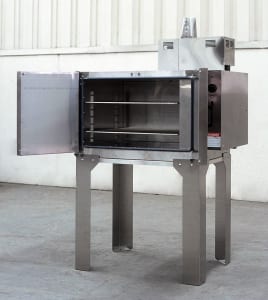 No. 991 is an electrically-heated 350°F (~177°C) bench oven from Grieve, currently used for heating parts, including those with emissions of flammable solvents. Workspace dimensions are 28” wide x 24” deep x 18” high. 4KW are installed in Nichrome wire elements to heat the workload.
This Grieve bench oven features 2” insulated walls, leg support stand, Type 304, 2B finish stainless steel interior and exterior of brushed #4 stainless steel. Two oven shelves are also included.
Since flammable solvents are handled in No. 991, a powered forced exhauster with powered forced airflow safety switch to shut down heat if there is an exhauster failure, as well as a purge timer to allow the oven to exhaust four volumes of fresh air prior to turning on the heat source are all onboard.
For more information, please contact: THE GRIEVE CORPORATION, Web: www.grievecorp.com. Email: sales@grievecorp.com. Attention: Frank Calabrese.
Continue reading
Using Stotz air gages to validate spindle interface components, this leading supplier keeps quality on highest levels; every part, every time
Stotz USA, LLC, is a leader in air gaging technology, products and quality gaging system integration. According to company president, Chris Koehn, Stotz has achieved that goal by a variety of means, not the least of which has been the loyalty of good customers, who appreciate the value Stotz products brings to theirs. One of those customers is also a longtime friend of Koehn’s and he can say that with complete honesty, because he worked there, long ago.
Advanced Machine & Engineering (AME) of Rockford, Illinois is a world player in high-quality machine tool spindle interface components. As part of the Goellner, Inc. Group, AME enjoys a reputation throughout the machine tool industry for manufacturing the finest power drawbars, spindle shafts, guide bushings, locknuts, hydraulic sleeves, expansion gibs and more. AME components, through their own branded products and those of their brother companies such as OTT Jakob, Spieth and Tschudin & Heid, as well as their “other brother” Hennig, itself a world leader in chip conveyor and machine protection systems, are found on nearly every major machine tool brand.
AME was a customer of Stotz before Chris Koehn ever came to work at the air gaging company. Today, these two market leaders maintain a great working relationship, for all the right reasons. AME demands the highest level of quality in their machining and finishing departments and Stotz air gaging systems facilitate the accomplishment of that goal, every day, according to AME Service Manager, Greg Hobbs. “Air gaging is the only technology we’ve found that’s accurate enough to check the machine tooling and especially the spindle tapers we produce here. That’s a fact. In the past, we’d use hard gages and we still use them, but only for certain OD checks. We’d blue up the tapers, insert them, give them a good twist and do our inspections. Way too much inconsistency. Today, with sophisticated HSK tooling, this method is too hit or miss to be reliable. Air gaging provides dead stops on the test stand and the documentation is unbeatable for validation on the straightness, surface finish and taper angles. Plus, the Stotz system allows us to upload all the data on every part, so we have our favorite word…documentation…for every part we produce.”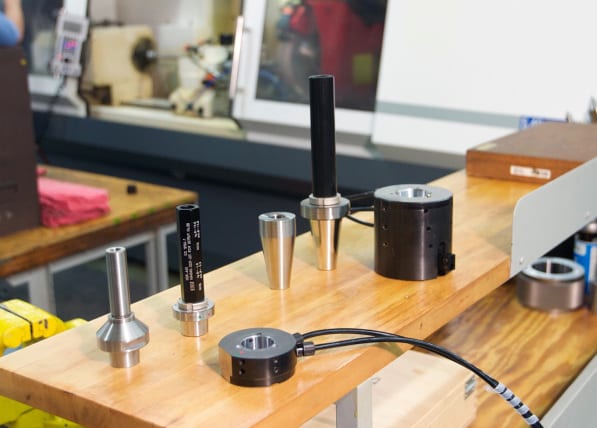
Hobbs also commented on the user-friendliness of the Stotz air column. When the program is first input into the column for a part in the AME grinding department, for example, the Stotz column essentially becomes a PLC, providing hard data via the Ethernet connections to the host data base. In this manner, every parameter of every part is documented and recorded. In a classic example of the law of unintended consequences, this process is not only used on the parts run, it’s also used for calibrating the AME machines, in a predictive maintenance function.
At AME, various testing of machined spindle interface and other components is performed both at the machines in the grinding department, in a temperature-controlled 72° environment, plus in the company’s totally environment-controlled in-house testing department, supervised by the company’s Director of Quality, Brad Patterson. He confirmed Greg Hobbs’ observation that numerous other technologies have been investigated over the years for quality checking at AME and that air gaging has been found to be the best and most reliable for this company’s applications, particularly ID dimensions and configuration. Patterson also observed, “The sophistication of the Stotz air column is unmatched in the industry. We get all the data required and we get it in exactly the fashion needed to support our customers. Repeatable results and elimination of error, every time. Plus, the set-up is much faster than on our laser mics, which can’t be used for ID measurement.” Patterson further noted that the replacement of the bluing technique, one he termed a “black art,” with air gaging has brought and keeps AME up to the most current industry standards for quality evaluation.
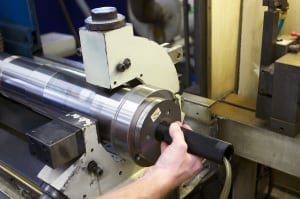 The typical Stotz air column found here is the Model MSG, with four pneumatic channels or ten LVDT channels operating simultaneously, pneumatic length measuring, user specific programming up to 18 programs per column, full statistical analysis and full data transfer capability within the host network. All info is fed into the AME host computer by serial number, so any job can be quickly retrieved, while historical records on any part produced can be easily called up for evaluation, deviation claims or to dovetail with a customer’s internal quality protocols.
Typically, as AME’s Grinding Supervisor, Sam Schubert, explains, the finished product will rest for 24 hours of soaking, allowing the diameters to normalize. Though statistically predictable for most metal materials, thermal expansion can cause off-normal readings to occur. For checking certain bearing journals or spindle shafts, snap gages are set to accommodate size measurements down to the twenty millionths (0.000020”) range. The acceptable diameter tolerances for most AME products measured are in the 1-2 tenths (0.0001-0.0002”) range.
In cases where new masters are made for setting control values, those values are preset offline and programmed into the air column’s software, according to Greg Hobbs. Stotz typically performs this function for the customer in a remote manner over the Internet, through a proprietary IP address.
Among the many products finished in this grinding department are CAT/ISO 40 taper spindles, HSK test arbors, HSK grind quills, HSK steep taper milling tools and more. Often, older and worn spindle shafts are reverse engineered by AME for retrofits and reman’s. Even in these cases, air gaging is used to evaluate the finish process on the ID taper, as this versatile technology is easily adapted to such applications, according to AME personnel.
Sam Schubert expanded on the use of Stotz air gaging at AME.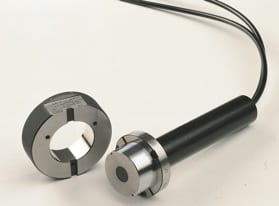
“We have a full and very expensive inventory of hard gages with state-of-the-art indicators attached. But the air gages can do so much more. We use them for set-up on the grinding machines and they save us hours, every week. When you run the number of jobs we do here, that translates into substantial, additional work product and therefore more revenue for the company. In terms of reliability, some of the Stotz air gages we run here have been at AME since we began using the technology, nearly ten years ago now.” Schubert also noted the air gaging set-ups on the grinders dramatically reduce the time to first part in his department’s operation.
On one major spindle shaft project for an Asian machine tool builder, who was looking for a local source of supply in America, Schubert notes, AME was confronted with an unusually large quantity run, where tool degradation during the run would normally impact the production at some point. After an initial batch was produced, the machine builder claimed that everything but the taper was satisfactory. Quite surprised by this claim, AME checked all the documentation and determined that the customer’s test unit was actually out of spec, in a case where the error was repeated consistently and thus overlooked. In the end, the AME products were deemed better than perfect, in that instance.
 Sam Schubert cites a useful analogy here. “The documentation we can produce from the air gaging procedure is like a birth certificate on every unit we make. All our spindle shafts for customers, for example, can be viewed as a series of genetically identical twins to each other and we’re providing the documentation of their DNA.” Quite a family.
As evidence of their commitment to this technology, Schubert notes that AME is now purchasing air gaging fixtures for all new customer applications. This quality spindle interface manufacturer aims to “keep breathing easy” in their process and product validation, as a result.
“Stotz has been a leader in gaging technology for almost 60 years. We are constantly striving to improve our designs and develop new products to solidify our position as a leader in measuring technology. The Stotz customer base consists of the top manufacturers and suppliers in the machine tool, automotive, aerospace and medical industries,” according to company president, Chris Koehn.
Harold Goellner, Vice President at AME, also contributed to this article.
For more information: STOTZ USA, LLC Email: chris@stotz-usa.com Attention: Chris Koehn, President
All photos kindly supplied by Bill Edmundson of Advanced Machine & Engineering
Release: STOTZ USA, LLC
Date: January 20, 2010
Continue reading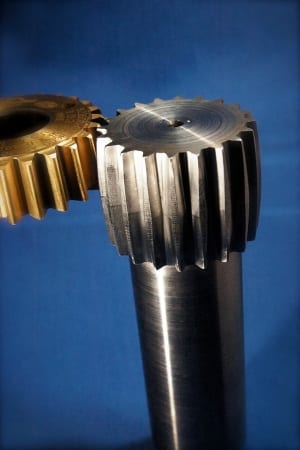 Noisy gear trains have been a common problem for gear designers for a long time. With the demands for smaller gearboxes transmitting more power at higher rpm and incumbent demands for greater efficiency, gear engineers are always searching for new ways to reduce vibration and limit noise, without increasing costs.
Some popular solutions to the noisy gear problem include enlarging the pinion to reduce undercut, using Phenolic, Delrin or other noise-absorbing products, where possible, or changing to a helical gear train. Other methods include tightening specifications to insure greater gear quality or redesigning the acoustical absorption characteristics of the gearbox. Occasionally, experimentation with gear ratios can limit harmonic frequency amplification, which otherwise can cause a gearbox to amplify noise like a finely tuned stereo system. The engineer can also study material and hardness requirements, so that modifications may be made to minimize heat treatment distortion or possibly eliminate the need for heat treatment entirely.
Particular attention must also be paid to gear geometry to insure maximum contact.
Another approach to the gear noise problem that yields good results is crowning or barreling of the teeth. This technique involves changing the chordal thickness of the tooth along its axis. This modification eliminates end bearing by offering a contact bearing in the center of the gear.
A second benefit of the crowning approach to gear cutting is the minimization of misalignment problems, caused by inaccurate machining of the casting, housing, shafting, gearboxes or bearing journals. Crowning can also reduce lead problems in the gears themselves, which causes the gears to wear unevenly and bind because of eccentricities and position errors. Obviously, a gear with a center contact is less affected by discrepant manufacturing or design; furthermore, one can reduce the backlash requirements and allow the gears to wear in rather than wear out.
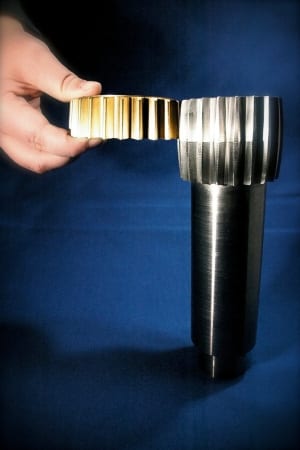
Shaving is a secondary gear finishing operation done after rough hobbing or shaping to create the desired crown. Crown shaving has long been a popular method, especially in manufacturing coarse pitch gears. With the recent evolution of gear equipment capable of crowning while cutting, the need for shaving just to achieve a crown has been eliminated.
Two variations of the crown shaving method will produce a gear to compensate for off-lead or misalignment conditions.
One approach produces a crown by rocking the table during the reciprocation of work and cutter. The degree of crown is readily changed by this method. The other approach is plunge feeding, which requires dressing the shaving cutter to the desired crown. Generally, it is faster to plunge feed, but the technique can subject the cutter to greater wear. Of course, it is more difficult to change the crown, provided one starts with good quality gears. Shaving improves the quality of profile and reduces error in the gear tooth, through the cutting and burnishing action of the cutters.
The crown form can be produced on gear teeth in several other ways. One method is to shape the gear by use of a crown cam in the shaper back-off mechanism. The proper radius of the gear is calculated by using the amount of crown on the flank and the pressure angle of the gear. Unfortunately, the blocks, while not complex, tend to be expensive.
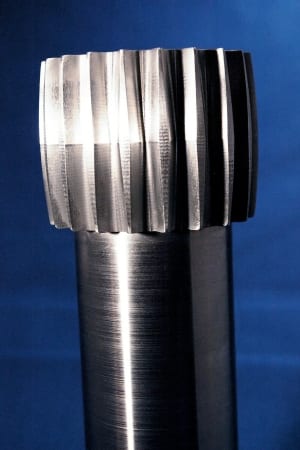
The advent of the latest generation of gear equipment has made two methods of crowning while hobbing popular. Both methods produce crowns by increasing and decreasing the center distance of cutter to workpiece. The first method utilizes physical copying of a template by a hydrocopying or mechanical following device. This allows taper hobbing or even the creation of sinusoidal wave forms, if desired. More recently, the second method, CNC hobbing, has become commonplace.
Depending on software limitations, CNC allows cutting gears in almost any desired form. A disadvantage to this approach is the high cost of the equipment, though the payback has decreased considerably, in recent years.
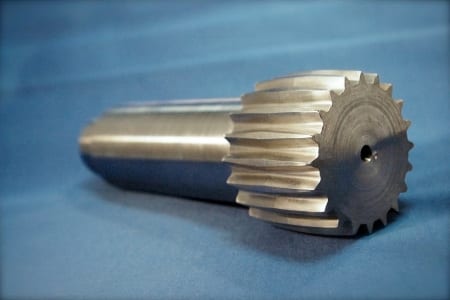
New CNC shapers can cut a crown gear or spline without the need for buying a special crowning cam. On our Gleason Pfauter P 300 ES, for example, we can crown by cutting a slight right and left hand helix angle along the face width of the part. This leaves the root diameter straight. We also have a Bourn & Koch Fellows MS 450 with a U-axis for controlling the back-off. It can be programmed to move the cutter spindle in and out during the stroking cycle to crown the tooth by cutting deeper at the ends of the face width and more shallow at the high point of the crown.
Who is using this gear cutting technology today?
Users of heavily loaded gears have been using crowning for quite some time. Another area ripe for the use of crowning is in the manufacturer of hydraulic wobble motors. Here, the application is strictly for misalignment problems rather than for noise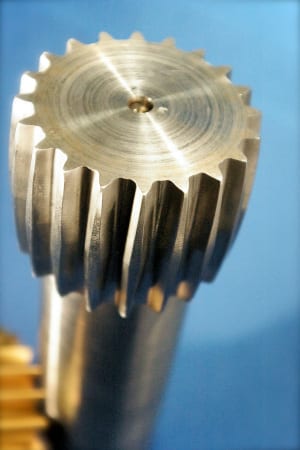 reduction. An allied area involves heavily loaded pinions used in actuators for aircraft control surfaces. Generally speaking, it is more advantageous to crown the pinion because it makes more revolutions per minute and may generate more noise. In this case, it is of paramount importance to compensate for load deflection. Unfortunately, few companies in the United States have been applying this technology to commercial fine pitch gearing. However. the few manufacturers who have tried it are most pleased with the results. Some users have reported a 5x to 10x reduction in noise, accompanied by less vibration, wear and power draw.
Prime candidates for use of the crowning technique are the small fractional horsepower motor manufacturers or anyone dealing with spur or helical pinions that are susceptible to noise or misalignment. Because crowning on foreign gear hobbing equipment has been available for a greater length of time, this method has been developed to a greater extent in Europe.
American manufacturers would be wise to take advantage of the availability of this kind of technology. Exploration of crowning as a solution to noise and misalignment problems can produce a real competitive advantage for gear manufacturers and users alike.
Fred Young, CEO Forest City Gear Roscoe, Illinois
For more information, please contact Fred Young at: Forest City Gear 11715 Main Street Roscoe, IL 61073 fyoung@forestcitygear.com 866-623-2168
AUTHOR-Fred Young is the owner and CEO of Forest City Gear Co. in Roscoe, Illinois. He has worked for the company since the mid-1950s and assumed its management in 1968. He is a graduate of Rockford College, where he studied physics, mathematics and English literature. Mr. Young is a leading authority on gear manufacturing.
Agency contact: Tim Daro Bernard & Company tdaro@bernardandcompany.com 847-934-4500
Editor note: Mr. Young is available for interviews on this or other gear design and manufacturing issues. Please contact agency to arrange. Also, any publication-generated leads from this article should be sent to Wendy Young at wyoung@forestcitygear.com. Thanks!
Continue reading
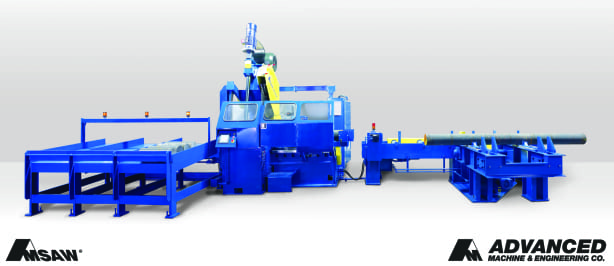
At both the AIST Iron & Steel Show and the Forge Fair, Advanced Machine & Engineering will be displaying their carbide circular sawing systems.
AMSAW® high-speed, production saw machines are specifically designed to use carbide blades to improve the cutting speed of ferrous and non-ferrous material, bars or billets, rails, profiles, pipes and tubes. Standard design features include:
 Options include: stock size measuring, automated length measuring systems, bar manipulating systems, infeed and outfeed systems and stackers.
Also displayed will be various chip conveyors, safety devices and machine enclosures offered by AME and its sister division, Hennig.
Advanced Machine & Engineering Co., is a manufacturer located in Rockford, IL, serving the Machine Tool Industry with precision components and accessories, including spindle interface components, workholding devices, and, through our sister company, Hennig, machine enclosures, chip removal and filtration systems. The Fluid Power – Safety markets are served with cylinder rod locks and safety catcher devises; and the Production Saw market with our Amsaw carbide saw machines and Speedcut blade products. AME has manufacturing partners and customers around the world and across the U.S. To learn more, visit www.ame.com.
Hennig, Inc. design and produces custom machine protection and chip/coolant management products for state-of-the-art machine tools. Hennig products are designed to protect against corrosion, debris and common workplace contaminants. Manufacturing facilities located in the U.S., Germany, Brazil, India, Japan, China and South Korea. Repair centers are located in Machesney Park, IL; Chandler, OK; Livonia, MI; Blue Ash, OH; Mexico City, Mexico and Saltillo, Mexico. To learn more, visit www.hennigworldwide.com.
For more information, contact:
Tim Waterman
ADVANCED MACHINE & ENGINEERING CO.
2500 Latham St.
Rockford, IL 61103
Phone: 815-316-5277
Fax: 815-962-6483
E-mail: info@ame.com
Connect with AME online: 
 Practical Operation
The SCHÖMA machine factory opted for a cycle turning machine with Sinumerik 840D solution line CNC for the manufacturing of individual parts and small batches of locomotive wheels; this machine also features Siemens ShopTurn with Manual Machine function. This hardware and software solution combines the flexibility and benefits of conventional machining with the productivity and efficiency of a CNC and this is what tipped the balance in its favor for one customer.
Christoph Schöttler Maschinenfabrik GmbH (SCHÖMA) is based in Diepholz, Germany. The company specializes in the development and production of diesel-engine locomotives. The model range includes tunnel and shunting locomotives; service, field and narrow-gauge locomotives; handcars, passenger carriages and gang cars. Around 90 percent of the locomotives produced each year at SCHÖMA are destined for use in tunnel construction.
Each construction project brings its own specific requirements and each country through which the locomotives travel has different environmental and safety legislation. SCHÖMA uses a modular system to meet a diverse range of customer requirements and the resulting need for a variety of equipment and product versions. One of the tasks facing the company is working out how to equip the locomotives for transportation by rail on differing track widths. Another requirement is locomotives with driving wheels featuring diameters between 600 mm and 900 mm, depending on local track usage.
The right decision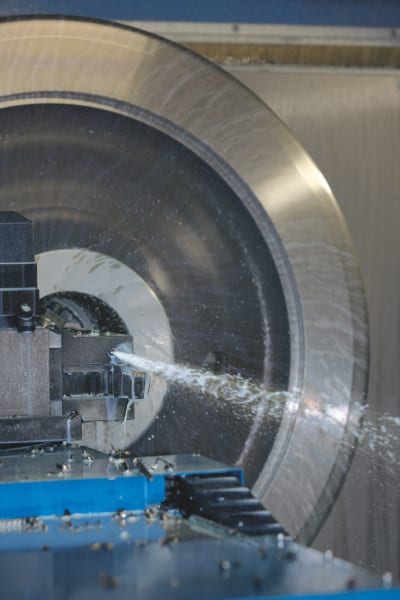
Faced with even more demanding requirements in terms of production capacity and flexibility, SCHÖMA’s Managing Director, Christoph Schöttler, last year decided to add a cycle-control Seiger Record LC 1400 lathe to his inventory of machines. “We opted for a head turning machine, as we do not need a tailstock to produce driving wheels, axle bearing housings and gear wheels. It is working just as we envisioned, so we obviously made the right decision,” says Schöttler.
SCHÖMA constructs around 120 locomotives each year, which equates to 480 wheels. In addition, there are also repair orders, which increase the workload to between 560 and 600 driving wheels per year. These wheels are produced in two mountings from forged blanks on the cycle turning machine. The first mounting is used to machine the wheel flange on the reverse side and the wheel hub. The shaft locating bore is pre-turned. In the second mounting, the first task is to pre-turn the driving wheel profile, then the rolling circle level and the wheel shaft locating bore are finished.
Careful approach
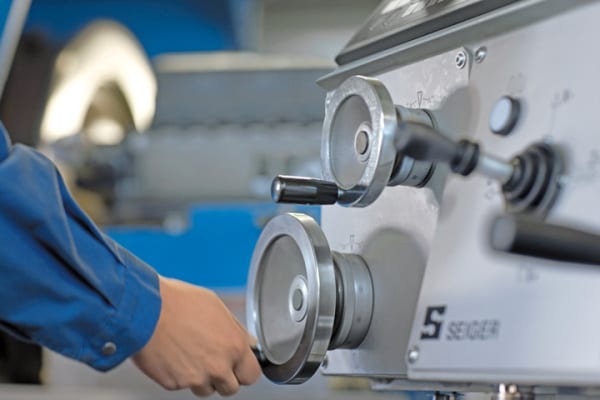
The cycle turning machine is controlled by a Siemens Sinumerik 840D sl CNC, equipped with the ShopTurn software package with Manual Machine feature. If required, ShopTurn programming can be performed on a separate PC as part of an operator’s work planning, without interrupting the work sequences on the machine. The programs are routed to the machine via the network, where they are called up as required, depending on the workpieces to be produced. The Sinumerik CNC is used for both numerically controlled machining and manual operation with the ShopTurn’s Manual Machine functions. In manual mode with electronic handwheels, the machine behaves just like a conventional lathe with an actual value display.
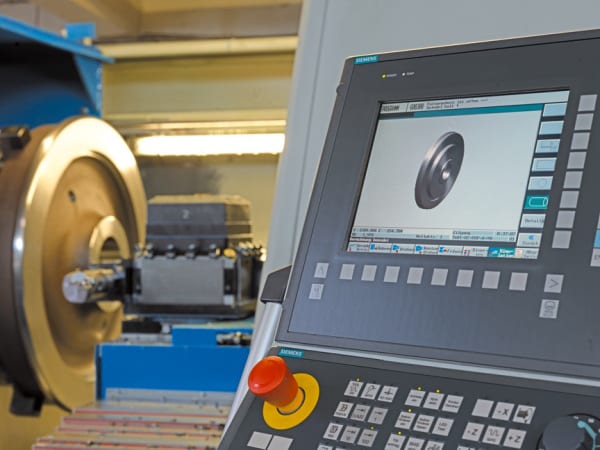
During face and longitudinal turning, the process operates with the entered feed and spindle speed. The real highlight of the system is that every cycle can be used straightaway, without having to create a custom program. At SCHÖMA, the option for manual intervention is used for setting the zero point or for simple contours. Diameters are determined manually, if driving wheels have been newly profiled or if driving wheel profiles require resurfacing. The wheel profiles abrade as a result of the high loads experienced in heavy-duty operation or on poor-quality tracks or as a result of the driven wheels skidding.
“With a machine that uses only CNC, it is difficult to rework the driving wheels, as it is not possible to determine how much material needs to be removed. With this optional manual mode, however, users can adopt a careful approach. This sums up the ease of control,” explains Walter Horstmann, head of mechanical production and wheel set construction at SCHÖMA.
Siemens ShopTurn with Manual Machine for the job shop
After machine start-up, the basic MANUAL screen is immediately displayed and offers direct access to choosing machining options without having to create a parts program.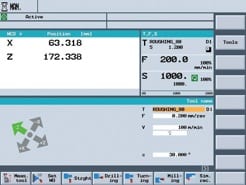
Machining procedures such as “taper turning” and “straight line face and longitudinal turning” can be executed immediately. The operator simply selects tool, feed speed, spindle speed and orientation, plus, if required, machining angle, then presses “Start”. The active direction is graphically displayed in the basic screen, using a compass rose symbol. All machining steps such as entry, thread grinding and drilling can also be started in manual mode.
For additional product information and inquirie, contact:
SIEMENS MACHINE TOOL BUSINESS
John Meyer
Manager, Marketing Communications
Siemens Industry, Inc.
(847) 640-1595
www.usa.siemens.com/cnc
SiemensMTBUMarCom.industry@siemens.com
Follow us on Facebook: www.facebook.com/SiemensCNC or Twitter: www.twitter.com/siemens_cnc_us.
—
Siemens Industry Sector is the world’s leading supplier of innovative and environmentally friendly products, solutions and services for industrial customers. With end-to-end automation technology and industrial software, solid vertical-market expertise, and technology-based services, the sector enhances its customers’ productivity, efficiency and flexibility. With a global workforce of more than 100,000 employees, the Industry Sector comprises the Industry Automation, Drive Technologies and Customer Services Divisions as well as the Metals Technologies Business Unit. For more information, visit http://www.usa.siemens.com/industry.
The Siemens Drive Technologies Division is the world’s leading supplier of products, systems, applications, solutions and services for the entire drive train, with electrical and mechanical components. Drive Technologies serves all vertical markets in the production and process industries as well as the infrastructure/energy segment. With its products and solutions, the division enables its customers to achieve productivity, energy efficiency and reliability. For more information, visit http://www.usa.siemens.com/drivetechnologies.
Continue reading