
Contact us today:
(847) 934-4500
tdaro@bernardandcompany.com
Contact us today:
(847) 934-4500
tdaro@bernardandcompany.com
Casting process simulation to automotive industry standards
 Continental is one of the five biggest international automotive suppliers worldwide. The two group sectors, Automotive and Rubber, provide a range of products addressed to automotive trends in the areas of safety, environment and information. In 2009, the 143,000 employees in six divisions generated sales of approximately 20 billion euros (~$28B).
Cast components can be found throughout engine, brake system, body and interior components. For this reason, Continental, with its three automotive divisions, is one of the world’s largest consumers of castings. Continental does not produce the castings itself, but instead buys these parts in large quantities from outside vendors. In view of the great importance of these components in its products and systems, the Automotive Group devotes a great deal of attention to its cooperation with foundries. For Continental, it is vital that all suppliers reliably meet their quality standards and can guarantee secure processes. If production lines come to a standstill at Continental – or worse, at Continental’s customers – losses can quickly run into the millions.
As a direct supplier to carmakers, Continental is in a sandwich position. The company must guarantee product and process quality to its customers and pass on these requirements to its own suppliers. Consequently, continuous audits of partners are used to assure a constant, sustainable productivity and to ensure the use of the most competitive technologies. The same applies to requirements for product and service quality, which must be highly cost effective, as well as comply with project deadlines.
Casting simulation as foundry selection criterion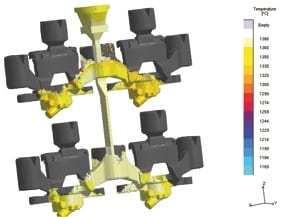
When it comes to the quality of purchased castings, Mustafa Ata, Senior Expert Casting Quality, is in demand in Continental’s Automotive Group. He audits the foundries which supply Continental worldwide. “The quality requirements for castings, which are for the most part installed in safety-relevant areas of cars, are extremely high. The prevailing international standards are supplemented by internal group standards, e.g. with regard to service life, material strength, metallurgical properties (microstructure), machinability of the components and optical appearance,” Mustafa Ata said when describing what he expects from foundries.
From Continental’s point of view, a reliable compliance with this performance catalog cannot be achieved without the foundries using the latest casting technology and tools. In the case of safety components, the group requires its suppliers to use software for casting process simulation, to check the casting process and analyze the results with Continental before production starts. Continental also requires that their foundries be in a position to optimize the process if necessary.
“Simulation is anchored as an important part of supplier communication. This means that in every casting project, product realization is supported from the very beginning by numerical simulation. We expect our suppliers to possess a simulation tool,” Ata noted, leaving no doubt in this regard.
 From design to production – but not without simulation
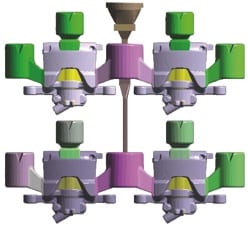
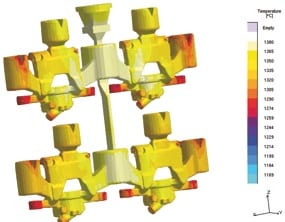
The casting development process begins at Continental. The design department designs the casting according to the automotive manufacturer’s requirements. The 3D data produced goes to selected foundries to enable the latter to simulate the casting process with suitable software. The simulation checks various factors that are critical for casting quality simultaneously.
First, the simulation can determine whether the casting was designed in a casting-appropriate manner or whether the design department, in cooperation with the suppliers (simultaneous engineering), needs to readjust the design to permit standard-compliant parts to be reliably produced in a cost-effective casting process. Second, the simulation results can reveal whether, under the specific production conditions of the foundry, a stable, economical process can be established or whether changes need to be carried out.
Simulation result: production and delivery security
As its final result, the simulation provides Ata with the certainty that the foundry can reliably produce and deliver a casting that meets the requirements at optimal costs. Without casting process simulation, such security could only be achieved with multiple casting trials and machining, at costs and project times that are no longer competitive in the automotive industry.
Simulation with MAGMASOFT® welcomed
In general terms, Continental allows its suppliers to choose which software they use for casting process simulation. But, most foundries opt for the MAGMASOFT® software from MAGMA Gießereitechnologie GmbH, which Ata welcomes for various reasons.
MAGMA is the pioneer in casting process simulation software. As a software developer, more casting engineers work at MAGMA than in many foundries. Because of this, MAGMA is regarded as the worldwide market and technology leader and sets the standard in this field.
The simulation results provided by MAGMASOFT® are extremely realistic.
Empirical checks through real trial castings regularly demonstrate that the results correspond to a large extent with the observable properties of the cast components.
“Simulation results from MAGMASOFT® are accepted as reliable by all parties involved in the production process. As a result, they form the basis on which designers, foundrymen and users can discuss component quality and process optimization, further developments and modifications,” according to Ata.
MAGMASOFT® offers solutions for all casting processes and process steps. In doing so, the software covers every possible simulation situation which arises at Continental in the cooperation with foundries. Therefore, the partners do not need to deal with different applications.
In the foundry, MAGMASOFT® users benefit from the simple operation of the software and the service of the provider, which meet the high demands of the automotive industry.
Continental considering using MAGMASOFT® itself
Until now, Continental has only required that its vendors utilize casting process simulation software. However, Continental is now considering using MAGMASOFT® itself. In this way, the design of a component could be checked for casting suitability immediately and the feedback loops shortened further. Simultaneously, communication with Continental’s development partners could be improved even more through the common “language” of simulation results.
About software for casting process simulation
Casting process simulation software considers the complete casting process including mold filling, solidification and cooling, and also provides the quantitative prediction of mechanical properties, thermally induced casting stresses and the distortion of cast components. Simulation accurately describes a cast component’s quality upfront before production starts, thus the casting layout can be designed with respect to the required component properties. This results in a reduction in pre-production sampling, but also the precise layout of the complete casting system leads to energy, material and tooling savings for the foundry.
The range of application of MAGMA solutions comprises all cast alloys, from cast iron to aluminum sand casting, permanent mold and die casting up to large steel castings. The software supports the user in component design, the determination of melting practice and casting methodology through to mold making, heat treatment and finishing. This saves costs consequently along the entire casting manufacturing line.
During the last 10 years, the use of casting process simulation has become a valuable business asset for many foundries. MAGMA5 now expands the capabilities of casting process simulation and will further accelerate the acceptance of this technology.
About MAGMA
MAGMA offers comprehensive solutions to the metal casting industry, casting buyers and casting designers worldwide. The MAGMA product and service portfolio includes the powerful modular simulation software MAGMASOFT®,with the newest release MAGMA5, as well as engineering services for casting design and optimization.
Today, MAGMASOFT® is used throughout the metal casting industry, especially for the optimization of cast components in automotive and heavy industry applications.
MAGMA Giessereitechnologie GmbH was founded in 1988 and is headquartered in Aachen, Germany. A global presence and support are guaranteed by offices and subsidiaries in the USA, Singapore, Brazil, Korea, Turkey, India and China. Additionally, more than 30 qualified partners represent MAGMA around the world.
For more information on this release, please contact:
Christof Heisser
President
MAGMA Foundry Technologies, Inc.
10 N. Martingale Road, Suite 425
Schaumburg, IL 60173
Phone 847-969-1001 ext. 225
Email cheisser@magmasoft.com
Agency contact:
Wendy McCormick
Bernard & Company
847-934-4500
Continue reading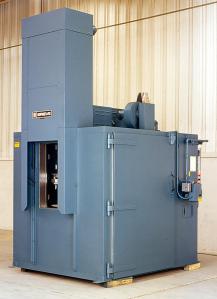 No. 816 is a 500ºF gas-fired, rotary hearth oven from Grieve, currently used for preheating and curing powder coatings onto electric motor parts. Workspace dimensions on this oven measure 54” W x 54”D x 72”H. 350,000 BTU/HR are installed in a modulating gas burner, while a 4200 CFM, 3 HP recirculating blower provides horizontal airflow to the workload.
This Grieve rotary hearth oven features aluminized steel interior and exterior with 4” insulated walls. Two 48” diameter hearths, constructed from rolled angles and covered with perforated metal, carry the loads in process. Each hearth is designed to rotate for 15 seconds, every time the motor-operated vertical lift door is opened and closed. The hearths are driven by a 1/3 HP motor through a gear reducer with torque limiting device.
All safety equipment required by IRI, FM and National Fire Protection Association Standard 86 for gas-fired equipment are onboard No. 816, including a 325 CFM, 1/3 HP powered forced exhauster.
For more information, please contact: THE GRIEVE CORPORATION, 500 Hart Road, Round Lake, Illinois 60073-2835 USA. Phone: (847) 546-8225. Fax: (847) 546-9210. Web:www.grievecorp.com. Email: sales@grievecorp.com. Attention: Frank Calabrese.
Continue reading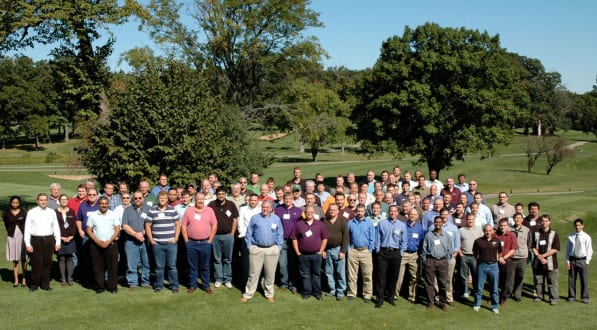
The entire group of MAGMASOFT users and the MAGMA staff gather on the grounds for a group photo
Schaumburg, IL –Removing Roadblocks to Success was the theme for the 2011 MAGMASOFTNorth American User Group meeting, held September 13-15, 2011 at Eaglewood Resort & Spa in Itasca, Illinois. One of the main purposes of the annual MAGMASOFTUser Group Meeting (UGM) is for MAGMA to provide its users with ways to be more successful using MAGMASOFT, the leading simulation software in the foundry market. MAGMA has learned that their users benefit greatly by gaining knowledge from each other as well as relying on the MAGMA engineers for technical support.

MAGMA annual user group meeting gather on day 1 for the general group session
MAGMA looks to its customers to help them continue to improve and grow as an organization. MAGMA sees itself as an asset to their customers’ entire organization and wants to help them to not only utilize MAGMASOFT to its fullest potential, but to go beyond the engineering department and implement MAGMASOFT in their entire organization, i.e. in sales and marketing, production, and quality departments. The more areas in the customer’s organization where MAGMASOFTis utilized, the more productive and profitable their operations become, according to company president Christof Heisser.
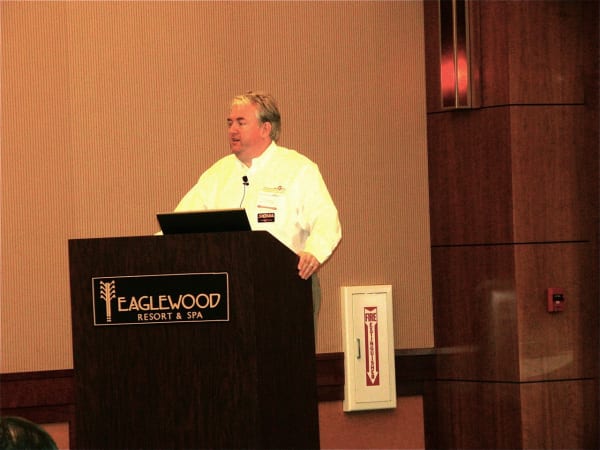
Christof Heisser, President of MAGMA Foundry Technologies, Inc. welcomes the MAGMASOFT users to the 2011 North American User Group Meeting.
MAGMASOFT users addressed the group with their presentations. Greg Miskinis from Thyssen Krupp Waupaca presented “How To Get Management to Write the Big Check.” Keith Pearl from Caterpillar South Milwaukee discussed “Utilizing MAGMASOFTin the Supply Chain.” Brodie Biersner and Sairam Ravi, both from the University of Northern Iowa, presented papers on mold instrumentation and simulation of veining defects using MAGMAapi, respectively. Lastly, Charlie Monroe from Caterpillar closed out the general session with his presentation entitled “Save Money Using MAGMAfrontier.”
In addition, three candidates, Ivy Courtney from Riverside Brass, Jason Lythjohan from Premier Aluminum and Ian McNally from Hodge Foundry gave their presentations for their MAGMASOFTCertification within the MAGMA User Group.
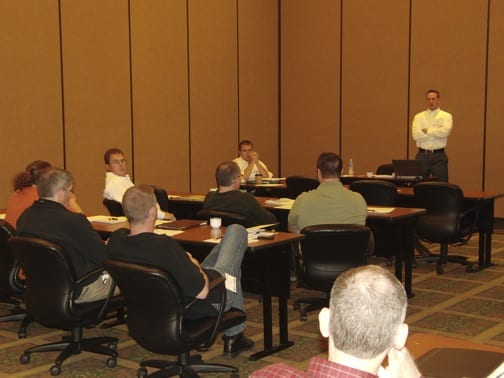
Steve Sikorski and Benji Johnson (seated at front table) both from MAGMA facilitate the non-ferrous breakout group discussion on “roadblocks”
After completing a questionnaire regarding different roadblocks during the general session, the 120 MAGMA users in attendance were split into one of four categories: HPDC, Non-ferrous, Steel or Iron. In these groups, potential roadblocks such as set-up and analysis of simulation, calculation times, hardware (memory, speed), capability (training) of users, immediate management, upper management, workload, communication issues with customers, as well as others were discussed in a peer-to-peer group setting, with attendees as well as MAGMA staffers providing possible solutions.
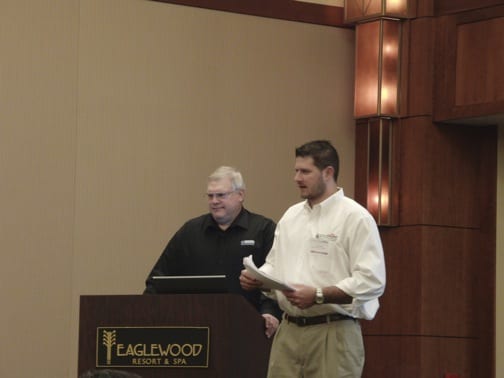
Matt Jacobs of MAGMA Foundry Technologies, Inc. facilitated the general sessions.
The advanced use of MAGMASOFTand specifically its latest version MAGMA5was a recurring topic in the traditional small group breakout sessions. In addition, guest speakers presented process and alloy specific topics, creating an environment for interaction between these technical experts, users and MAGMA staff. To close the two-day meeting, details of the anticipated version 5.2 and future developments were presented to the User Group.
For more information on this release, please contact: Christof Heisser President MAGMA Foundry Technologies, Inc. 10 N. Martingale Road, Suite 425 Schaumburg, IL 60173
Phone 847-969-1001 ext. 225 Email cheisser@magmasoft.com Web www.magmasoft.com
Agency contact: Wendy McCormick Bernard & Company 847-934-4500 wendy@bernardandcompany.com
Continue reading
One job that took two weeks due to reworks now done in two days, the result of Tenaxol polymer quenchant with anti-foaming agent and greater concentration consistency

Brothers TJ (left) and Jacob Dohlun operate Complete Heat Treating, companion company to Wisconsin Steel Industries, both in the Milwaukee area. Complete operates open fire furnaces and quench tanks to process large steel castings and forgings, as well as metal fabrications and some aluminum parts.
TJ and Jacob Dohlun are not easily impressed. Despite their relatively young ages, 40 and 32 respectively, they have both worked in the family’s dual heat treating businesses in the Milwaukee area, as far back as they can remember. Their grandfather, Theodore Dohlun, started Wisconsin Steel Industries in 1939 and the family has had involvement in heat treating for three generations. Their dad Ted continued the tradition until his recent retirement and both of the “boys” have been active a long time. They began Complete Heat Treating in 2007 as a separate entity and run it with their mother, Chris Dohlun.
Both Wisconsin Steel and Complete Heat Treating run commercial heat treating operations, serving regional manufacturers in the mining, construction, wind energy, rail, government contract, medical, off-road and agricultural equipment industries. They also serve companies as far away as Brazil, however. Combined, they employ approximately 50 people at the two facilities, processing materials such as 4140 and 4340 steel in the forms of castings and forgings up to 100,000 pounds, as well as fabrications and some aluminum parts.
Never ones to rest on their laurels, however, TJ and Jake have been making significant improvements in their operations, especially on the technology side. They use a proprietary software system to operate their furnaces, they’ve incorporated a number of green initiatives into the business operation and, about a year ago, switched their polymer quenchant supplier to the originator of that chemistry, Tenaxol (Elkhorn, Wisconsin).
At Wisconsin Steel and Complete Heat Treating, they run a total of 13 open fire car bottom and feed furnaces with capacities up to 1,000,000 pounds and workspaces up to 52’ long x 20’ wide x 16’ high. Quench tanks at the facilities range up to 40,000 gallons.
Typically, hardness and mechanical specs are supplied by the customers and the metallurgists and chemists in the labs at these facilities work to determine the optimum processing conditions. Wisconsin Steel is rated to the GE Nuclear standards, while Complete Heat Treating received its ISO 9001:2008 certification just recently.
Many value-adding secondary services are supplied here, including machining, straightening, roto-blasting and saw cutting, as well as metalcoating.
The quenching operations at Complete were a particular challenge, owing to the large parts processed here, the dwell times in the quench tanks and the recurrent problems of concentration flux and, most notably, foaming and dragout. As TJ explains, “We were having a lot of problems on one part, a spun metal with thin but substantial surface area and a rimmed edge. The dragout and the excessive foaming were causing us to rework parts to hit the spec. There were shipping delays and we were struggling to hold the concentrations in the tanks for any extended period.”

Previous polymer quenchants were causing excessive foaming and were inconsistent in holding concentrations. Both problems were overcome with Tenaxol polymer quenchants, according to the brothers.
Jacob adds, “We had been talking to Tenaxol about their anti-foaming products and, despite some cost differences with our then-current supplier, we agreed to testing. Although we were not a customer, the Tenaxol team really went the extra mile to give us the best results their lab could suggest.” As a result, Tenaxol Quench 2500 Ultra polymer quenchant with a non-nitrite corrosion inhibitor, defoamer and biocide was purchased from this new supplier and the results have been outstanding, according to the Dohlun brothers. “We no longer have consistency issues, the percentages stay in line, plus we can vary the temperatures in the tanks without compromising performance. That opens more opportunities for new business and it’s been working very well.” Complete Heat Treating is currently on a record sales pace, with more customers and much faster throughput, boasting a 25% increase in sales and working capacity today. On that spun metal part, for example, TJ notes, “We went from two weeks with a lot of rework to two days on a typical batch.” Jacob adds, “The savings in staged deliveries alone run to thousands of dollars, each time.”Complete is now able to process a wider range of materials, as a result of using Tenaxol quenchants, according to the brothers, who credit Jim Harrison, CEO at Tenaxol, and his team of chemists and metallurgists with much of the significant improvement in their processing scenario.
TJ Dohlun takes a temperature measurement on a batch of steel parts in quenching.
Describing the situation when the previous quenchant vendor was used, “On that spun metal part, for example, our stacker crane would come out of the tank, full of foam. It looked like a bubble bath,” Jacob joked. TJ further noted the drain-off of the Tenaxol product allowed the parts to enter the tempering furnace much faster, avoiding excess cooling of the surface area. The Complete customer for this job, Rich Prescott of Glenn Metalcraft (Princeton, Minnesota), echoes the Dohlun’s, “The turnaround time has been super. They made great improvement in their deliveries to us over the last year and that’s helped us satisfy our customers faster.”
“This anti-foaming agent in the Tenaxol product has literally changed our shop,” TJ concludes. Jacob also cited the supplier’s customer service. “We get help from their lab on a regular basis, including water testing and support documentation, which is necessary for the PPAP requirements of several customers.” He adds, “Jim (Harrison) and his team did a lot of testing for us, before making their final recommendations and they continue to help us fine tune our operation.” He further noted Tenaxol’s involvement with MTI was important. “This supplier supports our industry and that meant a lot to us.” The supplier also provided a solution to problems Complete was experiencing in their cooling tower water by conducting lab testing, automated equipment and cost-effective chemical treatments, according to Dohlun.
As a result of this initial relationship with Tenaxol, Complete Heat Treating has expanded its purchases of products to include various greases and lubricants from this vendor, which is part of the Chemtool family of companies, a wide-ranging industry supplier of myriad lubricant, cleaning and metalcutting fluid products.
To see a video of heat quenching at Complete Heat Treat, click HERE.
For more information on this story, interested parties should contact:
COMPLETE HEAT TREATING
125 E. Greenfield Ave. Milwaukee, WI 53204-2937
Phone: 414-643-5161
Web: www.CompleteHT.com
Attn: TJ Dohlun or Jacob Dohlun
TENAXOL TECHNOLOGIES, INC.
1001 E. Centralia St. Elkhorn, WI 53121
Phone: 414-476-1400
Web: www.tenaxol.com
Attn: Jim Harrison
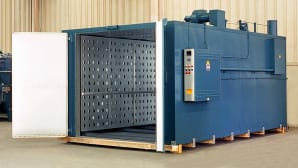 No. 857 is an electrically-heated 500°F (~260°C) walk-in oven from Grieve, currently used for annealing plastics at the customer’s facility. Workspace dimensions are 7’ wide x 12’ deep x 7’ high. 100 KW are installed in Incoloy-sheathed tubular heating elements to heat the oven chamber, while a 17,500 CFM, 15 HP recirculating blower provides horizontal airflow to the workload.
The oven has 4” thick insulated walls, plus an aluminized steel interior and exterior. The door sill on this unit was eliminated and both oven doors are equipped with drag seals. Wear bars were also installed on the sides of the workspace for added durability.
Controls onboard No. 857 include a 975 CFM powered forced exhauster and motorized dampers on the intake and exhaust for accelerated cooling of the oven chamber.
For more information, please contact: THE GRIEVE CORPORATION, 500 Hart Road, Round Lake, Illinois 60073-2835 USA. Phone: (847) 546-8225. Fax: (847) 546-9210. Web:www.grievecorp.com. Email: sales@grievecorp.com. Attention: Frank Calabrese.
Continue reading ATLANTA, Sept. 26, 2011 — Siemens Industry, Inc. announced today the extension of the upper performance range of its popular Simotion D motion controllers. The new generation of Simotion D445-2 multi-axis controllers has new features such as onboard Profinet interfaces, high-speed I/O, and with three times the performance, a single controller can support up to 128 axes of motion.
Simotion D motion control systems are the ideal solution for production machines covering all levels of performance — from simple single-axis positioning tasks to complex synchronous applications — with extremely short cycle times on a large numbers of axes. Thanks to its scalability, Simotion D offers users a high degree of flexibility for the ever-changing demands on machine automation. The Simotion D drive-based multi-axis control system not only offers PLC, motion control and advanced technology functions, but also an integrated drive control based upon Siemens Sinamics S120 drives.
Today, with the new Simotion D445-2 DP/PN and D455-2 DP/PN versions, the performance range has been extended even higher. Compared to the previous generation, the maximum quantity has been doubled to 128 axes and the memory capacity significantly expanded. This has increased the PLC and motion control performance by a factor of three. With Simotion D445-2 DP/PN and D455-2 DP/PN, the previously optional Profinet I/O interface has now been integrated on the modules as standard. This frees up the option slot for other expansion cards. The onboard interface is equipped with an integrated three-port switch and facilitates different network topologies such as line, star or tree structures, without the need for additional external switches. The interface not only supports real-time (RT), but also isochronous real-time (IRT) data exchange and can be operated as a controller and / or device of another controller.
In addition to the Profinet interface, Simotion D445-2 DP/PN and D455-2 DP/PN also have two Profibus and two Ethernet interfaces, as well as 28 digital I/Os, of which 16 can be used for technology tasks such as output cams and measuring inputs with micro-second resolution.
For more information about motion control solutions and services from Siemens, point your web browser to www.usa.siemens.com/motioncontrol. Join the community by following us on Facebook: www.facebook.com/siemens.dt.us and talking to us on Twitter: www.twitter.com/siemens_dt_us.
The new Simotion D motion controllers for production machines cover all levels of performance, from simple positioning tasks to demanding applications with extremely short cycle times or large numbers of axes, up to 128.
Please forward all inquiries to: Siemens Industry, Inc. Motion Control Business 390 Kent Avenue Elk Grove Village, IL 60007 Attn: Marketing Communications
For specific product information and inquiries, call (800) 879-8079 ext. Marketing Communications
or send an e-mail to: SiemensMTBUMarCom.industry@siemens.com
Siemens Industry
Siemens Industry, Inc. is the U.S. affiliate of Siemens’ global Industry Sector business—the world’s leading supplier of production, transportation and building technology solutions. The company’s integrated hardware and software technologies enable comprehensive industry-specific solutions for industrial and infrastructure providers to increase their productivity, sustainability and profitability. The Industry Sector includes six divisions: Building Technologies, Industry Automation, Industry Solutions, Mobility, Drive Technologies and Osram Sylvania. With nearly 204,000 Siemens Industry Sector employees worldwide, the Industry Sector posted a worldwide profit of $4.7 billion on revenues of $47.3 billion in fiscal 2010. www.usa.siemens.com/industry
Drive Technologies
A division of Siemens Industry, Inc., the Drive Technologies Division is the world’s leading supplier of electrical and mechanical products, applications and solutions that cover the entire drive train. Drive Technologies is the global leader in energy-efficient motors and drives, as well as products and services for production machinery and machine tools. Technologies include standard products, industry-specific control and drive solutions, as well as mechatronics support and online services for web-based fault management and preventive maintenance. Drive Technologies provides its customers with energy-efficiency, productivity and reliability in industries as diverse as clean and renewable energy, transportation, oil and gas, utilities, metals and mining, machinery manufacturing and machine tools. With nearly 36,000 employees worldwide, the Drive Technologies Division posted worldwide revenues of $9.5 billion in fiscal year 2010. www.usa.siemens.com/drives
Continue reading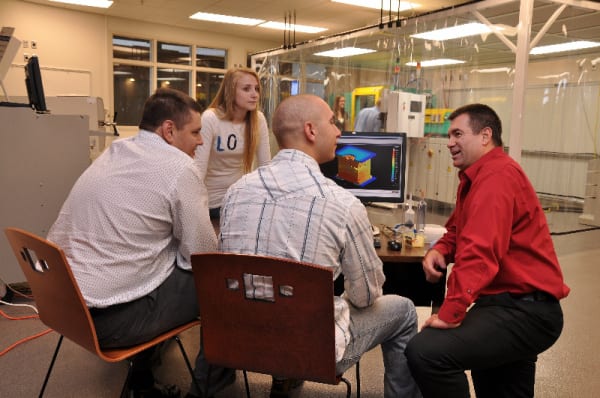 Schaumburg, IL. — SIGMA Plastic Services Inc. has donated SIGMASOFT® polymer process simulation software to Penn State Erie’s School of Engineering at Penn State Erie, The Behrend College, a gift valued at $3.7 million.
With this software, the campus has new technical capabilities for its soon-to-open Medical Plastics Center of Excellence and current Medical Plastics certificate program, two initiatives that address the emerging medical plastics market.
The U.S. market for medical plastics is growing at a rate of 5 percent to 10 percent annually and sales are projected to reach $6.55 billion in 2012.”Thanks to SIGMA Plastic Services, our students and faculty members will be able to develop the next generation of medical devices. This is a great partnership between academia and industry that ultimately benefits our students,” said Ralph Ford, director of the School of Engineering.
The $3.7 million gift supports Penn State Behrend’s goal of raising $32 million during the University’s current capital campaign, For the Future: The Campaign for Penn State Students. To date, the college has secured 81 percent of that goal.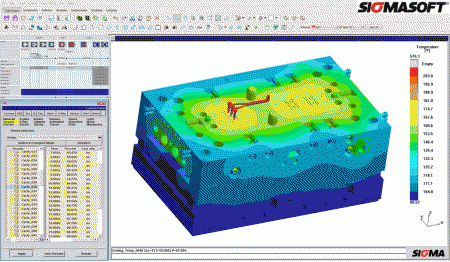
Penn State Behrend’s Medical Plastics Center of Excellence is an applied research and outreach center that supports companies in the development of new medical devices and packaging, technologies that could not exist without advanced plastics materials. SIGMASOFT® software, designed for the molding of advanced elastomer, silicone and thermoplastic materials, supports these technologies.
Students enrolled in the Plastics Engineering Technology bachelor’s degree program can pursue the Medical Plastics certificate. The 14-credit certificate program prepares graduates for careers in medical product development with courses in advanced materials, new product design, manufacturing, and FDA regulatory issues. Nationwide, this is the only medical plastics certificate or degree program offered at the undergraduate level.
“Students will acquire in-depth knowledge of SIGMA products and will be better prepared to put what they have learned into practice after graduation,” said James Chiamardas, president of TPStek. “This is the first gift of SIGMASOFT® to a college or university in the United States. We’re pleased to work with Penn State Behrend on this important initiative.”
 James Chiamardas, a Penn State Erie plastics alumnus and Erie native, played a key role in securing the gift. Chiamardas earned his associate and bachelor’s degrees in Plastics Engineering Technology. He is president of TPStek, LLC, a SIGMASOFT® reseller.
TPStek will provide technical support for the software, which is included in the value of the gift.
Christof Heisser, President of SIGMA Plastic Services, Inc. says, “We are happy to provide the School of Engineering at Penn State Erie, The Behrend College, with 25 seats of SIGMASOFT®, thereby giving students access to state-of-the-art Polymer System Simulation. Simulation has revolutionized the manufacturing world in the last 25 years and has become an integral part of the manufacturing process. It is, therefore, essential to integrate this technology into the education of the next generation of engineers and we at SIGMA are proud that one of the leading universities in the manufacturing world has decided to work with our simulation tool.”
SIGMA Plastics Services is in Schaumburg, IL. Located outside of Chicago, SIGMA Plastics Services Inc. is part of SIGMA Engineering GmbH, headquartered in Aachen, Germany. SIGMA provides 3D Polymer System Simulation software and engineering solutions to companies throughout the world.
For further information on this announcement, interested parties should contact: SIGMA Plastic Services, Inc. 10 N. Martingale Road, Suite 425 Schaumburg, Illinois 60173 USA
Phone: +1 847 969 1001 x 225 Email: cheisser@3dsigma.com Web: www.3dsigma.com Attention: Christof Heisser, President
Agency contact for SIGMA: Wendy McCormick Bernard & Company Palatine, Illinois (Chicago) USA +1 847 934 4500 wendy@bernardandcompany.com
Continue readingHandles parts up to 240” long at major aircraft manufacturer
 Production problems occur in all sizes and trying to meet the challenge of making one size fit all requires a better idea, a better solution.
That is exactly how one customer’s problem became an opportunity for Bertsche. It began as a simple customer request, where a Tier 1 manufacturer of large airplane structural assemblies is required, on a daily basis, to modify semi-finished and partially assembled detail parts. The parts are required for large airplane structural assemblies. Plus, the parts are needed just prior to final assembly and so this manufacturer was searching for an all-purpose machine that could quickly be step up to run a wide variety of parts to support several different airplane programs.
To better appreciate this problem, it helps to understand the difficult work environment.
Airplane manufacturers often start the manufacture of parts for a specific airplane order well before all detail parts for that airplane have been fully defined. This is great for the airlines but complicates the process of building planes to a tight schedule. Furthermore, airplane manufacturers must have considerable flexibility built into their processes, to allow last-minute modification to parts that will be needed shortly thereafter in final assembly.
 In this environment, the manufacturer needs to have the ability, as required, to modify or rework every detail part needed for a specific structural assembly. On short notice, CNC part programs need to be created for virtually every part used in that subassembly, while special tools and fixtures need to be readily available and easily set-up in machines, so that the parts can be manufactured just-in-time before they are needed at assembly. This is truly a “one off” manufacturing environment, where the first part must be a good part with no margin for error.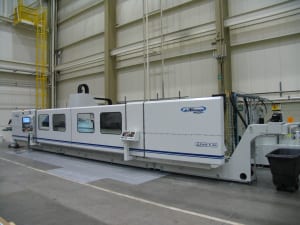
For Bertsche, the customer’s initial request was simple, namely, replace three small footprint machining centers with a single machine tool that could quickly be reconfigured with tools, workholding fixtures and programs to manufacture the parts needed to complete a specific airplane build (ship) set. Specialized workholding, developed over many years for legacy (older model, mature) airplanes had to fit onto the new machine as well as new workholding needed for the latest model airplanes. Setup time needed to be minutes or, at most, hours and not days.
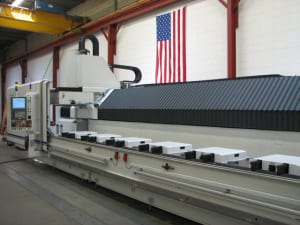 The customer wanted to reduce operating costs by reducing the number of people needed to run the machines, reduce setup time and improve the productivity. The existing machines could only manufacture small parts fitting a 20”x30” work envelope, but the new machine had to handle these parts plus parts as long as 240”. There was neither budget nor floor space to replace the existing machining centers with new ones and purchase a new long X-travel machining center.
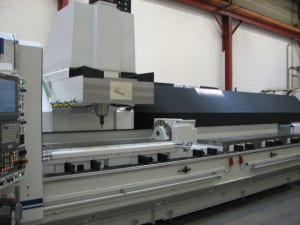
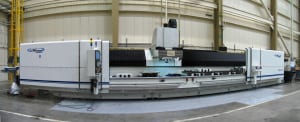
Having developed a long X-travel, raised-carriage, fixed bed machining center (Xi-Mill) for single or dual work zone long part machining, Bertsche’s solution was to expand the capabilities of the existing machine design by develop a new type of machine, the X-Flex Center, configured with multiple pallet receivers instead of the typical T-slot tables. This allowed the customer to load multiple workholding fixtures into the machine and have them ready to run on short notice. Equipped with a setup changer, the machine could quickly be reconfigured by pulling new workholding fixtures from storage and loading them into the machine to match constantly changing production requirements and schedule changes. Having the dual work zone feature with each work zone having its own dedicated tool changer, the operator was able to load newly tooled fixtures in one zone, while parts were being machined in the other. 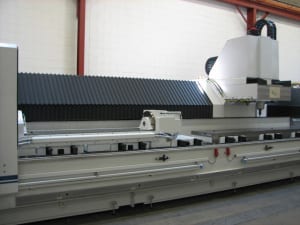
In keeping with lean operating principles, this solution was an FMS that didn’t require all the automation, expense and overhead to manage. The machine was easily overseeable, pragmatic and affordable, plus it allowed the manufacture of a wide range of parts with just a single machine. As the project unfolded, however, many divergent new requirements were identified as desirable and this began to conflict with the original “as concepted” solution.
Long parts, short parts, 4-axis machining, smart fixture control, automatic fixture recognition,
integral thermal growth compensation, video camera actual cutting display, different materials, aluminum, titanium, composite (CFRP) parts, sandwich materials, materials separation, special water filtration, materials separation and other considerations arose, with each requirement mandating additional machine functionality.
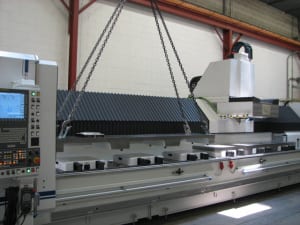 To machine the long parts, the machine needed a two T-slot tables, one for each work zone and the two used together for very long parts up to 240”. It needed a fourth axis trunnion-style table, designed to accept smart fixtures up to 72” in length, fixtures with retractable clamps controlled by the part program. The machine tables needed to be reconfigured from T-slot mode, to 4-axis trunnion mode, to pallet mode and back again.
To meet these requirements, a zero point clamping system was incorporated into the base table, which allowed the pallet receivers to be decked with various long part handling special tables. The zero point clamping features meant that different tables could be quickly installed, with a high degree of repeatability (0.0002” repeatability for a 120” long table). Large and heavy special tables could be craned overhead, lowered into place, clamped and locked down to do production-ready machining in minutes.
For further flexibility, a vacuum workholding system was added to allow any of the pallet receivers to use both mechanical and vacuum workholding.
Each work zone was equipped with a CNC part program addressable connection port, so that special fixtures with complex part clamping (part program actuated) could be controlled by the programmer.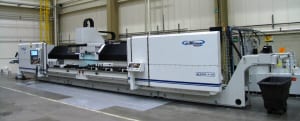
Being a very large machine with two different work zones and machining parts that only 24 hours later were used in final airplane assembly also meant there would be zero tolerance for error or delay. A video camera view port was provided to allow the operator to see what was happening in one work zone, while the other zone was being setup for the next part.
 A further complication revealed itself late in the project. Constantly changing and reconfiguring the worktables with different workholding fixtures also meant that the system was prone to operator error. To address this additional problem, a radio frequency identification system (RFID) read/write station was incorporated into each pallet receiver location. By means of reading the tooled fixture pallet tag, it was now possible to compare the “workholding fixture” installed in a given pallet location to the part program pulled down to the CNC. This insured that the program, part and tool matched. Additionally, the same system was used to scan the tools in the tool changer and could be used to verify the correct tools were available to machine the selected part before the actual machining cycle began.
Switching from aluminum parts to CFRP composite parts required a chip and water filtration system to convey both chips and sludge-like material. The waste material needed to be separated from the coolant. First, the chips from composite sludge, then the coolant suspended CFRP fines had to be filtered from the coolant. Material separation and disposal was not just an operational issue, it was also a facility and hazardous waste disposal issue. The machine was equipped with a flush and wash feature that allowed the entire work zone to be washed down and cleaned before the next material was machined. For chip collection and removal, a conventional chip conveyor was used to transport chips out of the machining area. The chips were separated and put into a dumpster. The cutting fluid carrying liquid and suspended composite particles was pumped to a cyclonic separator, where the sludge was separated and fleece paper filtered for separate disposal.
For long part machining, “hole pattern” to “hole pattern” accuracy was critical and thermal growth of the part relative to the machine was factored into the design. Knowing the temperature of the part (so that appropriate length compensation could be applied) was critical when parts needed to snap together at assembly. To this end, each work zone was equipped with a material sample station. A sample piece of the material was mounted, its temperature measured and the information fed to the CNC for corresponding machining thermal positioning adjustment.
To interface with the shop floor managing network, a front-end PC equipped with bar code reader allowed the operator to scan in work order information and, together with pallet loading instructions, send the right part program for the part(s) to be manufactured as needed to meet daily production requirements. The operator loaded workholding tooled pallets, as directed, to a specific pallet receiver location, while the system verified that the correct tools were available in each tool changer. The operator could then arm (enable) the work zone in which machining was to next take place and wait until the part(s) in the other zone had been manufactured. The process repeated throughout the day with nearly 100 % spindle and operator utilization in a “one off” demand driven environment.
To ensure the correct tools of size and length were being used, each ATC was equipped with its own tool length setter. Each tool could be measured, with offsets adjusted prior to machining. A spindle probe, one for each work zone, allowed fixtures and parts to be probed for location with corresponding work coordinate adjustments. A special marking tool allowed information to be written on a part in easily readable script.
While not every manufacturer has these same complex problems, having such a flexible large machine to make both long and short parts makes sense for even the smallest manufacturer. As a result, any manufacturer who needs flexibility and reconfigurable worktables can quickly adapt his machine tool to meet a wide variety of such machining needs.
For more information contact:
BERTSCHE ENGINEERING CORPORATION 711 Dartmouth Lane Buffalo Grove IL 60089 Phone: (847) 537-8757 www.bertsche.com Attention: Rich Bertsche, President rwb@bertsche.com
Agency contact: Tim Daro Bernard & Company 847-934-4500 tdaro@bernardandcompany.com
Continue reading
Mark Cunningham operates a Gleason gear shaper with Siemens CNC onboard. “It’s very user friendly,” he says.
Using CNC technology on advanced machine tools helps company sell its products worldwide
Roscoe, Illinois is home to many more gear companies than your average town of 10,000 people, but the reason is obvious. During the peak of the machine tool boom in nearby Rockford, it was critical to have these important components made locally. Over the years, that market has changed and so have the gear companies here, each taking its expertise in other directions to offset the decline in local machine tool building.
Forest City Gear Inc. took a different track to remain competitive globally. As Fred Young, CEO of the company, which was founded in 1955 explains, “We decided long ago to do two things. First, to make the very best fine and medium coarse pitch gears in the world, and to do so by using the best machines, people and quality assessment practices possible. Second and just as important, we became committed to reinvesting our company’s profits in newer and better machinery, based on the global standards and the ongoing technical advancements made by machine tool builders around the world.”
Kevin Chatfield has worked on CNC machines for 20 years. Here, he uses a Samputensili gear grinder for internal, external and form grinding. “No other CNC can do all the work the Siemens does.”
This precision gear and spline maker performs nearly every aspect of production in-house, including blanking, turning, hobbing, shaping, milling, gear grinding with form wheels and generating grinding, thread grinding, broaching, honing, straightening, laser marking, magnetic particle inspection, metal-etching, CMM, hardness testing and final surface inspection. Forest City Gear continues to subcontract heat treating and plating. The blanking department, though relatively new, has been expanded several times to keep pace with increasing production. The company boasts nearly every leading brand of gearmaking machine tool on the world market, because, as Young puts it, “We really do put our money where our mouth is, to use that old expression. In a typical year, we invest between 25 and 40 percent of our gross sales back into better gear machines and metrology.”
Brian Turnbull runs various machine tools, including a Hoefler gear grinder, and notes, “The CNC is easy-to-use, very easy to layout and gives me no problems navigating.”
Among the most advanced gearmaking machines in this shop are four Gleason shapers, two Samputensili grinders (form and generating style) plus a Hoefler gear grinder. All these machines have something in common.
At the heart of any machine tool, of course, is the CNC that drives it, controls the motion, detects and integrates all the cutting parameters, feeding back that information to the computer logic of the control to ensure the part being made is as close as possible to the programmed specifications. Meanwhile, the ergonomic or operator-to-machine interaction must always be considered, because a control that’s too difficult to learn and use will result in substantial and costly delays in production. While Forest City Gear has the classic mix of longtime and newer employees, who all bring a variety of computer knowledge and machining skills to the job, this company has consistently sought the most advanced equipment on the market, as part of its “Excellence Without Exception” motto and its practical desire to stay ahead of the competition in the global gear market.
Forest City Gear is among the world leaders in fine and medium pitch gears, selling high-precision applications in medical, aerospace, defense, avionics, instrumentation and performance racing markets.
The control on these machines at Forest City Gear is the Sinumerik 840D from Siemens with specialized gear software. As Young explains, “The extensive gear software developments available are quite remarkable. Most have been a cooperative venture between a machine builder, the CNC builder and folks like us. The result has been software that’s specific to hobbing, shaping, gear grinding and thread grinding.” He also notes features of the Siemens CNC that have yielded positive impacts on the production at Forest City Gear, including “…sophisticated executive software for all machine movements and the fast program reading that allow us to cut and grind much faster, with more options such as reverse direction, segment cutting and combined operations, when compared to other controls we see.”

Company CEO Fred Young notes, “Most of the best gearmaking machines in the world use Siemens CNC and I’ve seen a lot of them, in my time.” He adds the controls have great flexibility, more motion precision and greater diagnostic capabilities than competitive brands he’s used at his company.
Typically, the CNC is used for all axis, rotary and spindle movements and the machine operators particularly appreciate the multiple standard cycles for cutting with degressive feeds, increasing speeds plus special cycles for gear tooth removal and reversing directions to improve finish or reduce cutter wear.
Forest City Gear cuts a wide variety of standard and exotic materials in the production of its gears and splines. These include titanium, Inconel, 4340, 300M, Vascomax 250 and 300, Nitralloy 135M, 9310, 4150, 4140, 8620, aluminum bronze, 13-8, 15-5, 17-4, 316 and 440 stainless, Hastelloy, Ferrium and numerous thermoplastics. The shop can carbide rehob to 60-62 RC and gear grind at all hardnesses.
Kevin Chatfield, a longtime Forest City Gear employee with 20 years’ CNC machine experience, works with the Samputensili grinders and says, “I’ve used all the brands of controls we have here… and for many jobs, no other control can do what the Siemens 840D can do. One example would be the internal, external and form-grinding I do on the Samputensili machine. If the other controls could perform these operations at all, which is doubtful, it would be a very slow process.”
Mark Cunningham, a 12-year veteran of CNC, runs the Gleason machines and notes the controls are very user-friendly. “The screens are easy-to-program and modify, then you get a clear picture of what’s happening at every step in the cycle. The precision is so good, we sometimes need to ‘lie” to the program to get what we want from the machine.”
Brian Turnbull, a newcomer to Forest City Gear, but a longtime machinist, had worked with a competing brand to Siemens CNC and was initially hesitant. “Then, as soon as I saw the easy layout, plus how quickly it could be set-up and go into action, with no trouble navigating at all, I was convinced Siemens was simply a better control.”
Young notes one last point about the CNCs on these machines. “These machine tools produce our most complex parts, including helical splines and internal gears most other shops simply cannot or will not make. The cycle and program read times on the Siemens controls are critical to our production work, plus these are the most expensive machines in the shop, so their run-time cost is the highest.” He adds, “Most of our jobs, though not all, here are short runs on very expensive materials. If the machine takes too long to complete the first part or has repeat rejects, we lose money — it’s that simple. I’m proud to say that neither our operators nor our production supervisors allow that to happen. And the controls on the machines are a big reason why we stay so successful in achieving that accuracy and consistently good part production at Forest City Gear.”
The company has remained among the leaders in the market for high-precision gears, owing to this strategy of buying the best machines, hiring the best gearmakers available and verifying the output of this 100-person shop by using the power of the industry’s leading quality lab, which occupies a cleanroom-level environment in the middle of the factory. As Young explains, “We do checking of our gears and splines at various test stations located throughout the shop, but the final proof resides in our quality lab. Our equipment is so sophisticated, even our competitors often bring us their work to have it checked. It’s one of the things that’s led to our current customer base of about 400 companies, about twenty percent of whom are other gear companies or gear producers themselves.”
For more information on this story, please contact:
FOREST CITY GEAR CO., INC.
Fred Young
CEO
11715 Main Street Roscoe, IL 61073
Toll-Free: 866-623-2168
Phone: 815-623-2168
Fax: 815-623-6620
Web: www.forestcitygear.com
Email: sales@forestcitygear.com
OR
SIEMENS INDUSTRY, INC.
DRIVE TECHNOLOGIES
MOTION CONTROL
MACHINE TOOL BUSINESS
390 Kent Avenue
Elk Grove Village, IL 60007
Phone: 847-640-1595
Fax: 847-437-0784
Web: www.usa.siemens.com/cnc
Email: SiemensMTBUMarCom.sea@siemens.com
Attention: John Meyer, Manager, Marketing Communication
Follow us on Facebook: www.facebook.com/SiemensCNC or Twitter: www.twitter.com/siemens_cnc_us.
—
Siemens Industry Sector is the world’s leading supplier of innovative and environmentally friendly products, solutions and services for industrial customers. With end-to-end automation technology and industrial software, solid vertical-market expertise, and technology-based services, the sector enhances its customers’ productivity, efficiency and flexibility. With a global workforce of more than 100,000 employees, the Industry Sector comprises the Industry Automation, Drive Technologies and Customer Services Divisions as well as the Metals Technologies Business Unit. For more information, visit http://www.usa.siemens.com/industry.
The Siemens Drive Technologies Division is the world’s leading supplier of products, systems, applications, solutions and services for the entire drive train, with electrical and mechanical components. Drive Technologies serves all vertical markets in the production and process industries as well as the infrastructure/energy segment. With its products and solutions, the division enables its customers to achieve productivity, energy efficiency and reliability. For more information, visit http://www.usa.siemens.com/drivetechnologies.
Continue reading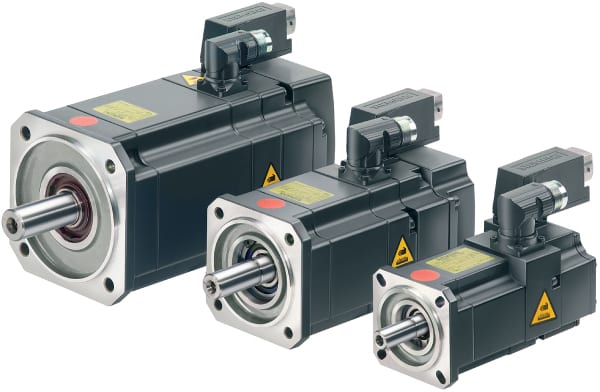 ATLANTA — Siemens Industry, Inc. announced today a value-added service for its popular line of 1FK7 servomotors. Using a configurable options menu to build exactly the motor required, customers can now place an order for any Siemens 1FK7 servomotor and have it drop-shipped in three weeks. Thanks to the diverse range of options available, this new service applies to over 100,000 possible configurations. All compact (CT) and high-dynamic (HD) servomotors in the 1FK7 family are included.
With a total of 6150 option pairings and 18 color choices, servomotors in the 1FK7 family can be configured to 110,700 possible designs. Options include stall torque and RPM rating, encoder style and bit resolution, holding brake functionality, shaft style, IP rating, AC line supply voltage and electronic nameplate recognition via Drive-Cliq®. 1FK7 geared motor options are not included in this program presently.
Siemens is now making this service available to customers in the U.S. market. With the motion controller Simotion® and the drive system Sinamics® S stocked in the United States, Siemens is also able to supply complete motion control systems in three weeks’ lead time.
According to Arun Jain, general manager, Siemens Motion Control Business, “We have made the commitment to significantly shorten servomotor delivery times. The 1FK7 family has a wide user base for motion control applications, so we have selected this very important line for our major customer service initiative. We have devised and implemented an entirely new protocol for motor manufacturing and production at our factories.”
For more information, visit www.usa.siemens.com/motioncontrol.
For specific product information and inquiries, call (800) 879-8079 ext. Marketing Communications or send an e-mail to: SiemensMTBUMarCom.industry@siemens.com.
Continue reading