
Contact us today:
(847) 934-4500
tdaro@bernardandcompany.com
Contact us today:
(847) 934-4500
tdaro@bernardandcompany.com
Whether we are talking about North America, Asia or Russia, within the oil and gas industry, there is a spirit of optimism. Geological discoveries have led to a massive increase in the estimated reserves in many countries. Along with these discoveries, the potential for the use of innovative technologies has also increased. According to the expert estimates, oil production in the Gulf of Mexico alone will rise from the present 1.3 million to 1.7 million barrels a day during the next decade, with demands for the highly sophisticated technological equipment required to accomplish it increasing as well. Two examples are delivery pipes and casings. To create the connection safely and in perfect alignment depends on the threads on the pipe ends. With its USC turning machines, the specialists from EMAG Leipzig have not only created a tool that specializes in this application – and one that has perfected the production sequence for these threads – but also developed complete solutions that guarantee component quality and process integrity.

Specially optimized for the thread cutting of delivery pipes and casings: the USC series of machines from EMAG
Economic key performance indicators for suppliers to the oil and natural gas industry change rapidly. An impressive example of this is found in the USA. The USA hopes to reduce its dependence on oil imports and instead invest heavily in new technology. An indicator, for the US, are imports of equipment technology for the American oil and gas industry, which the U.S. Department of Commerce for 2012 show an increase of 33 percent, compared to the previous year. The experts also expect a production boom in South America and Asia. For Brazil, the foreign trade experts at Germany Trade and Invest (GTAI) predict a “high level of growth in new reserves“. And on the other side of the globe, the investment volume in the oil and gas sector of Vietnam alone has reached 40 billion USD, according to GTAI.
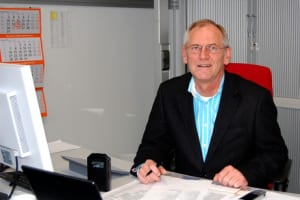
Frank Schiffler, Head of Sales at EMAG Leipzig Maschinenfabrik: “We design all-round solutions. In addition to that, we have available a comprehensive service network. The two together guarantee the economic success we enjoy among our clientele.“
The experts at EMAG Leipzig are aware that this extraordinary dynamic has a direct impact on the production of the required technology. For decades, the machine builders at Leipzig have been specializing in the machining of delivery pipes and casings for the oil and gas industry. Many users can no longer do without their special know-how in demanding thread production. Frank Schiffler, Head of Sales, fills us in on the background: “We are talking about a gigantic production output. One steel mill produces up to 2 million metric tons of pipes per annum. Component quality is paramount for these because the pipe threads have to be totally leak-proof and must carry the enormous total weight of pipe and oil during the delivery. The machining centers used must ensure that the quality and efficiency of the threads produced is 100%.”
Flexible solutions for the production of pipes

The flexible loading of the workpieces is designed specifically for the customer and fully automated. The transport system does not need to be reset and adjusts itself to individual tasks and workpiece dimensions
The USC series from EMAG Leipzig Maschinenfabrik represents an extraordinary, sophisticated solution for this particular production requirement. Flexibility is very important in the construction of these turning machines. Not only do the different machine sizes allow for the complete-machining of different sizes of pipes with external and internal threads to API and GOST standards, they can also cut all proprietary threads. “The larger oil field technology producers have their own thread standards. We can adjust our machines perfectly to their demands“, explains Mr. Schiffler. For instance, all workholding and centering equipment is configured to suit individual requirements. The same applies to all automation components. As a result, the customer has an extremely fast production solution that automatically loads and unloads the components in 12 to 20 seconds (depending on pipe size and thread type), then carries out the 3-part threading process – from facing to chamfering and finally threadcutting. The output ratio therefore increases enormously, compared with that of traditional turning machines.

These machines handle an enormous amount of pipe material and are made to perfectly suit manufacturer’s individual requirements. The threading process itself takes just 12 to 20 seconds
However, there are two important factors that must be taken into account when machining threads on delivery pipes and casings: processing quality and process integrity. The quality is guaranteed by a perfectly adjusted machine, with proven EMAG technology and the know-how of the speciality machine builders from Leipzig come together. The whole process benefits from the following important design details:
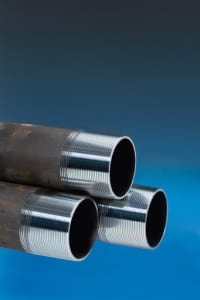
The USC series offers great rigidity, preloaded linear guideways and dampening clamping systems that together ensure the production of thread profiles as smooth as glass
“This quality is a feature of all our USC series machines,” acknowledges Mr. Schiffler. Depending on the machine used, the max pipe diameter can be any dimension from 2⅜” to 20”.
Complete solutions guarantee process integrity
When faced with high production rates, fast machining processes and expensive pipe blanks, machine downtimes are particularly costly for the manufacturer. For this very reason, the process integrity of these machines is another key development area in Leipzig. “We design complete solutions for our customers, who – in turn – benefit from the quality of the EMAG components“, explains Mr. Schiffler. “In addition to that, we integrate, for instance, measuring stations, crack detection equipment, embossing and plating units and, of course, a monitoring system that covers all components. At the end, what we supply is a production system that guarantees the greatest possible degree of process integrity.“ Of similar importance in this context is the worldwide service presence of the specialists. Not only are both user and maintenance staff trained to perfection, a 24-hour 365-day telephone service is also available. This ensures that possible machine downtimes are reduced to an absolute minimum.

The two compound slides with 4-position table-type turrets of EMAG design accommodate a number of different tooling systems. The various quick-change toolholders hold tools for external and internal turning operations. The compound slides are subject to high rapid traverse speeds in X- and Z-axis and ensure idle times are kept short. The guideway system for the slide unit features pre-loaded linear roller guides for greatest machining accuracy and high dynamics
Projects from A to Z
How do the special machine manufacturers assess their market opportunities over the next few years? Mr. Schiffler’s judgement on the market’s dynamic is a positive one: “We already are the market leader in machines for the threading of oil and gas pipes; and we intend to further extend this position.“ One formula for success in this field is the famous “Made in Germany“ – which is a sign for quality. Over 70 percent of the machine components are made and assembled at EMAG in Germany. Every customer comes to Leipzig for the machine acceptance, where the first test run, using the actual pipe blanks, is carried out. Only then will the machine be installed at the production site. “Our particular quality of service kicks in long before the machine is built, or the central claim made by EMAG Leipzig would not be a valid one. Our name stands for projects that are carried through to perfection from A to Z, and that represent all-round solutions.“
See the USC series in action HERE.
For more information:
Kristal Kilgore
EMAG LLC
38800 Grand River Avenue
Farmington Hills, MI 48335
Tel: (248) 875-0313
Fax: (248) 477-7784
E-mail: kkilgore@emag.com
Web: www.emag.com
24,000 RPM max. styles available for all popular machine tools

Axial milling and drilling head style speed multiplier from Heimatec, ER 16 variation
Heimatec, a world leader in live tools, angle heads and multi-spindle drill heads, announces immediate availability of its newest development, a line of 1:4 live tool speed multipliers in 24,000 RPM max. styles, available for all popular live tool lathes currently on the market.
These speed multipliers are provided as axial or radial drilling and milling heads, with either external or internal coolant design, and mounting configurations to suit virtually any machine tool turret set-up, including all VDI and BMT sizes.

Radial milling and drilling head style speed multiplier from Heimatec, ER 16 variation
Speed multipliers for Haas and Nakamura machines are now in stock with others in production for short lead time deliveries.
According to Heimatec President Preben Hansen, “As our presence in the American machine tool market continues to expand, so does our product line. These speed multipliers are a great addition to our line. They give us more to offer the job shop and large production departments, through our growing network of reps and distributors, serving the market here.”
For further information and literature, or to arrange a demo on this new line, please contact:
Preben Hansen, President
HEIMATEC INC.
16 E. Piper Lane Suite 129
Prospect Heights, IL 60070
Phone: 847-749-0633
Fax: 847-749-2445
Email: info@heimatecinc.com
Website: www.heimatecinc.com
Connect with Heimatec Inc: 


—
Heimatec is an international tooling manufacturer, based in Renchen, Germany. Its experienced staff is dedicated to providing customers the most innovative tooling technology possible. In 2010, the company opened Heimatec Inc. in Prospect Heights, IL, near Chicago, to serve its growing North American customer base with sales and service, plus an extensive inventory of products. Heimatec serves the auto, aero, medical, off-highway, rail, energy, woodworking, composites and other industries, as well as an ever-increasing number of machine tool OEM’s worldwide.
Continue reading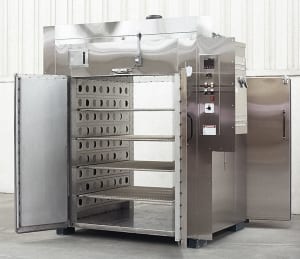 No. 981 is a 350ºF, electrically-heated floor-level cabinet oven from Grieve, currently used for curing flat urethane sheets at the customer’s facility. Workspace dimensions of this oven measure 48” W x 48” D x 60” H. 18KW are installed in Nichrome wire elements to heat the oven chamber, while 2000 CFM, 2-HP recirculating blowers provide horizontal airflow to the workload.
This Grieve oven has 4” insulated walls, 2” insulated floor, top-mounted heating chamber, Type 304, 2B stainless steel interior, stainless steel exterior with #4 brushed finish, double doors front and rear, plus a special sealing flange to allow the oven to seal into a wall between a cleanroom and the fabrication area in the customer’s facility.
Controls on No. 981 include a digital indicating temperature controller, manual reset excess temperature controller with separate contactors, recirculating blower airflow safety switch and a 30-hour shutdown timer.
For more information, please contact: THE GRIEVE CORPORATION, 500 Hart
Road, Round Lake, Illinois 60073-2835 USA. Phone: (847) 546-8225. Fax: (847) 546-
9210. Web: www.grievecorp.com. Email: sales@grievecorp.com. Attention: Frank
Calabrese.
Continue reading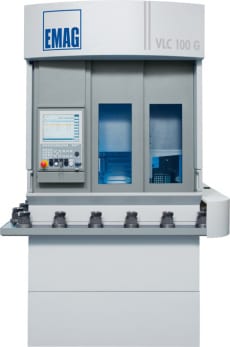
VLC 100 G Vertical Pick-up Grinder
Automobile manufacturers all over the world were able to enjoy an increase in their sales figures, this year! The biggest increases were experienced in the USA, China, India and Russia. However, the rapidly increasing number of vehicles built also brought some production challenges – for instance, the sub-contractors must deal with the increasing output levels and also need to ensure that process safety and component quality do not suffer. In fact, even the smallest components with complex geometries must be produced with increasing levels of precision. In the development of the VLC 100 G Vertical Grinding Center from EMAG, our grinding specialists have made sure that the machine concept offers efficient, error-free machining processes for the production of small chucked components.
Small chucked components are typically produced in large quantities. The demand for components, such as gearwheels, planetary gears, chain gears and flanged components for cars, for instance, have necessary quantities that typically go into the millions; and short cycle times in the production of these components have become mandatory. For instance, the internal contour of a gearwheel must be ground in the shortest possible time and the machine’s workholding unit must be loaded with a new workpiece just as quickly. In many production environments, this represents a critical moment, because the idle time is commonly a decisive factor in establishing the economic viability of the whole process.
Automatic loading scores heavily
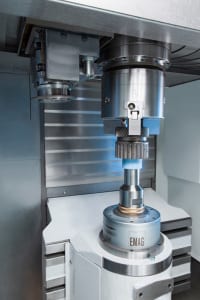
The VLC 100 G is equipped with three axes (X, Z, C). The machine uses its overhead pick-up spindle to load itself. The machining area features one or two grinding spindles for internal and/or external work.
High output levels – short cycle times. This is exactly why the VLC 100 G Vertical Grinding Center from EMAG, for small chucked components with a maximum diameter of 100 mm, was developed. The machine utilizes its onboard pick-up system to load itself. And while one workpiece is being machined, the operator – or the automation system – is putting the raw-parts on the conveyor belt. This reduces idle time and increases output rates. Another benefit is the vertical machining concept; the design ensures that the grinding sludge falls to the bottom of the machine unhindered, where it is then transported out of the machine. (Click HERE for a video detailing the VLC 100 G Vertical Grinding Center)
Quality control is integrated
Measuring processes can also be integrated into the machine, making quality control an integral part of the whole process. The measuring probe is located between the machining area and pick-up station, where it is protected from contamination.
In use are two different grinding wheels
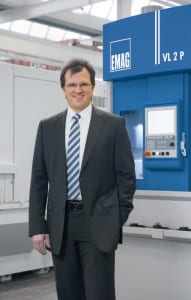
Dr. Guido Hegener, Managing Director EMAG Salach Maschinenfabrik GmbH
An important feature of the VLC 100 G is that it offers the possibility to use two grinding spindles, which can be used to perform different grinding operations, or to handle both rough- and finish-grinding work. In other words, the first wheel performs the “rough” job of removing excess material from the raw-part at high feedrates (the CBN wheel is specially designed to absorb the necessary forces), while the second wheel (with different specifications) takes over the finishing work to guarantee a perfect surface finish on even the most challenging geometries. With the help of this intelligent tooling combination, EMAG design engineers have succeeded in drastically reducing the grinding time of even very complex components. “For the removal of large amounts, two wheels offer a shorter cycle time than one, with the first wheel designed to do the rough-grinding and the second one in charge of finish-grinding work,” explains Dr. Guido Hegener, Managing Director of EMAG Salach Maschinenfabrik GmbH in Germany.
A convincing machine concept

Very easy access! Generously designed maintenance and service doors make the machine easy to access.
The combination of fast loading and efficient grinding processes leads to a very compelling machine concept. The VLC 100 G works very well with the dynamic developments in automotive production. Now, with the rapid increase in required quantities, the demand is for new machine concepts that can be integrated into existing production without any problem. With the VLC 100 G, two features enable it to be integrated without any problems. “Programming the workpieces with our new EMAG NAVIGATOR software is simple and intuitive, saving valuable setup time. For many production environments, this is an advantage that should not be underrated,“ confirms Dr. Hegener. Furthermore, the exceptionally small footprint for the VLC 100 G should make the work of every production planner easier. The stand-alone machine occupies about 4.5 square meters (48 square feet), making sure that the growth of a production facility of this kind will not be limited by floor space requirements.
The advantages of the VLC 100 G
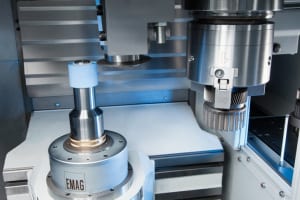
The dressing unit with diamond roll.

The workpieces are mounted on pallets and taken into the VLC 100 G by the conveyor belt. The pick-up spindle then further automates the whole loading and unloading process
For more information:
Kristal Kilgore
EMAG LLC
38800 Grand River Avenue
Farmington Hills, MI 48335
Tel: (248) 875-0313
Fax: (248) 477-7784
E-mail: kkilgore@emag.com
Web: www.emag.com
Planning and partnerships lead to success on export machine series
C.G. Bretting Manufacturing Company Inc. has been in business for over 120 years, serving the OEM paper converting industry and providing contract manufacturing services for more than 60 years. Bretting is located in Ashland, Wisconsin on the southern shores of Lake Superior. The fourth generation of the Bretting family leads the business today, while the fifth generation is currently on deck.

Bretting paper converting machine, utilizing all Siemens controls, including motors, drives, PLC and motion controller plus related software. Bretting builds machines for various paper converting operations such as napkins, interfolded paper towels, bathroom roll and boxed facial tissues.
OEM paper converting equipment converts rolls of paper into folded and rolled paper products such as napkins, interfolded napkins, singlefold facial tissue, multifold paper toweling, kitchen towel rolls and bathroom tissue rolls. Bretting is an industry leader in global sales and service of OEM paper converting equipment. Machines are designed, manufactured, assembled and tested at the Ashland factory, prior to shipping to the customer’s site for set-up and commissioning.

Simotion motion controllers, Sinamics drives, Simatic PLCs and various Simotics motors were used in the building of the first all-Siemens controlled platform machine at Bretting.
Bretting recently delivered its first paper converting machine controlled entirely by Siemens hardware and software. The project was a major undertaking for Bretting, Siemens and Standard Electric (local Siemens distributor) and was deemed a great success, according to Dave Vedder, director of engineering, C.G. Bretting. “Planning and partnerships with our vendors were keys to our success on this first 41-axis Siemens-controlled machine. We planned for success and achieved it. The project started more than 24 months prior to delivery of the machine to the customer.”
Vedder continued to explain the process.
“The project started with listening to our customers, who had been requesting Siemens automation on our equipment for some time. Meeting customer needs is a Bretting strength. We realized it was time to act. The Bretting Leadership Team commissioned an effort to provide an acceptable solution. That solution comprised Sinamics drives, Simatic PLC and Simotion motion controllers.”
The purchasing department then met with the local distributor, Standard Electric. Meetings were organized with Standard Electric, Siemens and Bretting within several weeks. Planning for the first Siemens machine was initiated. It was determined the products and software available would satisfy the full range of Bretting machine functionality and other requirements. Initial planning included:
A formal customer inquiry for a new machine followed about six months later. The inquiry included a requirement for a full Siemens automation solution on the customer’s new paper converting machine. Bretting, Siemens and Standard Electric were now well prepared and ready to respond, Vedder explained. Proposals for the machine with full Siemens automation solutions were shared with the customer. A new set of planning protocols was started, one that focused specifically on the first Bretting paper converting machine to be equipped entirely with the new vendor’s products and software onboard.
First machine planning included-
The customer ordered the machine approximately six months after the initial inquiry. The plans for the first machine were approved and authorized for production. Some checks and adjustments were required during the machine engineering and build process. “The combined talents of Siemens, Standard Electric and Bretting addressed and resolved any issues as they occurred,” Dave Vedder explained. “The customer approved the machine during the Final Machine Checkout process. The time from Order to Checkout was similar to other machines we’ve produced during recent years.”
The machine was then disassembled and shipped to the customer’s site in Europe. The reassembly, startup and final commissioning proceeded without issue. The machine is currently running successfully in the field, with no significant service issues reported, according to Vedder.
Planning and partnership were key to the success of this first export paper converting machine with Siemens automation onboard, all made possible by the combined efforts of the machine builder, the controls supplier and the local value-adding electrical distributor.
Bretting is an ISO9001:2008 Certified manufacturer with sales representatives worldwide.
For further information on this story, please contact:
C.G. BRETTING MANUFACTURING INC.
3401 Lake Park Road
Ashland, WI 54806
Phone: 715-682-5231
Web: www.bretting.com
Attention: David Vedder, Director of Engineering
or
SIEMENS INDUSTRY, INC.
Drive Technologies — Motion Control
390 Kent Avenue
Elk Grove Village, IL 60007
Phone: 847-640-1595 Fax: 847-437-0784
Web: www.usa.siemens.com/motioncontrol
Email: SiemensMTBUMarCom.industry@siemens.com
Attention: John Meyer, Manager, Marketing Communications

Matt Lorig
Machine Tool Business appoints new business development manager for Asian builder relations plus dealer support manager for Eastern U.S.
May 15, 2012 — The Siemens Machine Tool Business, part of the Drive Technologies — Motion Control group within Siemens Industry, Inc. has appointed Matt Lorig as business development manager for the company’s Asian builder base. As such, Lorig will engage in direct sales of the company’s CNC, motor and drive packages to Asian builders and importers in North America, plus maintain existing business in a response mode to better serve this growing customer segment for Siemens. Matt brings over 20 years in industrial automation to this new position, much of it in the machine tool industry with a major Japanese supplier. He has expertise in CNC, robotics, servo technology and general motion control.

Chris Pollack
In related news, Christopher Pollack assumes the duties of dealer support manager for the Eastern United States. His primary responsibility will be field support for the growing dealer network in the region that sells machine tools with Siemens CNC technology onboard. This will include technical CNC training, software support and hands-on utilization demonstrations for dealer customers, both onsite and at dealer events. Chris brings extensive knowledge of CNC technology to this position, plus a working knowledge of MasterCam and SolidWorks. He is a certified Class A machinist and was most recently an applications engineer at Fryer Machine Systems.
For more information on the this story, contact:
Siemens Industry, Inc. Drive Technologies — Motion Control (Machine Tools)
390 Kent Avenue Elk Grove Village, IL 60007
Phone: 847-640-1595
Fax: 847-437-0784
Web: www.usa.siemens.com/cnc
Email: SiemensMTBUMarCom.industry@siemens.com
Attention: John Meyer, Manager, Marketing Communications
Follow us on Facebook: www.facebook.com/SiemensCNC or Twitter: www.twitter.com/siemens_cnc_us.
—
Siemens Industry Sector is the world’s leading supplier of innovative and environmentally friendly products, solutions and services for industrial customers. With end-to-end automation technology and industrial software, solid vertical-market expertise, and technology-based services, the sector enhances its customers’ productivity, efficiency and flexibility. With a global workforce of more than 100,000 employees, the Industry Sector comprises the Industry Automation, Drive Technologies and Customer Services Divisions as well as the Metals Technologies Business Unit.
The Siemens Drive Technologies Division is the world’s leading supplier of products, systems, applications, solutions and services for the entire drive train, with electrical and mechanical components. Drive Technologies serves all vertical markets in the production and process industries as well as the infrastructure/energy segment. With its products and solutions, the division enables its customers to achieve productivity, energy efficiency and reliability.
Continue reading
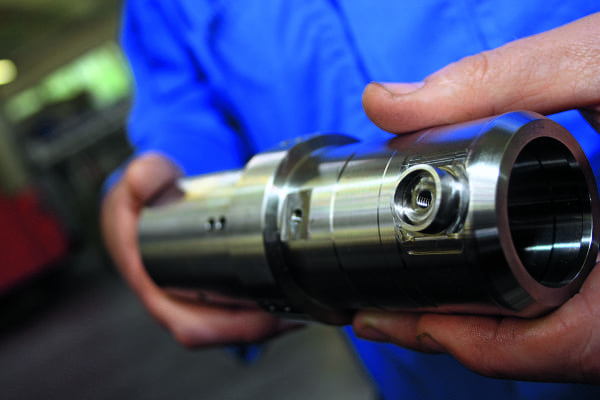
A variety of complex underwater electrical connector casings are made by Gisma, using Siemens Sinumerik CNC-controlled Spinner lathe technology.
Gisma specializes in the production of underwater connectors typically used in offshore energy generation. Siemens Sinumerik-controlled Spinner CNC machine tools contribute significantly to the success of the company.
Special connectors are required to safely and reliably connect electrical and fiber-optic cables deep underwater. With maintenance more difficult, all of the parts must meet the most rigorous technical requirements in terms of reliability and service life. Products from Neumünster, Germany-based Gisma Steckverbinder GmbH are designed to be fail-safe and to withstand maximum pressure loads, while still operating on the basic “push and pull” principle. In addition to shipyards, the offshore oil and gas industry, and the military, Gisma is now receiving an increasing number of orders from offshore energy companies. Gisma works closely with its customers on all of its developments – most recently on a single-pole, wet-mateable power connector for use in offshore underwater turbines, which was designed to handle operating voltages of 12 kV at 400 A and is guaranteed to be fail-safe for 25 years.
Manufacturing repeatability to the nearest micron
To meet the high standards required in underwater technology, manufacturing accuracy to the nearest micron is required, especially for fiber-optic connectors. In addition, the materials must all be corrosion-resistant. The highest levels of functional safety are also required to enable the machining of seawater-resistant bronze and stainless steels, along with more sophisticated materials such as duplex and super-duplex steels, titanium and high-performance plastics. The demands placed on the cutting machines and controllers used in the production of these parts are correspondingly high. For many years, Gisma has relied on Spinner milling and turning centers equipped with Siemens Sinumerik CNCs. “The machines rarely fail, mostly because of the high-quality drive and control technology,” says production manager Michael Königsmann. He is particularly impressed by the TC77 universal turning machine from the 800 series, which will be used, among other purposes, to turn the casings for a new high- performance connector measuring up to 3000 mm long. The TC 77 is built on a rigid Meehanite cast iron base with large tempered steel guide rails, allowing a high cutting capacity, along with good damping and rigidity characteristics. It is equipped with a water-cooled motor spindle, which allows precision turning to within a few hundredths of a millimeter, shortly after switching on. The machine also has a counter spindle and features 12 tool stations with driven tools. “This lets us manufacture some workpieces in a single run, whereas previously it would have taken several,” explains the production manager. In accordance with VDI/DGQ 3441, the machine achieves repeat accuracy of 2 µm in the x- and z-axes.
Consistent CNC strategy since 2000
The sophisticated Sinumerik 840D sl CNC plays an equally important role in reducing manufacturing time. Since the year 2000, Gisma has used only Siemens controllers in its production facility. “By standardizing the controller, we have created an environment where we can deploy our employees flexibly all over the shop floor and operator error has become a thing of the past,” explains Tobias Frerck, Gisma’s managing director. “We have always had great results with Sinumerik controllers and knew we could rely on our competent regional service partners on those rare occasions when something went wrong.” For newly developed products, production manager Königsmann and his staff usually create the CNC programs on external PCs in DIN ISO and then send them over the network to the most suitable machine. If there is a need to manufacture new connectors based upon an existing family of parts, the required CNC programs can usually be adjusted directly on the machine itself. And, just as during initial setup, the Sinumerik 840D sl’s fully integrated and user-friendly ShopTurn software comes into its own here. The animated graphical user interface is completely intuitive, meaning that it can be easily picked up even by temporary staff. The Sinumerik Safety Integrated software package provides additional safety when working in setup mode, allowing operators to monitor the production process with the machine door open. Safety mode allows speeds of up to 2 m/min, and the software ensures that the drives stop quickly after a maximum of 1 to 2 mm, should any problems arise. If anything is unclear when an operator is entering data, he or she can push a single button on the operator console to bring up a help menu. Switching to a text-based DIN interface is just as straightforward, for example, when an experienced programmer feels that he or she can more quickly and easily describe a complex contour using a DIN statement. As always, the main focus remains on achieving the highest possible standards in terms of both the manufacturing and the finished product.
For more information on this article, please contact:
SIEMENS INDUSTRY, INC.
DRIVE TECHNOLOGIES
MOTION CONTROL
MACHINE TOOL BUSINESS
390 Kent Avenue
Elk Grove Village, IL 60007
Phone: 847-640-1595
Fax: 847-437-0784
Web: www.usa.siemens.com/cnc
Email: SiemensMTBUMarCom.sea@siemens.com
Attention: John Meyer, Manager, Marketing Communication
Follow us on Facebook: www.facebook.com/SiemensCNC or Twitter: www.twitter.com/siemens_cnc_us.
—
Siemens Industry Sector is the world’s leading supplier of innovative and environmentally friendly products, solutions and services for industrial customers. With end-to-end automation technology and industrial software, solid vertical-market expertise, and technology-based services, the sector enhances its customers’ productivity, efficiency and flexibility. With a global workforce of more than 100,000 employees, the Industry Sector comprises the Industry Automation, Drive Technologies and Customer Services Divisions as well as the Metals Technologies Business Unit. For more information, visit http://www.usa.siemens.com/industry.
The Siemens Drive Technologies Division is the world’s leading supplier of products, systems, applications, solutions and services for the entire drive train, with electrical and mechanical components. Drive Technologies serves all vertical markets in the production and process industries as well as the infrastructure/energy segment. With its products and solutions, the division enables its customers to achieve productivity, energy efficiency and reliability. For more information, visit http://www.usa.siemens.com/drivetechnologies.
Continue reading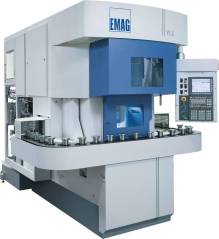
The VL 5i Vertical Turning Machine from EMAG has been designed for the quality- and cost-conscious medium-sized business and the sub-contractor: a production aid that can be used universally and that impresses by its small footprint and its highly advantageous price-performance ratio – including automatic workhandling.
Better component quality at a lower price? VL 5i, a vertical turning machine that is custom-made to fully meet the demands of the small and medium size manufacturing company.
With their VL 5i the machine tool specialists at EMAG have developed a comprehensive solution for small and medium size manufacturing companies. It can be used for small and large batch production, and complete-machines workpieces of up to 250 mm in diameter in a single setup. Flanges, gears, gear shafts and steering pinions can be machined with as much efficiency and to the same quality as brake disks or cams. The machine features a powerful 28 kW workspindle with a top torque of 300 Nm, plus a turret that accommodates turning as well as driven tools and has an impressively short indexing time of 2.2 s.
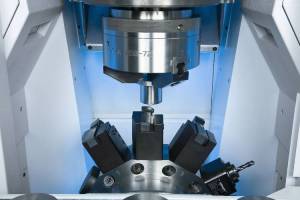
Machining area of the VL 5i: 12 turning or up to 12 driven drilling and milling tools allow you to carry out a great variety of operations in a single set-up.
Drilling and milling operations can be incorporated by equipping some or all of the 12 turret stations with driven tools. The outstanding feature in this is the EMAG turret drive that combines high speeds with outstanding performance and a small space requirement. For instance, the diameter of the turret is only 360 mm but accommodates 12 stations and has a maximum torque rating of 45 Nm.
Flexible automation included
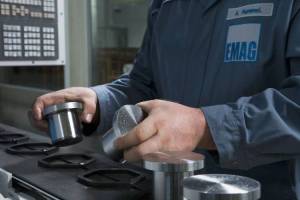
Flexible component loading: workpieces are loaded by inserting them directly into the carrier prisms or, where necessary, into workpiece receptors that can then be inserted into the prisms.

A recirculating conveyor band with carrier prisms that do not need to be reset, takes the components to the pick-up station. As this station lies behind the machining area, the operator is able to remove finished components and insert new raw-parts at the front of the machine.
Proof of the outstanding quality of the VL 5i is, first of all, its integrated automation system. It uses a recirculating chain conveyor equipped with carrier prisms that deliver the raw-parts directly to a pick-up station for machining. This station is located behind the machining area, so the operator can – at any time – insert new raw-parts at the front of the machine. It is hard to imagine a more flexible and, at the same time, more universal solution for the automation of a machine tool.
Short travel times = short idle times
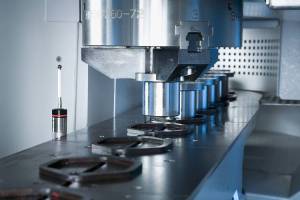
Quickly in and out: the workpieces reach the pick-up station in flexible carrier prisms mounted on the recirculating conveyor belt, with the flexibility of the prisms minimising the resetting effort for different workpiece diameters.
Another advantage of the VL 5i is its short idle times. Changing workpieces is a very fast process, because the distance between the loading position and the machining position is only 550 mm. The importance the EMAG turning specialists attach to the machine’s efficiency can also be seen in the design of the guideways. They are located outside the machining area, where they are protected against chips and dirt. This reduces the maintenance effort and makes the machine less susceptible to breakdowns. The machine can also be equipped with an optional measuring station, located outside the machining area. Here the component is measured on its way from the tooling zone to the unloading station, while still in its original clamping position. The measuring results are not distorted by the entrance of chips, as the vertical turning operation provides for ideal chip flow conditions.
Energy efficiency is very important
The sustainable use of energy and resources completes the picture of an engineering solution that not only offers a small footprint but also eliminates unnecessary design details which is the reason why the machine builders at EMAG can offer this machine at an advantageous price-performance ratio.
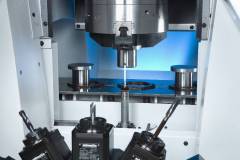
Optional measuring: a measuring probe, located outside the machining area, brings quality assurance to the machine. In automated measuring cycles, carried out between machining process and component removal, the VL 5i logs the offset data and provides a record for quality assurance purposes.
For more information:
EMAG LLC
38800 Grand River Avenue
Farmington Hills, MI 48335
Tel: (248) 875-0313
Fax: (248) 477-7784
E-mail: info@usa.emag.com
Web: www.emag.com
Attention: Peter Loetzner
Continue reading
Award-winning – the VL 2 from EMAG is one of the most energy efficient machines in the world.
According to the “Future Panel” of the IW – the Institut der deutschen Wirtschaft (Institute for German Economic Research) – energy efficiency is becoming increasingly more important in the metalworking industry. The IW suggests that over 60 percent of the companies interviewed for the award are hoping for “a push forward toward innovation”. EMAG is an initiator of such innovations. Its experts develop machine tools and production processes that consume significantly less energy then its competition. In honor of this, EMAG has received the “Energy Efficiency Award” from the ZF Group. This award states that EMAG’s contribution has been honored as one of the top five.
From their efficient manufacturing technology to economical design and construction, the machine builders at EMAG have shown their in-depth know-how and experience in one of the most important fields of industrial development, to compete for the “Energy Efficiency Award” from ZF. The result convinced decision makers at ZF and EMAG’s competition entry called “Energy-efficient Production Machines” has been honored as one of the “Top 5 Projects“. In fact, in this particular sector EMAG was the only machine builder honored. Before the competition as part of its “Year of Energy”, ZF contacted approximately 600 of its suppliers, inviting them to participate in the competition. From 30 eligible entries, the specialists in driveline and chassis technology picked the top five. These five companies were invited to present their particular approach to efficiency on September 13th at ZF, Saarbrücken.
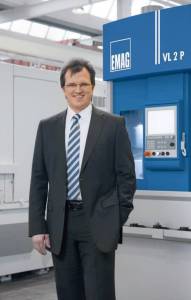
Dr. Guido Hegener, Managing Director EMAG Salach Maschinenfabrik GmbH
EMAG has been focusing on energy efficiency for years
“We are very pleased to have received this award”, declared Dr. Guido Hegener, Managing Director of EMAG Salach, Maschinenfabrik GmbH. “It is an incentive for us to continue on the chosen path. Our focus has been on energy efficiency for years.” During his presentation Dr. Hegener highlighted the various developments at EMAG:
“We have established how much energy each component consumes and where the biggest potential for savings lies”, explained Wolfgang Rummel, Head of Control Technology Development and Design at EMAG Salach Maschinenfabrik GmbH. He also referenced the concrete measures taken: EMAG includes the most efficient components in their standard machine design – for instance hydraulic packs with greater efficiency, low-wattage valves and intelligent auto-standby circuitry.
At the end of his competition presentation Dr. Hegener introduced a new overall objective: the development of the “sustainable factory”. He suggested that in future the production – together with the building in which it is situated and its technological contents – will be evaluated as a single entity. In conclusion, he expresses his belief that the measures taken to reclaim and recycle energy can lead to a potential saving of up to another 40 percent.
 (text translation from above)
SAVINGS POTENTIAL PLATFORM 2
46.9% over existing machines
9.6% – optimization cooling systems
8.0% – hydraulics (e.g. DvP units)
6.9% – drive cooler with through-hole technology (only on Fanuc)
6.6% – reduced air seal, system pressure pneumatics
6.6% – standby circuitry
3.2% – IE2 motors (IE3 option)
1.9% – low-loss gear motors (option)
1.8% – frequency-controlled auxiliary drives (option)
1.7% – timed relief valves, flat-jet nozzles (options)
0.6% – low-wattage valves
53.1% – remaining machine consumption
At EMAG energy efficiency comes as standard.
Energy savings are implemented on the machines with Platform 2, as compared to similar earlier models = 46.9%.
For more information:
Kristal Kilgore
EMAG LLC
38800 Grand River Avenue
Farmington Hills, MI 48335
Tel: (248) 875-0313
Fax: (248) 477-7784
E-mail: kkilgore@emag.com
Web: www.emag.com
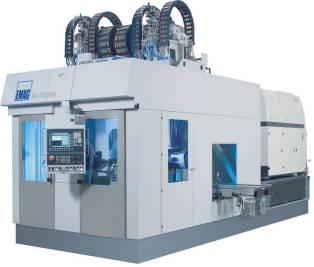
The ELC 250 DUO – a compact laser welding cell for the machining of differential housings. The DUO variant features two spindles. The twin-station operation allows for cycle time-concurrent loading and unloading of the work spindles.
“From Dual-Clutch Transmission to the classic differential: modern transmission technology is a pivotal research sector in the automotive industry. With new materials and altered geometries, designers optimize the functionality of the different gearwheels. Furthermore, these wheels are required in ever larger quantities, owing to the fact that the number of speed-gears in many passenger cars is on the increase. The innovations that promote the effectiveness of the production processes being applied include, for example, laser welding. With their ELC series of machines, the specialists at EMAG have developed integrated solutions for the application of processes with high output rates. The company’s in-depth knowledge of the production processes used for many transmission components has added to its competency in machine development.
(See the video HERE)
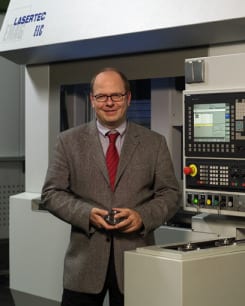
Herr Dr Andreas Mootz is Managing Director of EMAG Automation GmbH, Heubach, and responsible for the development of the production laser welding technology.
A first glance at a typical transmission component makes it plain where the challenges lie: even a small wheel with integrated synchronous gearing represents a relatively complex design. To manufacture it efficiently and at the highest precision calls for the two different parts to be produced separately and subsequently joined in a joining+welding process. It is at this point in modern transmission manufacture that laser welding comes into its own”, explains Dr. Andreas Mootz, Managing Director of EMAG Automation. “The process allows you to concentrate a carefully dosed amount of the energy emitted by the laser beam on the welding point, minimizing possible warping, while still achieving high welding speeds.” Furthermore, the welding process from EMAG uses solid-state lasers of outstanding energy efficiency. Whereas a classic carbon dioxide laser will achieve an efficiency factor of just about eight percent, the EMAG specialists can rely on an efficiency factor of approximately 20 percent with their technology. In other words, the power used to achieve the same optical performance is noticeably less, with energy costs in the production department massively reduced.
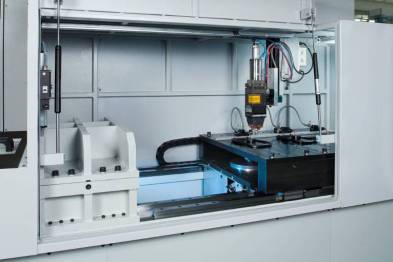
Machining area of the ELC 160 Laser Welding Machine for the welding of gearwheels. On up to three stations, the wheel assembly is pre-heated, joined and laser welded.
Stationary welding device scores heavily
Similarly effective within the total process is the integration of different production sequences on the ELC system. For starters, the work spindle uses the pick-up principle to load itself. The components involved are then clamped and pressed together in the joining press. The clamping technology used ensures the highly accurate positioning of the components, providing ideal conditions for the welding process. The design of the stationary optic ensures great operating safety and optimal stability of both machine and welding process. Depending on the workpiece material, the components can be induction-preheated prior to the welding process and brushed after it – and whatever is required, the process is completed in a single setup. The complete joining+welding process for a gearwheel takes just 12 seconds. This ensures that the components for a differential are thus finish-welded within no more than 40 seconds.

Laser welding the differential housing and the crown gear has meant a weight reduction of 1.2 kg or 2.65 lbs for this assembly.
Laser welding leads to advances in lightweight construction
The differential housing, as an example, clearly shows the possibilities the laser welding technology opens up in the general development of vehicle production. For some time now, automotive companies have been replacing the screw-type connection between differential housing and crown gear with a welded seam. The result: the cost of materials reduces and the weight of the assembly falls by approximately 1.2 kg or about 2.65 lbs. “When looking at the advances made in lightweight construction in the automotive industry, this kind of savings means the world”, explains Dr Mootz.
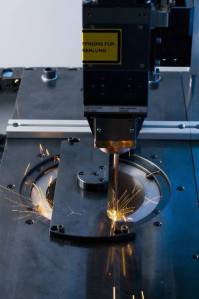
Laser welding a synchronous wheel onto a gear. The new fibre laser on the ELC 160 cuts operating costs in half.
The customer benefits from practical knowledge
Seen in context, the welding specialists from EMAG Automation in Heubach, Germany are able to look back on a truly impressive history of success. Over 50 ELC systems have been sold in the last decade. All leading automobile manufacturers are using them. EMAG is a world leader in solid-state laser systems for the production of transmission and powertrain components. How did this success come about? “It is of decisive importance that we have at our disposal a large reservoir of know-how in the manufacture of these components. We understand the entire manufacturing process, from turning and grinding, and from welding right up to the concluding ultrasound testing process”, emphasizes Dr Mootz. “We can develop and construct the whole of the process chain. This significantly simplifies the planning of new production sites and the expansion of existing ones.“
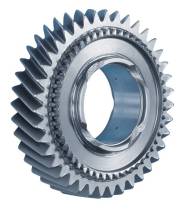
Laser-welded gearwheel
General market development is positive
The general market development does play into the hands of the German machine builder: It is not only the successful dual-clutch transmission that ensures the need for more gears. Conventional transmission systems also tend to have more speed gears, as this reduces gas consumption and improves the driving comfort. “Having said that, we are offering a well proven welding technology that provides an energy-saving, high-precision manufacturing process and, at the same time, helps to advance lightweight construction and reduce production costs. This is no doubt a very successful and persuasive combination”, concludes Dr Mootz.
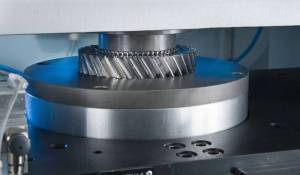
Joining a gear and a synchronous ring on the ELC 160.
For more information:
EMAG LLC
38800 Grand River Avenue
Farmington Hills, MI 48335
Tel: (248) 875-0313
Fax: (248) 477-7784
E-mail: info@usa.emag.com
Web: www.emag.com
Attention: Peter Loetzner
Continue reading