
Contact us today:
(847) 934-4500
tdaro@bernardandcompany.com
Contact us today:
(847) 934-4500
tdaro@bernardandcompany.com
Spokane Industries, a family-owned company established in 1952, is a steel foundry, metal products and precision castings facility of more than 240,000 square feet in Spokane, Washington. Spokane Industries serves customers in many industries from aerospace, construction and agriculture, to transportation, aggregate processing and general manufacturing. Proud to be a family-owned company, many employees here are second and third generation who are personally and professionally committed to their customers. Customers are not just coming to Spokane to buy castings, but they are coming to solve problems. With that in mind, experience, expertise, effort and the latest technology, including MAGMASOFT® process optimization software, are used to differentiate Spokane Industries in the marketplace. Spokane strives to create quality products delivered on time and as a result, their customers’ businesses are more successful and profitable.
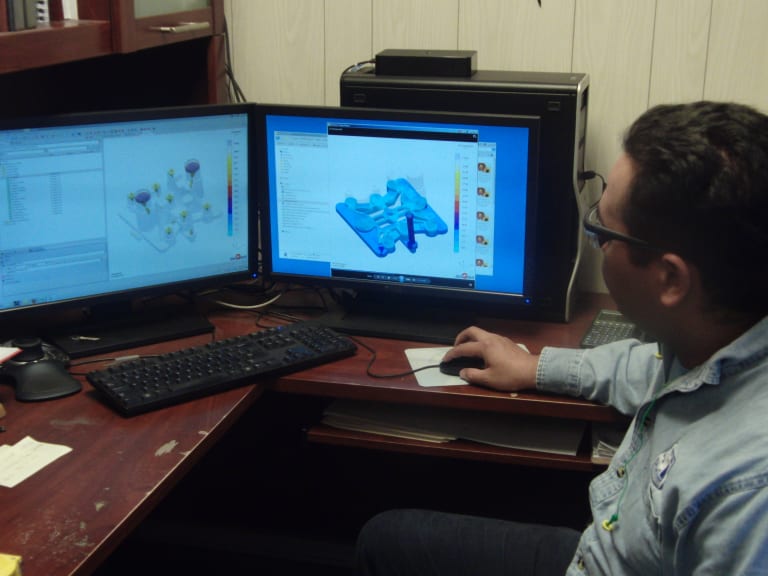
Antonio Melendez works on MAGMASOFT®
The Spokane Steel Foundry Division is the foundation of Spokane Industries and is committed to staying on the cutting edge of technology, upgrading its facility to optimize production and enhancing quality control procedures. Spokane Steel Foundry has been serving commercial and industrial customers around the world for more than 50 years, still maintaining some of their original customers; some are still ordering castings from their original patterns.
Experiencing decades of steady growth, Spokane Industries operates an environmentally clean, well-managed and technologically advanced organization dedicated to meeting the needs of its customers. Today, the foundry’s output includes durable wear parts for impact crushers as well as a wide variety of high specification quality castings for the construction, mining, manufacturing, transportation, aluminum and defense industries, striving to meet the demand with each project.
By introducing MAGMASOFT® at the company, Spokane quickly saw how this software’s capabilities of simulating the entire casting process start to finish, was not only an invaluable engineering tool, but also a tool that impacted the entire business. CFO Ken Vorhees reported, “Having MAGMASOFT® has improved our ability to reduce the number of samples and bring quality products to market faster through meeting specifications, tolerance and metallurgy, most often on the first run.” Foundry Division President, Tyrus Tenold, adds, “This is a very powerful tool, giving us the ability to virtually see the entire casting process before we have invested significant time and materials. We now catch problems before they become problems. By the time we are ready to run the part, we have confidence we will have a quality part on the first run, in most cases.” Using the software to run detailed process optimization for the entire casting process enabled Spokane to catch process issues anywhere in the casting process before the first actual run. The software enables the engineers here to catch potential problems with a casting before the part even hits the foundry floor and resolve them faster than any competitor not using this technology.
Having now utilized its MAGMASOFT® license for 2 years, Spokane has seen a significant change in their entire casting process. Rod Grozdanich, Technical Director, states, “We use the software to help customers refine their designs as well as convert many of their weldments into castings. Being able to simulate the entire process helps a lot, in that regard.” The software being one of the foundry’s business tools has helped them support their selling point that they are more cutting edge and in a leading group of local vendors with the latest technology and equipment.
Antonio Melendez, Design Engineer, points out, “By having MAGMASOFT®, we find that our customers expect more of us. We are confident that we can deliver and have always lived up to and exceeded the challenges our customers have given us.” He adds, “It has become common that when we go back to a customer with a design change that effects them, costs them more money, like adding a riser, they want to know why. MAGMASOFT® gives us that credibility and additional technical support for our case.”
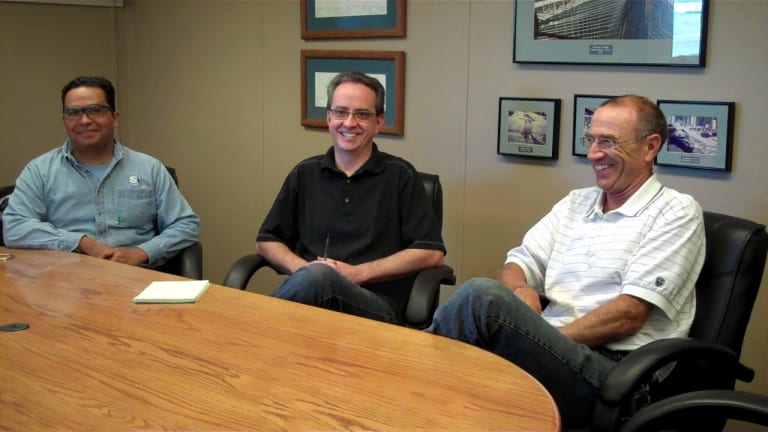
Spokane employees discussing MAGMASOFT’s benefits – Antonio Melendez, Design Engineer, David Jolin, Quality Assurance Manager, Rod Grozdanich, Technical Director
David Jolin, Quality Assurance Manager, says, “We do see both current customers and potential customers requiring that we run the casting through a solidification program. There have been times where we have been directly told that in order to be awarded a particular job, we need to show them simulation capability. We are seeing this as a requirement, more often nowadays.”
A big part of justifying the cost of the software was being able to go back and simulate past projects to make designs changes and improve the quality of the castings for future runs. Grozdanich says, “We found many jobs that we set up with our previous simulation software where we really couldn’t see the shrink, and now with MAGMASOFT®, we can see what’s happening and we can fix it. We had chronic instances with issues on jobs in the past that we just could not solve and with MAGMASOFT® we have been able to go in and fix them all.”
Simulating the entire process from design to finished part helps save time and money by creating all the changes and making all the mistakes virtually rather than during actual production. Melendez states, “We are trying to minimize the number of samples before releasing a casting for production. The idea is to do all the tweaking on the computer without spending money to pour multiple samples. This year, we have significantly reduced the number of samples and are more likely to produce a quality part on the first run.”
In addition to the ability to simulate the entire casting process, Spokane has found a solid partner in MAGMASOFT® by taking advantage of the resources extended to them as a user. “The user group meeting every year is a very good tool to keep us informed of new developments and get everyone up to speed on anything we feel we would like to improve upon. Peer-to-peer discussions on how we each utilize the software are invaluable,” Melendez says.
Of the four capabilities that make up Spokane’s license with MAGMASOFT®, namely filling simulation, solidification simulation, heat treatment and stress analysis, Spokane utilizes all these processes to the fullest extent, including macro segregation simulation. Grozdanich points out, “In the last 10 months, on the dozen or so new projects we have put out, all but one or two were quality parts on the first run. Our time to first quality part has therefore been greatly reduced.” Jolin adds, “Being able to simulate the entire casting process has significantly fixed our shrink issue, which was quite a struggle from my end before MAGMASOFT®.” Melendez offers, “One of the main advantages of the software is one can see roadblocks before they actually happen and can compensate for them, specifically with predicting the distortion of the casting and other issues that might arise before we actually build it.”
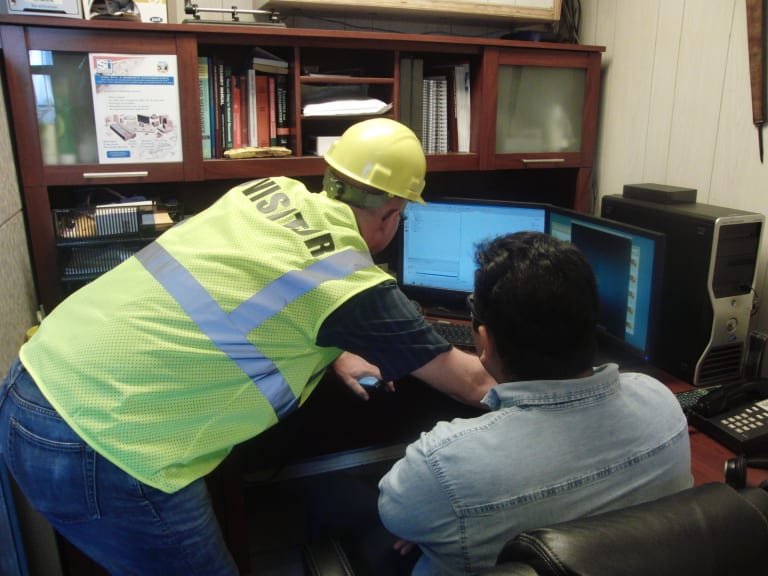
Søren Anderson of MAGMA shows Antonio Melendez, Design Engineer at Spokane, some MAGMASOFT upgrades
In addition, the software helps gain understanding and provides clues to what can be happening when issues arise that initially don’t make sense. It’s proving to be a reliable troubleshooting tool by helping to gain clarity where there are issues that arise that are initially not understood. MAGMASOFT® is the missing link that helps lead to that solution, according to Spokane engineers. Antonio Melendez observes, “The software verifies what is going on, gives clarity and enables us to pass on not only an opinion, but provides credibility to support our opinion to our customer. The software is able to set particular processing parameters. For example, when pouring through a sleeve with a filter, there were scrap issues with the filters breaking. After doing some simulations and flows through that method, we could see that, for one ladle, we needed to use an inch and a half diameter nozzle, that way the flow is just right for this particular set up.”
Melendez adds, “Each casting is different, the number of iterations are different. It is more a question of how tough is the part. For example, if you have a part with isolated hot spots and you don’t have clear filling patterns, you are going to struggle. The advantage with MAGMASOFT® is you can see those trouble spots and focus on resolving the issues before creating the first sample. Even if you need to do 200 iterations in the right direction, that’s okay, because we are no longer shooting in the dark.”
At this foundry, it’s clear that their use of process optimization software is yielding benefits across the entire business environment, from design through material use, production through part validation and in differentiating Spokane Industries from its competition in the marketplace. The result is more work being processed more efficiently, with the plant’s capacity utilization being much higher and more profitable, according to Spokane personnel.
For more information on this story, please contact:
Christof Heisser
President
MAGMA Foundry Technologies, Inc.
10 N. Martingale Road, Suite 425
Schaumburg, IL 60173
Phone: 847-969-1001 ext. 225
Email: cheisser@magmasoft.com
Web: www.magmasoft.com
An announcement from Bill Hunter, CEO of Hunter Automated Machinery Corporation, the world leader in automated matchplate molding machines, mold and sand handling equipment for the foundry market, Jim Fitzgerald will assume the newly created position of Chief Operating Officer, effective Friday – February 1, 2013.

Jim Fitzgerald will assume the position of Chief Operating Officer
Jim began his career as a machine assembler for Hunter in 1977, shortly after his graduation from Central College in Pella, Iowa. For the past 35 years, he has been dedicated to shop operations and manufacturing management at Hunter. He was promoted to his current position as Vice President at the company, following Art Hisel’s retirement in 1992.
Jim’s responsibilities as COO will include all Schaumburg, IL-based activities, with the exception of Sales and Marketing. His goals will include maintaining and building upon the company’s reputation for producing the world’s highest-quality foundry machinery and for providing superior after-sale support.
“Jim brings the education, proven ability and determination to help Hunter achieve these goals. His leadership and commitment to our company is unquestionable and exemplary,” said Bill Hunter in making this announcement.
For more information on this news, please contact:
HUNTER AUTOMATED MACHINERY CORPORATION
2222 Hammond Drive
Schaumburg, Illinois 60196-1094
USA
Phone: 847-397-5136
Email: sales@hunterauto.com
Servo-electric pump drive optimizes hydraulic presses — from a technical and energy efficiency perspective
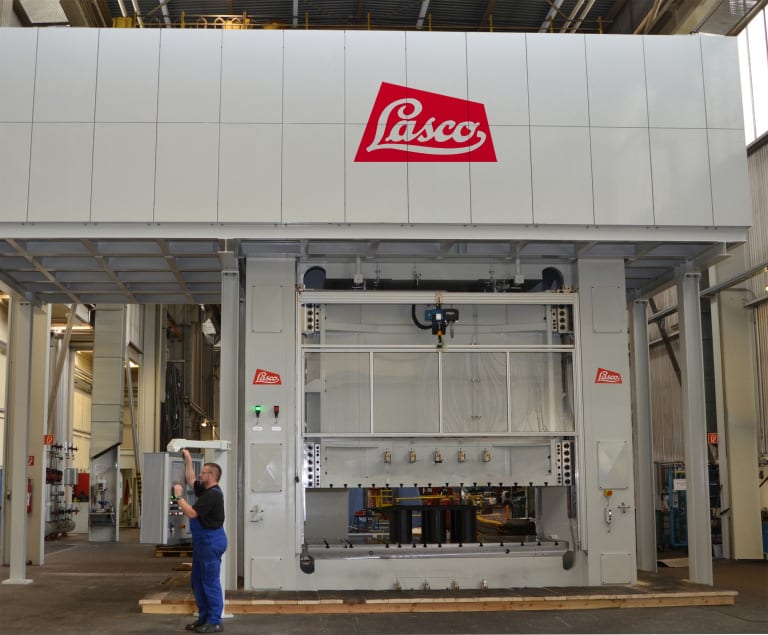
The servo-electric pump control for presses, developed by Lasco Umformtechnik GmbH in Coburg, uses far less energy than conventional valve control systems, often well into the double-digit range, according to this press builder.
A hydraulic pump directly coupled with a servomotor is an energy-efficient solution that delivers a highly dynamic performance with double-digit energy savings typical. The press manufacturer Lasco uses this servo-electric pump drive for solid and sheet metal forming presses. “This drive system provides us many performance advantages,” says Harald Barnickel, Head of the Electrical Engineering Department at Lasco Umformtechnik GmbH.
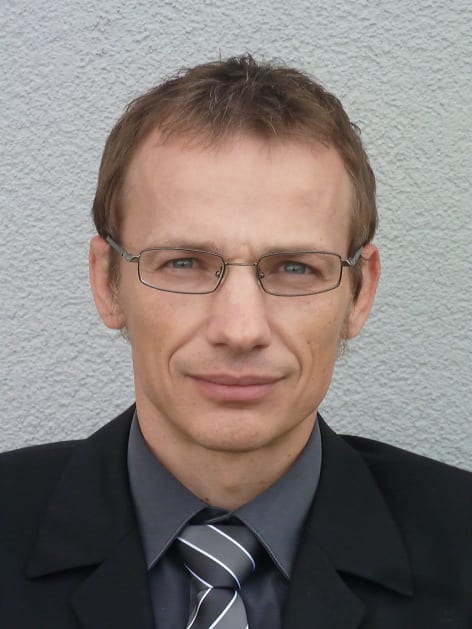
Harald Barnickel, Head of the Electrical Engineering Department at Lasco Umformtechnik:
“The innovative servo technology that we have developed for hydraulic presses was previously not available on the market.”
“Our new servo technology provides substantial energy savings for companies operating our presses,” says Harald Barnickel, Head of the Electrical Engineering Department at Lasco Umformtechnik GmbH, a machine tool builder in Coburg, Germany, in describing the significant advantages of this innovative forming press technology. This well-known manufacturer of systems for solid forming and sheet metal forming produces screw presses, forging hammers, forging and cross wedge rolls, and even complete plants that are used by the building materials industry to produce sand-lime products. When Lasco was first founded in 1863, the main focus was on the iron foundry. However, just a few years later, it began producing water turbines, followed by forging machines in 1880. Since then, the company has concentrated on producing machines for forming technology, and has been active worldwide for many years. “As a solution provider, we develop customized systems for optimized workpiece transport within the press as well as for feeding and removing workpieces,” Barnickel reports. The company has a strong focus on continuous improvement in its processes and technology. And the servo technology mentioned above is exactly this kind of technological milestone, as demonstrated through Lasco’s implementation in a recently delivered deep drawing press with a press force of 800 tons for up to 40 strokes per minute.
A fast controller at the core
At the core of this type of solution is a Simotics 1PH8 servomotor from Siemens, which directly drives the hydraulic pump. This drive is controlled by the Sinamics S120 drive platform. A Simotion D445 motion control system handles the complete path, velocity and position control of the axes —
the Simotion controller and Sinamics drive are both from the same manufacturer. With a response time of 250 µs, up to 256 axes can be rapidly synchronized and precise axis motion and curve profiles are executed. “The initial applications have demonstrated that this type of servo technology provides outstanding results,” says Barnickel. This applies to the closed-loop control performance as well as to its energy efficiency and the application as a whole.
The challenge on the deep drawing press was to control the press force and press speed, based on a motion profile that could be set individually. The hydraulic force and thus the press force can be adjusted at the servomotor by means of the torque. The plunger speed is controlled by the motor speed and thus by the volumetric flow rate of the pump. For the project described, axial reciprocating pumps with a fixed displacement per revolution were used.
Scalability of the pump systems is a significant advantage
Four such pump systems connected simultaneously for a maximum pressure of 250 bar supply the pressure line for the press stroke of the plunger; three additional pump systems are responsible for the return stroke of the press plunger. “The possibility of scaling, in other words adapting this kind of standard servo solution to the actual requirements, is another advantage of this new technology that certainly cannot be underestimated,” notes Barnickel.
The hydraulic oil tank of the deep drawing press holds about 2377 gallons (9,000 liters). Because of the high flow rate of 16,000 l/min, filling valves are used for the fast downward motion of the plunger. The servo pumps provide the required flow rate for the actual pressing operation, with a speed of up to 100 mm/s. In the past, high-precision control valves with zero overlap were necessary to obtain the precise traversing profiles. Today, this function is handled by the motion control system, in conjunction with the servo pumps. Thanks to this new technology, the valve systems in the press can be reduced by up to 40 percent. The remaining valve technology is mainly needed to comply with machine safety specifications.
Energy milestone
As a result of the new technology, expensive, traditional valve systems were eliminated, and energy efficiency has been significantly improved. Electrical expert Barnickel knows this only too well. “In the past, the large cooling systems for the hydraulic oil had to be installed before the first test run at Lasco. But now, with servo technology, significantly smaller units can be used, and they are not required until the press is actually operational at the customer’s facility.” One reason for this is that the oil is no longer forced through the narrow gaps at the control edges of the control valves, which means that these types of technology-related losses no longer occur in the first place. The press manufacturer is seeing efficiency improvements well into the double-digit range depending on the application, significantly reducing users’ electricity costs, compared to older machines.
When comparing the new technology with very basic hydraulic presses using conventional technology, the amount of energy saved is certainly less than with presses equipped with complex control systems. The energy-saving effect is especially apparent during the drawing operation, during which the drawing pressure is provided by a pump equipped with a servomotor, with the motor of the die cushion pump thereby operating as a generator.
Another advantage of the electrical system used here is that energy can actually be recovered when the hydraulic fluid decompresses. This happens when the system is decompressed after the pressing operation and the main cylinder pressure must be reduced from 250 bar down to approximately 10 bar before the filling valve to the tank can be released. This operation takes approximately 100 ms. In the case of a compressibility of the hydraulic oil used of approximately 2.5 percent by volume, with a cylinder volume of approximately 800 liters of oil, the “spring energy” in the oil flows through the axial reciprocating pump and drives the servomotor. This effect is amplified when the press mechanical system is relieved. In this so-called generator or regenerative operation, the corresponding electrical energy is fed into the DC link of the S120 drive during each cycle. “However, in addition to the energy recovered, the other advantage is that there are no additional power losses in the form of heat, as would be the case with conventional concepts,” Barnickel explains.
Straightforward optimization — and everything immediately documented
Although the Siemens Simotion controller has been specifically optimized to address motion control applications, Simotion can also control the complete system. However, Lasco’s philosophy is to separate the various press tasks, and it therefore uses a separate PLC for the system control. As a fail-safe control, this also addresses the safety technology requirements. Simotion can be programmed in various ways, for instance, with high-level-language, graphic programming, or Motion Control Chart (MCC) as well as a classic logic control. The trace function with eight-channel plotter supports commissioning engineers and ensures detailed documentation of the press operation. Control parameters are saved in the drive, which guarantees seamless documentation of the drive system.
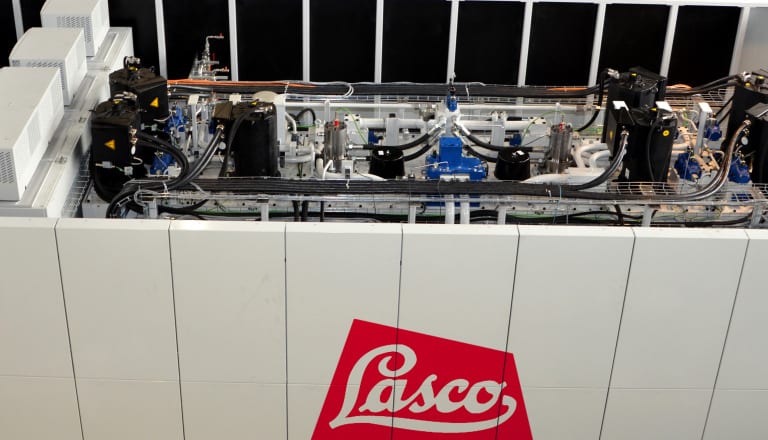
The drive unit for the pump control consists of Simotics servomotors, Sinamics S120 drives and Simotion D445 motion control devices from Siemens.
Safety technology simply integrated
In addition, the fail-safe Simatic S7-319 F 3PN/DP PLC from Siemens, used here as the press system control, allows all safety technology to be implemented without any major additional expense. The fail-safe signals are read via distributed Simatic ET200S I/O stations from the same manufacturer and transferred to the control via Profisafe. This represents a simple yet complete solution for Lasco press engineer Harald Barnickel, who notes, “As a consequence, we obtain a clear machine structure.”
For instance, there are generally two monitored valves, which monitor the reduced traversing speed of the plunger, when setting up. The new solution is far more precise, where the fail-safe S120 drive also monitors the reduced speed (Safely Limited Speed: SLS) as well as a safe stop (Safe Stop 1: SS1).
Simple parameterization through a seamless, integrated system
The press experts at Lasco also view the integrated, seamless nature of the Siemens systems as an additional benefit. For example, the drive automatically identifies the servomotor and reads its parameters. Another interesting feature of this servo solution is that the 1PH8 motors are available either as synchronous or asynchronous motors. The application itself, or more specifically, the dynamic performance required, is the decisive element in selecting the appropriate motor type, according to Barnickel.
Both versions have the same mechanical mounting dimensions, the same wiring and the same encoder connection. Here, too, this state-of-the-art technology has some significant advantages. For instance, instead of a typical 17-core cable, a single cable with RJ45 connector is sufficient.
And finally, this new drive concept for hydraulic presses, based on a servo-electric pump control, results in a significant overall improvement: “In addition to the energy savings, its extremely precise controllability is far superior to that of a classic valve control,” says Harald Barnickel. As he further noted, any defined motion profiles can be precisely implemented using this concept.
The motion control system has also proven itself to be extremely valuable in certain steps of the pressing process. For instance, if the plunger moves to upper dead center, then the closed-loop position control in Simotion ensures that any leakages are compensated. “A far higher precision is achieved when using servo technology than when using pure valve technology,” Barnickel summarizes.
Servo technology ensures dynamic performance of the press
The development of new servo technology for large hydraulic presses, based on the Simotion motion control system from Siemens, has already awakened significant interest among customers of Lasco Umformtechnik GmbH. However, it is not only when building new machines that this dynamic company of 400 employees benefits from lower costs and improved quality; the drive concept described is also suitable for modernization and retrofit projects.
With the standard concept, comprising the Simotics 1PH8 servomotor, the Sinamics S120 drive platform and the motion control unit, Lasco Umformtechnik GmbH has clearly demonstrated that, when hydraulic presses are equipped with servo-electric pump drives instead of pure valve technology, the dynamic performance, precision and especially energy consumption on the press are improved. This results in tangible press improvements that are decisive in the marketplace. For Barnickel, it’s clear: “Anyone who addresses the challenges of press technology with E-motion (energy in motion) is creating innovation.”
For more information on this story, please contact:
Siemens Industry, Inc.
Drive Technologies — Motion Control Business
5300 Triangle Parkway, Suite 100
Norcross, GA 30092
Phone: 847-640-1595
Fax: 847-437-0784
Web: www.usa.siemens.com/motioncontrol
Email: SiemensMTBUMarCom.industry@siemens.com
Attention: John Meyer, Manager, Marketing Communications
 A name you may not yet know, but NOARK Electric provides reliable products and efficient solutions to intelligent power and energy systems worldwide. This global supplier of electrical components and intelligent control systems recently presented an assortment of UL 489 Listed circuit breakers, relays and contactors at the AHR Expo in Dallas. This show represented the company’s first trade show in the North American market. According to Tony Diaz, North American Product Marketing Manager, the company secured solid leads from numerous distributors, rep agencies, OEMs and panel builders of electrical systems.
The NOARK value proposition centers on products that improve the profitability and maintain the highest levels of performance for customer end products, through the combination of local support with local inventory, exceptional value and superior product quality, backed by the industry’s first 5-YEAR WARRANTY.
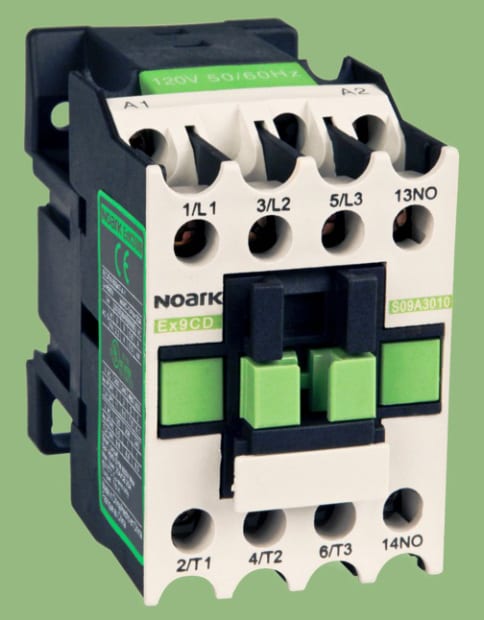 Among the many offerings now available in the North American market are the following NOARK products:
ALL ABOVE NOARK PRODUCTS ARE UL489 LISTED.
 Key personnel for Noark in North America include Paul Xu, VP of Strategy & Marketing, Ken Hilborn, Sales & Marketing Director, Tony Diaz, Product Marketing Manager and Kirk Wilson, West Region Manager.
NOARK Electric, Inc., the North American headquarters of the company, was previously located in Rockford, IL and, due to its rapid growth and inventory commitments, has recently moved to a larger facility in Oak Creek, WI, just south of Milwaukee.
The company is currently in the process of establishing a representative and distribution network to serve its primary markets, which include the building trades and electric panel board builders in various industries.
A global supplier, NOARK currently operates four R&D centers, three distribution centers, 15 office locations and employs over 1000 associates. Sales for the company exceed $2 billion worldwide.
For more information, please contact:
NOARK Electric, Inc.
9817 South 13th Street
Oak Creek, WI 53154
Phone: 414-304-8189
Website: www.noark-electric.com
Email: tony.diaz@noark-electric.com
Attention: Tony Diaz
Highlights include two-sided machining and servo drive technology
Recently, Northern Italian machine tool manufacturer Biglia introduced its multi-functional turning centers of the ‘Quattro’ series with the Sinumerik 840D sl CNC. The mechanical concept, together with the scalable control, provides users with the most diverse standard turning and milling operations. The result is increased flexibility and higher speeds for end users. That quality machine tools are built in Northern Italy is nothing new. And this fact is confirmed again by the “Quattro” series from the machine tool manufacturer Biglia. These machines are multifunctional turning centers that are valued throughout Europe for their high reliability and performance power. The machines are available in different versions from 11 to 15 CNC axes. They are also intended for different turning diameters (45, 52, 65, 71 and 80 mm).

Biglia has equipped its turning centers of the ‘Quattro’ series with the Sinumerik 840D sl CNC control. The individual machines have 11 to 15 NC axes.
The two opposing spindles form a special feature of the “Quattro” series. This allows the workpiece to be machined from two sides, which reduces the machining time. The second spindle can also be moved linearly in two directions (lengthwise and crosswise). This provides some leeway in the case of additional milling operations, but it can also be used for automatic workpiece unloading. Two turrets, mounted on the y-axis, ensure proper positioning of the necessary tools.

The turning centers from Biglia have two spindles and two independent tool turrets for simultaneous machining.
This innovative machining technology allows the creation of not only rotary but also prismatic workpieces – including polygons. Dealing with everything in one setup not only reduces cycle times, it also enhances accuracy. The machines are developed on the basis of a modular concept that ensures flexible application options – from the universal CNC lathe, to complete machining of complex workpieces with powered tools (c- and y-axis).
Getting it right, from the start
By offering the Siemens Sinumerik 840D sl CNC control, Biglia now wants to expand its previous options and its own market by combining its technologies with that of the Siemens control. “In this project, which is of personal significance to all of us who worked on it and of strategic significance for Biglia, we wanted to do everything perfect right from the start and to get the most out of it,” says Giovanni Delmondo, Business Development Manager for machine tools with Siemens Italy. The result is an all-round successful machine series with a highly modern control that already includes the innovative system expansions of recent months – including increased energy efficiency options offered by the control and drive systems from Siemens.
To illustrate this, Giovanni Delmondo points out that “the fans on the spindles are shut down automatically when they are not required, or certain services such as hydraulics, lubricant supply, or compressed air are deactivated during machine standstill times. This is handled via special screen forms on the control and is extremely simple, using the Run MyScreens function.”
Also notable is the standard energy efficiency solution from Siemens in the Sinamics S120 drives onboard this machine series. This includes automatic power factor correction or regenerative feedback of the energy generated in braking operations, a substantial factor in energy savings.
Performance and scalability
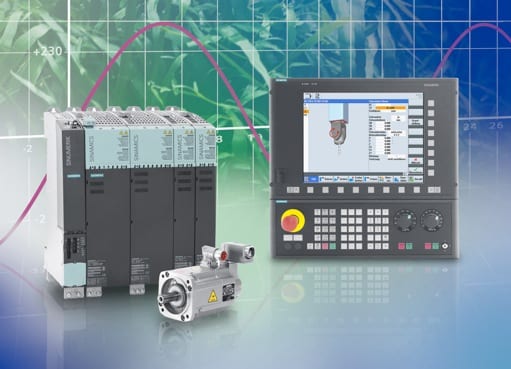
The Sinumerik 840D sl control is based upon the Sinamics S120 drives platform.
The centerpiece of the automation concept of these Biglia turning centers is the Sinumerik 840D sl control. This is a universal and flexible CNC system, implemented in the Sinamics S120 design (see Fig. 3). It is suitable for up to 31 NC axes. Whether you are turning, drilling, milling, grinding, laser-machining, nibbling or punching, the Sinumerik 840D sl is suitable for use in the most diverse machining technologies. The CNC control also has PLC (programmable logic controller) functionalities, so that a special PLC can be eliminated, if applicable.
This high-end control from Siemens is ideally suited to medium and complex tasks and production and can be adapted to the task, thanks to scalable hardware. The CNC is also characterized by openness, so the operator interface and also the software present few limits to specific job adaptability. This applies all the way to supplementing the NC core of the control; however, a special license is required for this adaptation.
On the Biglia turning centers, the control was equipped with the Sinumerik Operate user interface, making operation simple and intuitive. Three different methods of parts programming are possible: Classic ISO code programming, programming with the help of the integrated ProgramGuide with graphical support of the selected cycles, and the new two-channel ShopTurn with graphical 3D simulation. The user is led step-by-step through the cycles, whether for simple metal removal, drilling, thread cutting, pocket milling, groove milling or engraving. Complex programming cycles for complex contours are also possible. The “ProgramSync” function for automatic synchronization of the machining programs via two channels ensures a significant increase in machine productivity. The control is equipped with a 15″ monitor and integral keyboard.
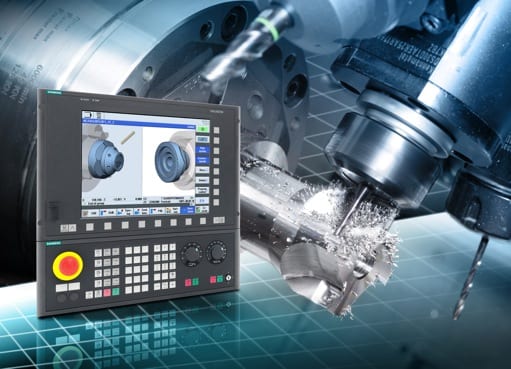
Siemens CNC in metalcutting applications.
The Quattro series from Biglia also uses the highly effective personnel and machine protection system provided by the Sinumerik control concept with the Sinumerik Safety Integrated package.
Biglia is also breaking new ground with servo drives. Thus, the new servo motor generation 1PH8 from Siemens is used for the main spindle motors in this series. The linear axes are further equipped with the new 1FK 7 G2 series of permanent-magnet synchronous motors. These motor types from Siemens enable onsite replacement of the encoders without having to dismantle the complete motor. This combination of machine and CNC control in the Quattro turning centers from Biglia provides users with greater flexibility.
For more information about Siemens CNC solutions for the machine tool industry, visit our website: www.usa.siemens.com/cnc.
For more information on the this story, contact:
SIEMENS INDUSTRY, INC.
DRIVE TECHNOLOGIES
MOTION CONTROL
MACHINE TOOL BUSINESS
390 Kent Avenue
Elk Grove Village, IL 60007
Phone: 847-640-1595
Fax: 847-437-0784
Web: www.usa.siemens.com/cnc
Email: SiemensMTBUMarCom.sea@siemens.com
Attention: John Meyer, Manager, Marketing Communication
Follow us on Facebook: www.facebook.com/SiemensSiemensCNC or Twitter: www.twitter.com/siemens_cnc_us.
—
Siemens Industry Sector is the world’s leading supplier of innovative and environmentally friendly products, solutions and services for industrial customers. With end-to-end automation technology and industrial software, solid vertical-market expertise, and technology-based services, the sector enhances its customers’ productivity, efficiency and flexibility. With a global workforce of more than 100,000 employees, the Industry Sector comprises the Industry Automation, Drive Technologies and Customer Services Divisions as well as the Metals Technologies Business Unit.
The Siemens Drive Technologies Division is the world’s leading supplier of products, systems, applications, solutions and services for the entire drive train, with electrical and mechanical components. Drive Technologies serves all vertical markets in the production and process industries as well as the infrastructure/energy segment. With its products and solutions, the division enables its customers to achieve productivity, energy efficiency and reliability.
Continue reading
Heimatec is a world leader in the development and manufacturing of live tools, angle heads and multi-spindle drill heads. With U.S. head quarters located in the Chicagoland area and company head quarters and manufacturing in Renchen Germany, we are dedicated to supplying our customers the most innovative tooling technology possible.
Check out the new look at www.heimatecinc.com!
For more info on Heimatec:
Preben Hansen, President
HEIMATEC INC.
16 E. Piper Lane Suite 129
Prospect Heights, IL 60070
Phone: 847-749-0633
Fax: 847-749-2445
Email: info@heimatecinc.com
Website: www.heimatecinc.com
Connect with Heimatec Inc: 


—
Heimatec is an international tooling manufacturer, based in Renchen, Germany. Its experienced staff is dedicated to providing customers the most innovative tooling technology possible. In 2010, the company opened Heimatec Inc. in Prospect Heights, IL, near Chicago, to serve its growing North American customer base with sales and service, plus an extensive inventory of products. Heimatec serves the auto, aero, medical, off-highway, rail, energy, woodworking, composites and other industries, as well as an ever-increasing number of machine tool OEM’s worldwide.
Continue readingSaws built for low vibration work best
by Willy Goellner, CEO, Advanced Machine & Engineering, Rockford, IL
Carbide saws equipped with carbide or coated cermet-tipped blades are designed to cut extremely hard materials. How effective the blade is depends in large part on how the saw is built.

Fig. 2 Close loop force distribution on pivot saw
The relatively brittle carbide or cermet tips require very rigid and backlash free machines, operating with low vibration to avoid cracking of the cutting tips and ensure an equal chip load on each tooth of the saw blade. This is especially important with the spindle drive. The spindle drive gears must have low backlash and must be supported by preloaded, heavy-duty bearings to minimize vibration. The same is true with the blade feed mechanism and the head slide or pivot mechanism.
Generally, there are two types of saws, differentiating in the way the blade is fed into the work piece: slide-type or pivot-type saws. The more common saws are slide-type machines, where the head slide could be arranged in a vertical, horizontal or angular position. The preloaded slide could glide on box ways or preloaded linear ways. Experts still argue whether box ways using low friction lining and hydraulically preloaded way clamps have a better dampening effect than linear ways with hardened balls, rollers and blocks.
Pivot-type saws are simpler, have fewer components and, if properly designed with oversized taper roller bearings, can be made very rigid by preloading the pivot bearings to the limits. Built for extreme stiffness, a pivot mechanism for the spindle gear box would be nested in a rigid base close to the floor, fed by a heavy duty ball screw attached to an upper sub-assembly, such as the fixture frame, and having the spindle located between the pivot point and the feed mechanism. Due to the feed force and the center of gravity of the head, the ball screw is always under tension, which eliminates the need for a preloaded ball screw and provides a very positive feed for interrupted cutting, enhanced longevity and efficiency.
This arrangement provides a closed loop force distribution since closed frames are stiffer than open profiles. It also subsequently reduces the remaining deflection of the feed mechanism due to the ratio of ball screw and spindle in relation to the pivot point and contains the cutting forces within the machine structure.

Fig. 1 Open loop force distribution on horizontal slide saw
Compared to a standard slide machine (Fig. 1), a pivot machine would be stiffer and less expensive. Pivot saws are built to saw material up to 24” (600 mm) stock size and have proven themselves in various standard and special saw systems.
Circular carbide tipped blades are limited to a maximum of 80 inch blade diameter and can therefore only cut up to about 30 inch diameter material. However, the cutting volume per minute is much higher with circular carbide saws, compared to carbide tipped band saws. In this range up to 30 inch material, carbide saws using circular blades really shine.
For more information, visit www.ame.com or contact:
Tim Waterman
ADVANCED MACHINE & ENGINEERING CO.
2500 Latham St.
Rockford, IL 61103
Phone: 815-316-5277
Fax: 815-962-6483
E-mail: info@ame.com
Connect with AME online: 
Cost-efficiency and flexibility in one complete panel
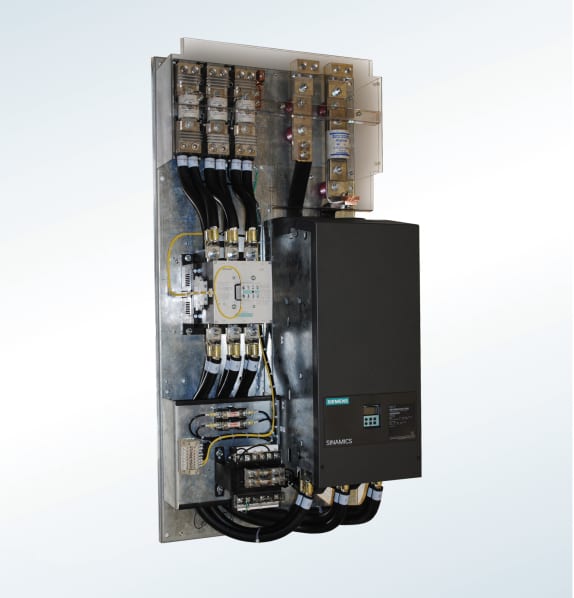 Siemens Industry, Inc. introduced today its new Sinamics DC Master (DCM) Base Drive as a result of increasing demand for base drive panels using the Sinamics DC Master converter.
This pre-wired solution is offered complete and fully tested with all necessary components mounted onto a back panel. Sinamics DC Master Base Drives are an extremely flexible and cost-effective solution for new installations and retrofits where space is limited. They are ideal for end-users and third-parties such as system integrators and Siemens solution partners.
Sinamics DC Master Base Drives offer more power per panel in the same footprint as compared to the previous two generations of base drives. These base drives are rated from 15A–850A continuous current.
Standard features of the new SINAMICS DCM Base Drive include — input fuses, output DC fuses (regen only), control transformer, AC line contactors, PROFIBUS, BOP20, UL508A Certification and 65KA SCCR rating. They are ready-to-order with deliveries available after February 2012.
For more information about the Sinamics DC Master Base Drive, visit our web page www.usa.siemens.com/motioncontrol.
Please forward all inquiries to:
Siemens Industry, Inc.
Motion Control Business
390 Kent Avenue
Elk Grove Village, IL 60007
Attn: Marketing Communications
For specific product information and inquiries, call (800) 879-8079 ext. Marketing Communications or send an e-mail to: SiemensMTBUMarCom.industry@siemens.com.
Continue reading
The ideal and efficient solution for closed-loop temperature control
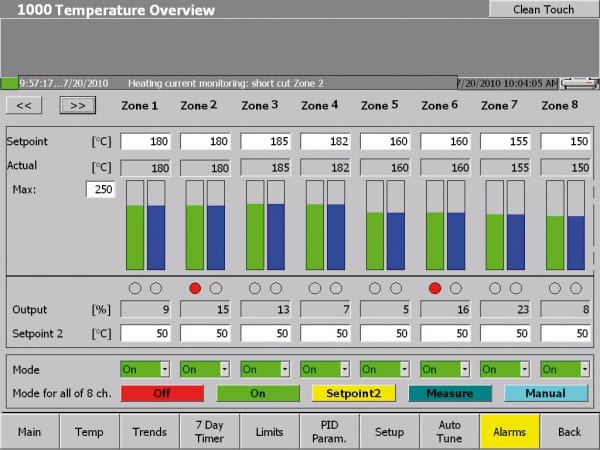
The improved TCP3000 temperature controller from Siemens is a scalable, pre-engineered solution to make plastics extruder machines more simple and economic
ATLANTA — Siemens Industry, Inc. unveiled today its improved TCP3000 temperature controller for plastics machines making extruders more simple and economic.
This pre-configured solution allows OEMs to save time and expense when equipping their machines; provides users with the highest degree of flexibility, scalability and performance; and offers simple and clear operator screens for temperature zone monitoring and control.
The TCP3000 can be operated using the new Simatic Multi-Panels including the 10-inch MP 277 and the 12-, 15- or 19-inch MP 377. It is supported by standard Simatic PLC software from Siemens, which requires no special high-level programming expertise.
Machine operators, technicians and maintenance engineers have a wide range of screens
at their disposal for easy and convenient operation and service. These include:
For more information about our solutions for extrusion, visit our website: www.usa.siemens.com/plastics.
For specific product information and inquiries, call (800) 879-8079 ext. Marketing Communications or send an e-mail to: SiemensMTBUMarCom.industry@siemens.com.
Continue reading No. 987 is an 850ºF electric cabinet oven from Grieve, currently used for baking various paint samples at the customer’s facility. Workspace dimensions of this oven measure 20” W x 20” D x 20” H. 10 KW are installed in Incoloy-sheathed tubular elements to heat the oven chamber, while a 600 CFM, 1/2-HP recirculating blower provides horizontal airflow to the workload.
This Grieve cabinet oven features 4” insulated walls, aluminized steel exterior, Type 304, 2B stainless steel interior, a silhouette plate with removable cover inside the door opening and an oven hearth driven by a ¼-HP motor through a gear reducer with a torque limiting device variable from 1 to 27 RPM. This 19” diameter oven hearth is constructed from Type 304 stainless steel with 1” studs on 1” centers to support the paint coupons in process.
All safety equipment required for handling flammable solvents are onboard No. 987, including explosion-venting door hardware.
Controls onboard No. 987 include a digital indicating, time proportioning temperature controller and excess temperature controller with separate heating element control contactors. An auto door switch stops hearth movement when the oven door is opened.
For more information, please contact:
THE GRIEVE CORPORATION
500 Hart Road
Round Lake, Illinois 60073-2835
Phone: (847) 546-8225
Fax: (847) 546-9210
Web: www.grievecorp.com
Email: sales@grievecorp.com
Attention: Frank Calabrese