
Contact us today:
(847) 934-4500
tdaro@bernardandcompany.com
Contact us today:
(847) 934-4500
tdaro@bernardandcompany.com
Operations for the prep on tubings and pipes generally require multiple manufacturing steps such as cutting, chamfering, face-off, turning and tapping including thread milling or thread forming.
Higher part quantities usually combined with the need for different manufacturing steps demand efficient and time saving production methods to help reduce time and cost. Special purpose machines such as rotary & linear transfer machines, offer the best solutions to help obtain shorter overall part cycle times.
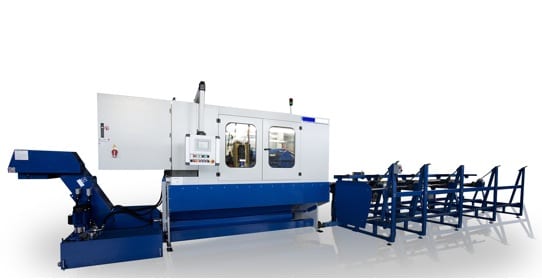
The machining of tubings begins from bar stock length
The transfer machine performs OD and ID turning incl. chamfering oerations followed by thread rolling.
An extensive background of experience with operations on transfer machines allows SUHNER to optimize a manufacturing process with standard or custom solutions for each machining application. One specific application is for large & long OD threads. These operations are extremely difficult and challenging for manufacturers, when trying to obtain shorter cycle times, simply because an OD threading operation by itself will dictate the overall machine cycle time.
SUHNER, in cooperation with WAGNER, a German manufacturer for OD thread rolling heads, has developed a special process, which allows threading operations in very short cycle times. A pneumatic cylinder-activated system is used to open and close the thread rolling head, which is equipped with multiple thread cutting or forming inserts.
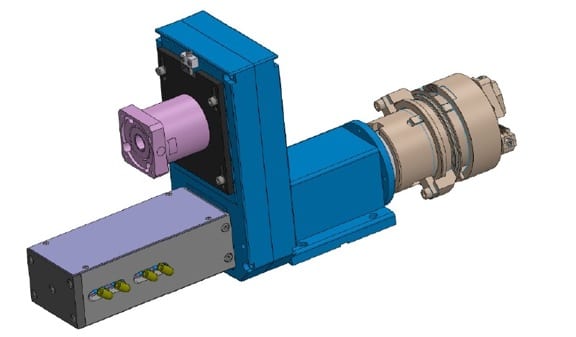
Special unit BEX35 ISO40 equipped with WAGNER Z27-2 thread rolling head allows optimized OD thread rolling operations and shortened machine cyle times
The work piece is fed from bar stock material. After a cut to length operation, it is machined by (3) Suhner BEX15 machining units with special Weldon tool holders. Operations include OD & ID and face turning. All units are equipped with a 1.5kW motor and high precision angular contact spindle bearings.
The most interesting station on this machine is the one for an OD threading operation, which is accomplished with a BEX35-ISO40 machining unit equipped with a WAGNER Z27-2 thread rolling head. In this operation, the thread rolling head is rotating and the work piece is stationary. The feed motion for this station is done with a CNC slide unit. In order to synchronize the thread pitch, both the BEX35 spindle and CNC slide are servo motor driven.
As soon as the threading operation is finished, the WAGNER thread rolling head with integrated inserts opens quickly to allow a fast return to the home position.
Opening and closing action of the head is accomplished by an internal BEX35 drawbar, controlled by a 3-position pneumatic cylinder.
This pneumatic cylinder is designed to make an additional stroke of 10mm. This allows for head and insert adjustments or replacements, depending on thread size.
Depending on length, a typical OD thread rolling cycle time ranges between 6 -10 seconds. Illustrated work pieces are steel tubings as used in the HVAC product industry. There are 7 part variations, each with a different thread size, pitch and length requirement. Thanks to the application of CNC servo driven spindle and slide components, customers can achieve very short changeover time, as well.

SUHNER INDUSTRIAL PRODUCTS, CORP.
Hwy 411 S./Suhner Drive
P.O. Box 1234
Rome, GA 30162
Phone: 706-235-8046
Fax: 706-235-8045
Attention: Lee Coleman, Automation Division
www.suhner.com
automation.usa@suhner.com
Text and pictures files can be found and down loaded at:
www.suhner-press.com
First application of CT scanning for metrology in America involves aluminum casting
Josh Schradin, one of the 3D Scanning specialists at Exact Metrology’s Cincinnati facility, recently completed a CT Scanning project involving aluminum castings measuring approximately 12” x 6” x 6” and weighing 10 to 15 pounds.
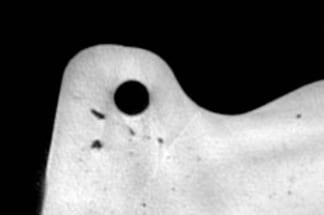 The company’s new Metrology Grade GE v|tome|x 300 CT Scanner, with Nanofocus Tube (180kV/15 W) and Microfocus Tube (300kV/500W), is equipped to “look inside” aluminum to a wall thickness or total amount of material of six to seven inches, or steel to a wall thickness or total amount of material of one inch.
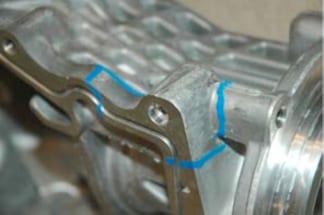
For this particular job, which represents the first use of CT scanning for metrology in America, the client was interested in wall thickness inspection as well as porosity and void analysis. The blue paint visible in some of the images was applied by the customer to indicate stress areas where leaking or breaking was suspected. Josh Schradin performed three stacked scans, each taking only about 30 minutes, to capture the entire casting. The result of the scans revealed the voids (legitimate holes) and highlighted the most serious problem areas in red-to-pink shadings.
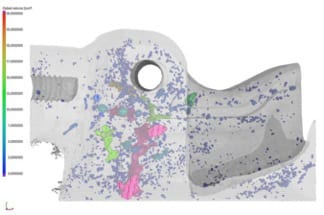
In addition to offering the only method to get 3D views inside a part, another primary benefit of the Exact Metrology CT scanning is the true dimensional data provided in a non-destructive test manner, i.e. without cutting up or otherwise destroying the test object.
The workpiece (casting) was rotated 360 degrees in the x-ray beam’s path, with multiple readings from various angles being taken. Once the CT grey scale images were converted into voxel-based 3D point clouds, Schradin was able to generate a CAD-to-Part comparison for the customer.
If interested parties have a need for Internal Defect Analysis/3D Quantitative Porosity Analysis, Materials Structure Analysis or Assembly Control, CT Scanning (Industrial X-ray), Exact Metrology invites inquiries for immediate assistance.
Exact Metrology is an ISO 9001:2008 Certified Company.
To see videos on this new scanner’s capabilities, please visit:
VG GE casting analysis with CT hi-res at Exact Metrology
v | tome | x m CT scanner at Exact Metrology
For more information on this new system or to arrange a demonstration, please contact:
EXACT METROLOGY, INC.
11575 Goldcoast Drive
Cincinnati, Ohio 45249
Phone: 513-831-6620
Toll Free: 866-722-2600
www.exactmetrology.com
stevey@exactmetrology.com
Steve Young, President
Connect with Exact Metrology online: 


—
Exact Metrology, with facilities in Cincinnati and Milwaukee and affiliated offices throughout the Midwest, is a comprehensive metrology services provider, offering customers 3D scanning, reverse engineering, quality inspection, product development and 2D drawings. The company also provides turnkey metrology solutions, including equipment sales and lease/rental arrangements.
Continue reading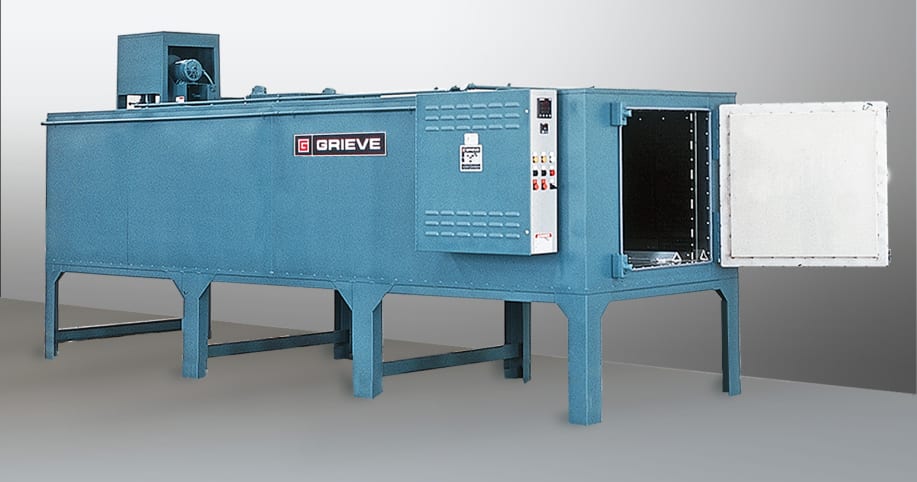
No. 980 for post curing fabric-coated silicone rubber gaskets | #GrieveCorp
No. 980 is a 500ºF (260ºC), electrically-heated universal style oven from Grieve, currently used for post curing fabric-coated silicone rubber gaskets at the customer’s facility. Workspace dimensions of this oven measure 30” W x 144” D x 30” H. 24 kW are installed in Nichrome wire elements to heat the oven chamber, while a 4200 CFM, 3-HP recirculating blower provides front-to-rear universal airflow to the workload.
This Grieve universal oven features 4” thick insulated walls, aluminized steel exterior, Type 304, 2B finish stainless steel interior, plus an integral oven leg stand and one pair of truck wheel guide tracks installed on the top of the floor to accept the customer’s wheeled fixture.
No. 980 includes all safety equipment required for flammable solvent processing, including explosion-venting door hardware and powered forced exhauster.
Controls on this oven include a digital indicating temperature controller.
For more information, please contact:
THE GRIEVE CORPORATION
500 Hart Road
Round Lake, IL 60073-2898
Phone: (847) 546-8225
Fax: (847) 546-9210
Web: www.grievecorp.com
Email: sales@grievecorp.com
Attention: Frank Calabrese, VP
New extrusion head from market leader features NO hardware, for easy cleaning, plus quick-change tooling, as tips removes from the back, die from the front
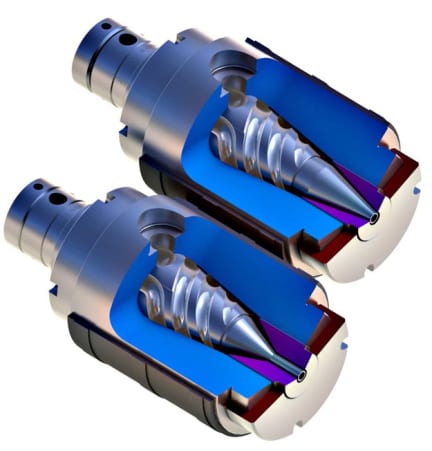
The Bullet, showing the absence of hardware, i.e. nuts and bolts, so disassembly, cleaning and restart are made easier
Guill Tool introduces The Bullet™, a new extrusion head with fixed center design, multi-port spiral flow design and gum space adjustment, plus the added feature of no fastening hardware, so cleaning and restart are easier and faster than any conventional head on the market currently, according to company sources.
The Bullet allows quick tooling changes, as the tips remove from the back and the die removes from the front of the unit. The absence of fastening hardware eliminates leaking, as does the taper body and deflector design pioneered by Guill.
High- and low-volume applications are suitable for this head and are accommodated with the simple, easy changing of just one component. A family of crosshead designs is available and users can specify the “caliber”, that is, the max. die ID.
A vacuum chamber and kit for assembly and disassembly are included with the unit. Optional keyed tooling capability offers machine designers and end users quick orientation, so the overall unit design enables faster disassembly, proper cleaning and restart, allowing the line to become more profitable.
For further information, please contact:
GUILL TOOL & ENGINEERING CO., INC.
10 Pike Street
West Warwick, RI 02893
Phone: 401-828-7600
Web: www.guill.com
Email: sales@guill.com
Attention: Bill Conley
Connect with Guill Tool online: 
See it at WESTEC 2015 – Booth 551!
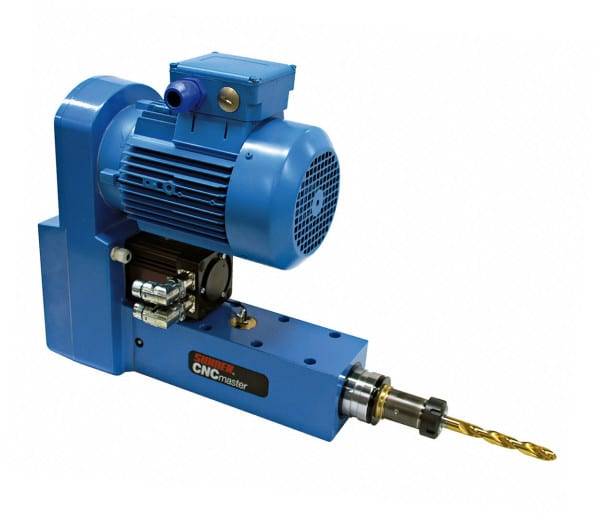
Following its successful launch, SUHNER is presenting the BEA 16 spindle machining unit with an all new drive and control concept.
The objective of this new development was the integration of the latest servo drive and control technology from Bosch Rexroth. Software developed additionally allows the user to program six different basic cycles without prior knowledge of CNC.
By visualizing these six cycles – drilling – combined drilling (drilling and thread cutting with the one tool) – thread cutting – drilling with chip removal – drilling with jump function – undercutting, the unit has become extremely easy to program.
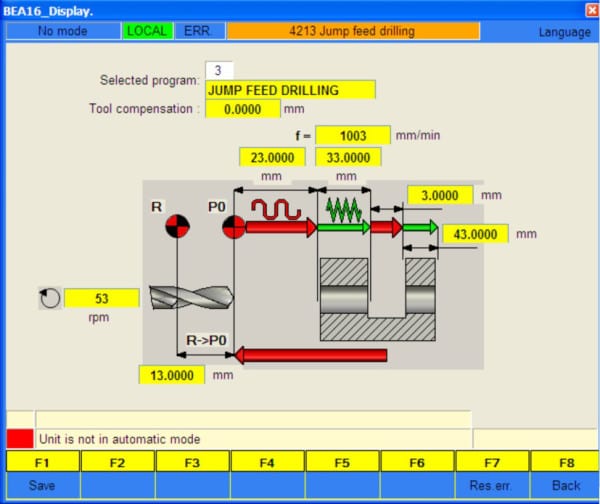
Example of a drilling cycle with jump function | Suhner Automation BEA16
Plus, should the required machining cycle not be found among the standard selections or prove more complex, the unit can be switched to sentence programming.
The BEA 16 machining unit itself is a precision device from the SUHNER spindle machining unit series that has been designed for gruelling continuous use in multiple shift operations. The BEA 16 has a drilling capacity of 16 mm Æ in 450 N/mm2 steel. The max feed path is 140 mm, and the max speed is 500 rpm.
Today, rising production piece numbers and greater workpiece complexity with all-round machining are leading to a renaissance of the so-called special machine. However, today’s special machines are being used no longer as purely single-purpose solutions, but rather for whole part families.
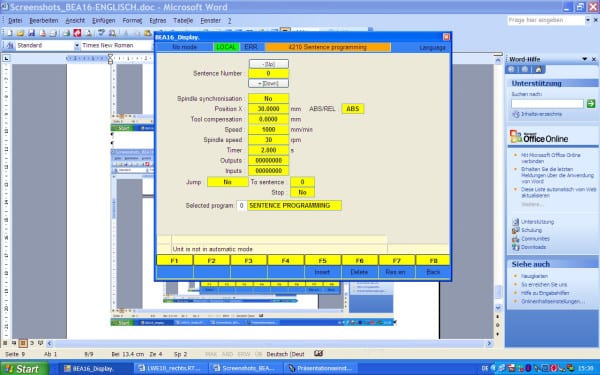
Example of a sentence programming | Suhner Automation BEA16
These require different machining cycles, feed speeds, feed paths and rotating speeds, and, of course, must allow fast retooling. And it is these requirements exactly that the BEA 16 will meet to the full.
SUHNER INDUSTRIAL PRODUCTS, CORP.
Hwy 411 S./Suhner Drive
P.O. Box 1234
Rome, GA 30162
Phone: 706-235-8046
Fax: 706-235-8045
Attention: Lee Coleman, Automation Division
www.suhner.com
automation.usa@suhner.com
Text and pictures files can be found and down loaded at:
www.suhner-press.com
Product demonstrations and technical presentations from principals impress large crowd
On June 25, 2015, Exact Metrology held a tech event at the Horseshoe Casino in Hammond, Indiana for local companies, to demonstrate its new 3D scanning equipment. Cleverly titled “Don’t Gamble with Your 3D Scanning,” the event was attended by local area industries, including steel, oil & gas and power gen “players”.

Hosted by Dean Solberg, Exact Metrology co-president, the day included presentations by Leica GeoSystems and Hexagon Metrology, business partners of Exact, plus product demonstrations featuring the newest technology in 3D scanners. Several scanners were demonstrated and available for hands-on use by the attendees, including the Romer Absolute Arm, the Leica Absolute Tracker and the Leica T-Scan.
Attendees were impressed by the ease of use, speed and accuracy of the demonstrated models, with scanning capabilities of over one million points per second. Bruce Bowditch of Leica described them as “a survey total station on steroids.”

Attendees could be heard discussing their excitement and one steel industry engineer commented, “That specific type of scanning can be applied to a lot of what we do. Pumps need to be scanned to assure proper fit. The Romer Absolute Arm is definitely quicker and more accurate. Our current process is so cumbersome; there’s just no comparison.” After trying out the Leica Absolute Tracker, one attendee in the oil industry stated, “Speed and accuracy is what we’re after. We have a model that does about half of what this can do. A lot less field time…hoping to get one. We’re excited.”
Exact Metrology offers a complete line of portable scanning and measurement technologies as well as contract measurement for 3D laser scanning services, reverse engineering services, non-contact inspection, metrology services, 3D digitizing and training.
See all the photos from the event on Facebook, here.
For more information on any of the systems discussed or to arrange a demonstration, please contact:
EXACT METROLOGY, INC.
Dean Solberg
20515 Industry Avenue
Brookfield, WI 53045
Phone: 262-533-0800
Local: 866-722-2600
www.exactmetrology.com
deans@exactmetrology.com
—
Exact Metrology, with facilities in Cincinnati and Milwaukee and affiliated offices throughout the Midwest, is a comprehensive metrology services provider, offering customers 3D scanning, reverse engineering, quality inspection, product development and 2D drawings. The company also provides turnkey metrology solutions, including equipment sales and lease/rental arrangements.
Sequenced changeover of all process control parameters yields successful implementation of system upgrade with minimal downtime
Lisle, Illinois – Synergy Systems, Inc., a consulting engineering firm and Recognized System Integrator for Rockwell Automation, today announced the completion of a successful upgrade on the main blast furnace and stove control system at a major Midwest steel producer. Unique to this 18-month project was the absence of production downtime experienced by the client, during the transition from legacy control system elements to a Rockwell Automation ControlLogix and Wonderware-based HMI platform. Synergy Systems termed its protocol on this project the System Transition Execution Plan (STEP). During the implementation of STEP, the client experienced no interruption in overall blast furnace or stove control system operations, as it transitioned from an older DCS (distributed control system) to the new system, which was entirely designed and installed by Synergy Systems engineers, working onsite at the steel mill with client personnel.
At the heart of the concept, according to Synergy Systems VP Marc L. Hunter, “We developed our strategy around a core principle that targeted zero downtime during the changeover. Essentially, we created a building block operation, in which each control input/output on the old system was upgraded with parallel monitoring of performance values and system readouts. Only when each new component was functioning properly and the signals were inline with the existing monitored values did we execute the changeover of the control strategies, which was then integrated loop-by-loop into the new process LAN.” Utilizing this strategy, Synergy Systems enabled the client to maintain full production at the mill, throughout the entire project. Client engineering confirmed their complete satisfaction with the performance on this major project.
The STEP upgrades included all the following procedures: replacement of legacy PLC hardware with AB ControlLogix, replacement of DCS/PLC interface, movement of I/O from DCS to ControlLogix, deployment of Wonderware HMI, movement of control from DCS to ControlLogix, Wonderware historian integration and finally Level 2 interface via Wonderware HMI. Essentially, the control scheme for each system element was installed in parallel to the legacy control, then connected to the new ControlLogix processor and monitored on a channel of the client’s overall process control LAN for comparison to the older output.
Using this STEP approach, minimal process impact occurred and there was a significant savings realized for the client, both in operational expense and total project cost. As Hunter explains, “This project, because it happened in steps, so to speak, could be costed as a maintenance, not a capital, expense. The major capital expenditure diminished, owing to our strategy of loop-by-loop cutover and a gradual evolution of the graphical user interface, plus a progressive integration with the plant historian software. Collateral benefits to the client included a gradual weaning away from the legacy system, which allowed our team to thoroughly familiarize our client’s operational and maintenance personnel with the new hardware and software, as the changeover progressed.”
The determination to upgrade this system had resulted from numerous factors, according to the client. The I/O had become obsolete and the legacy system was UNIX-based, so many of the client’s current engineering staff onsite were not familiar with it. However, because a need existed to retain overall control strategies and functional client knowledge of system operations, Synergy Systems devised this STEP protocol to make the transition more gradual and self-teaching.
According to the client’s plant production & technologies manager on the project, “The blast furnace and stove control systems needed to be upgraded from a legacy DCS (Distributed Control System) to a Rockwell Automation PLC (Programmable Logic Controller) platform, with Schneider Electric Software Wonderware human machine interface and historian, along with statistical reporting mechanisms. Synergy Systems was challenged with cost-effective project deliverables requiring a proven transition plan, zero production outages, minimal risk implementation with no impact to production or product quality, improved technology with future expansion capabilities, improved process controls, enhanced operator interface, significant improvements to system reliability and stringent budgetary guidelines. This project required verification and movement of nearly 2000 I/O points, installation of new workstations, network communication upgrades, development of over 60 HMI screens with built-in diagnostics and alarms, extensive PLC programming, system functional documentation development and drawing approval, historian upgrades and onsite training. Finally, total project implementation and completion were required within a two-year period.”
He continued, “Synergy delivered beyond our expectations on every challenge presented. The innovative approach, level of engineering delivered and tools selected ensured a successful transition without impact to our production or product quality. Synergy’s professional manner plus their willingness to listen and offer solutions always made it easy for our Operations and Automation team personnel to work with them. The upgraded control systems have been in operation for nearly a year now, with high levels of reliability and efficient operations realized. Synergy proved to be an extremely cost-effective yet resourceful company, with a focus on the future of our mill control requirements. Our plant now has the technology to further enhance the automation strategies and drive flexibility and productivity that were not available with the legacy automation platform.”
For more information on this application, please contact:
Synergy Systems, Inc.
1982 Ohio Street
Lisle, IL 60532 USA
Phone: 630.724.1960
www.synsysinc.com
info@synsysinc.com
Attention:
Marc L. Hunter, VP
hunter@synsysinc.com
PLC, drive and motion-based functionality and architecture
Abstract
There are several architectural strategies that can be considered for web handling drive system controls. Current industrial control platforms permit the web handling controls to be implemented in either a Programmable Logic Controller (PLC) (typically the same as the machine control), directly in the drive system, or through a motion controller.
PLC-based web control has long been a traditional choice for machine builders for a number of reasons. The PLC provides a single platform for both automation and drive control with a centralized control structure. PLC-based systems offer a suitable level of usability, however, they can be limited in high-end performance capability and in their options for process-level programming.
Drive-based control typically offers distributed control architecture, peer-to-peer networks and an increased level of performance due to faster processing times. Graphical engineering tools are common for drive-based systems and are a preferred programming environment due to their ability to visualize and document the web control processes.
Motion controllers offer the highest level of performance and functional flexibility. Their inherent capability of providing position data can help increase web handling performance on several fronts. Motion controllers also permit the line integration of axis motion functionality such as positioning, electronic gearing and cam functionality in the common web controller. They are not limited by memory constraints and typically utilize the full range of programming languages.
This paper will review the merits of these three control architecture options in detail under the criteria of usability, functionality and performance, and also touch on the related topics of drive safety and remote diagnostics.
Overview / criteria
Usability
Usability defines the control system’s ease of use in the areas of engineering, commissioning, and maintenance. The following points apply to each of the control system options, PLC,
drive-based and motion control.
A common engineering tool utilizing a common database for machine and drive control is
recommended. Individual engineering tools for each controller (PLC, drives, etc.) should be
avoided. The engineering and programming connection to the system should be though a
single point with efficient routing to each drive or controller location in the system.
Additionally multi-user editing is an important feature for complex and large projects.
The programming language used for the web control should be considered for usability. The
programming language should be sufficient for implementing the critical tasks, easy-to-use
and understand. We find that the ideal programming language for the web control or drive
processes to be graphical function chart. Web handling control is a process and a graphical
programming editor offers the most efficient method to develop, visualize, support the
process and produce the system documentation.
The engineering platform should offer efficient and common diagnostic and troubleshooting
tools that include integrated online monitoring capability, time and frequency-based trace tools
and a drive axis commissioning control panel.
Control and drive hardware platforms that store programs on removable media are ideal.
The Compact Flash cards permit the easy swapping of hardware without the requirement
of program or parameter file downloading and retain current machine settings.
Download the brochure/PDF HERE.
—
For specific product information and inquiries, call (800) 879-8079 ext. Marketing Communications or send an e-mail to: SiemensMTBUMarCom.industry@siemens.com.
Siemens Industry Sector is the world’s leading supplier of innovative and environmentally friendly products, solutions and services for industrial customers. With end-to-end automation technology and industrial software, solid vertical-market expertise, and technology-based services, the sector enhances its customers’ productivity, efficiency and flexibility. With a global workforce of more than 100,000 employees, the Industry Sector comprises the Industry Automation, Drive Technologies and Customer Services Divisions as well as the Metals Technologies Business Unit. For more information, visit http://www.usa.siemens.com/industry.
The Siemens Drive Technologies Division is the world’s leading supplier of products, systems, applications, solutions and services for the entire drive train, with electrical and mechanical components. Drive Technologies serves all vertical markets in the production and process industries as well as the infrastructure/energy segment. With its products and solutions, the division enables its customers to achieve productivity, energy efficiency and reliability. For more information, visit http://www.usa.siemens.com/drivetechnologies.
Continue readingA. Roger Guillemette, 81, of Narragansett, Rhode Island, died Friday, June 5th. Born in Providence, RI, he was the son of the late Joseph Arthur and Yvonne (Roy) Guillemette, both Canadian born.
Roger graduated from Coventry High School and served as a machinist in the US Army, 600th Engineering Aviation Maintenance Co. He was stationed in  Korea and Mineral Wells, Texas.
He and his wife Claudette raised their four children in the village of Phenix, RI where they hosted many a sing-a-long around their piano. Among the many other things in life he thoroughly enjoyed, Roger loved playing Skip-Bo with his family and friends.
An entrepreneur, he established several businesses throughout his lifetime, creating long-term steady employment opportunities for many people. Guill Tool & Engineering Company was established in 1962 and remains in operation today, as a global leader in extrusion tooling. Until recently, Roger was very active as the CEO and always an inspiration to his employees, as his passion for engineering quality products and customer solutions never waned. He had been a fierce advocate for U.S. manufacturing on local and national levels; participating in many organizations as well as advocating for STEM education in the state of Rhode Island.
Professionally, Roger was SE MA Chapter past President of NTMA-RI and a longtime member of the Wire Association and Society of Plastic Engineers. Guill Tool, as a result of Roger’s leadership and drive, remains active in the Rhode Island Manufacturers Association, National Association of Manufacturers, National Institute of Manufacturing Skills, the Rhode Island STEM Center and other local endeavors for the betterment of the industry and community.
Memorial contributions may be made to The Johnny Cake Center of Peace Dale, 1231 Kingstown Rd., Peace Dale, RI 02879. Visit www.nardolillo.com for online condolences.
For more information, please contact:
Rich Guillemette
Guill Tool & Engineering
10 Pike Street
West Warwick, RI 02893
USA
Phone: 401-828-7600
www.guill.com
rguillemette@guill.com
No. 901 is a 1200ºF (649ºC), electrically-heated walk-in oven from Grieve, currently used for heat treating at the customer’s facility. Workspace dimensions of this oven measure 48” W x 60” D x 72” H. 120 kW are installed in Incoloy-sheathed tubular elements to heat the oven chamber, while a 12,500 CFM, 10-HP recirculating blower provides horizontal airflow to the workload. 
This Grieve high-temp walk-in oven features 10” thick insulated walls, comprising 2” of 1900ºF block and 8” of 10 lb/cf density rockwool; inner and outer door gaskets with the inner gasket sealing directly against the door plug, while the outer gasket seals against the front face of the oven; doors equipped with expansion joints on the inner face to guarantee uniform sealing at all temperatures; aluminized steel exterior; Type 304, 2B finish stainless steel interior; 7” insulated floor with truck wheel guide tracks and a 2000 lb. capacity stainless steel shelf oven truck with shelf supports on 6” centers.
Controls on No. 901 include a 325 CFM stainless steel powered forced exhauster with motorized dampers for cooling, manual reset excess temperature controller with separate contactors, recirculating airflow safety switch, 10” diameter circular chart recorder, digital indicating and programming temperature controller and an SCR power controller.
For more information, please contact:
THE GRIEVE CORPORATION
500 Hart Road
Round Lake, IL 60073-2898
Phone: (847) 546-8225
Fax: (847) 546-9210
Web: www.grievecorp.com
Email: sales@grievecorp.com
Attention: Frank Calabrese, VP
