
Contact us today:
(847) 934-4500
tdaro@bernardandcompany.com
Contact us today:
(847) 934-4500
tdaro@bernardandcompany.com
 A practical alternative to mechanical braking and non-regen drives systems in the converting, packaging, wireforming and printing industries
by William Gilbert, Industry Business Development Manager, Converting and Cranes, Motion Control Solutions
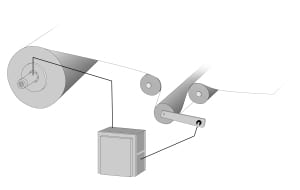
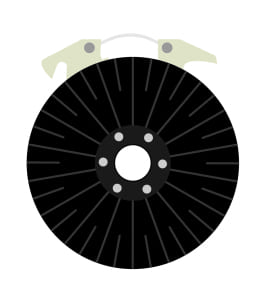
During the operation of any converting machine, whether for film, foil, wire, paper or board, plus most large printing presses, rolls of materials are handled by unwinds, often still driven by pneumatically operated braking systems. The traditional tension control system for an unwind stand is a simple mechanical brake. In principal, the unwind brake mechanically operates much like the braking system on your car, with a disk, caliper and pads, but is controlled by a tension sensor linked to a setpoint controller. As the roll unwinds, the tension is maintained by the brake for smooth passage of the material through the dies or rollers, resulting in better package alignment, less wrinkling, better print registration, even more consistent wire dimensioning and other production positives. These mechanical brake unwinds are effective in controlling the tension, but have inherent problems of heat and power loss, plus mechanical wear and constant maintenance needs, substantially impacting machine uptime.
The typical mechanical brake is pneumatically controlled and may utilize several sets of friction pads to control the web tension as the roll dimension decreases. Plus, a reasonable pressure range in many applications might be from 15-90psi or a 6:1 drop, a range significantly less than the core to full roll ratio for most jobs, an obvious inefficiency in operation.
To affect good tension control on the brake, these friction pad sets need to be manually changed in an out of the brake assembly, depending on the desired operating tension and the roll diameter changes involved. Often, the adjustments are several per roll during this manual changeover. Because the mechanical brake creates the unwind tension through friction, it generates substantial heat and often requires a separately powered fan for cooling to operate effectively. This friction also means the pads are subject to rapid wear, requiring frequent and time-consuming changes or maintenance checks.
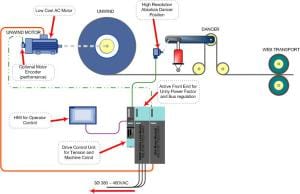
For almost a decade now, this old technology has been gradually replaced, though usually in the lower power ranges, by newer precision technology, involving AC motors, drives and electronic loadcells. On converting lines today, a further leap forward is being made with the onset of 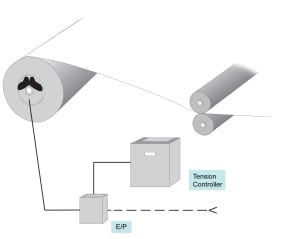 active front end technology.
With such technology, the operating principle is as follows.
Since the unwind application is regenerative (regen) in nature, a driven unwind needs to return the energy that the mechanical the brake produced as heat back to the AC line. In the past, regen DC drives have been successfully applied as driven unwinds, but DC drive systems are no longer common and even during their prime were very costly. Early in the AC drive technology for these applications, the drives did not have the capability to regenerate the power back to the AC line and, when applied as unwind brakes, required regen resistors to dissipate the tension energy. This was wasteful and costly.
Today’s AC drive systems now have the technology to regenerate the energy back to the AC line just as the DC drive did, but with added benefits to the user and machine designer alike. Sending the tension energy back to the line means power that once was wasted can now be retained, instead of the system producing heat and worn parts. When the drive is equipped with active front end technology, it will return the previously wasted energy with near unity power factors, something not possible for any DC drive system.
Even an open loop AC drive motor combination offers a tension control range far beyond the limits of a pneumatic braking system. Synchronous AC motors can offer precision open loop torque control without a tension sensor, thereby saving further cost and inventory. Today’s highly accurate tension control systems can be designed with high resolution (sin/cos) feedback encoders on both the unwind motor and dancer position feedback. Additionally, in more advanced active front end designs, the regen capability of the drive can actually assist in the increase of stopping times and tension control regulation, owing to the four quadrant control, i.e., the motor can sink or supply current to the motor in both directions.
 AC regen drive systems can also offer today’s machine designer software configurations with a wider range of control flexibility. They can be configured to operate in the most basic mode with no motor encoder or with tension feedback to system configurations, utilizing either dancer position sensors or loadcells. Alternatively, they can function as a programmable logic controller (PLC), controlling the machine functions on the unwind, while also connecting directly to a human-machine interface (HMI) panel. In most converting, packaging and printing applications, the dancer position sensor can be used to calculate the starting diameter of a roll, eliminating additional diameter sensors and the possibility of operator error in the roll diameter input. Further enhancements for unwind spindle motion such as jog for threading have also emerged for operator convenience through active front end technology.
Beyond the obvious cost savings of pad replacements on mechanical braking systems, AC motors are virtually maintenance free by comparison to DC motors, as AC motors have no brushes, do not require controller contactors to reverse direction of motor rotation or have commutators. Fewer moving parts invariably means less motor maintenance, for additional cost and time savings.
In the most advanced systems, common DC bus regulation, energy-monitoring devices for near unity power and, through the use of mechatronic services often provided by the manufacturers, “turn off” parameters in vector drives are possible. Mechatronic services can also be utilized for the proper tuning of these drives onsite or during machine build. For designers, such services further assist in the proper sizing of motors, based on the mechanical and electrical forces generated by machine operation or computerized simulation of it.
This combination of improved operation, reduced maintenance, motor power savings and conservation of nearly all energy within the system make AC regen drives with active front end technology a decided advantage for machine designers and end users of converting, packaging, printing, wireforming and other roll-fed machinery, where driven unwinds can be implemented.
For more information on regenerative drive motors and systems, please contact:
Siemens Industry, Inc. Drive Technologies — Motion Control
390 Kent Avenue Elk Grove Village, IL 60007 Phone: 847-640-1595 Fax: 847-437-0784 Web: www.usa.siemens.com/motioncontrol Email: SiemensMTBUMarCom.sea@siemens.com
Attention: John Meyer, Manager, Marketing Communications
Editor Note: Siemens will make the author as well as various other product and market specialists available to you for interviews on the many aspects of regenerative drive motors detailed in this article, as they apply to the particular nature of your audience. Please contact the agency to arrange. Thanks!
PR agency contact: Tim Daro Bernard & Company 847-934-4500 tdaro@bernardandcompany.com
Continue reading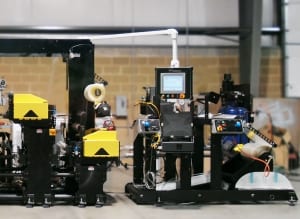 Company saves up to 80 percent in engineering time, plus helps leading label and filmic product maker create easily converted lower cost material offerings
Joe Drilling has a pride in his company that’s classic American entrepreneur. After years at a leading label machine builder, he founded Drilling Technical Services (DTS) in Milford, Ohio, a virtual engineering company specializing in the mechanical, electrical and process engineering of mid-width and narrow web printing, drying, converting, RFID and digital print equipment. DTS has a particular emphasis on web transportation, die-cutting and laminating solutions. As the installed base grew and responding to current market conditions, Joe founded a second company, Pre-Owned Press & Parts Solution LLC (POPPS), also in Milford, specializing in the evaluation, reconfiguration, remanufacturing, sale, commissioning and servicing of pre-owned presses. Another vital component of the business models at both DTS and POPPS is the engineering of energy recovery systems for containment of utility costs, an ongoing challenge in the printing industry.
The two companies primarily serve the needs of the flexible packaging, folding carton, tag and label, health and beauty, wine and beer, plus other label segments.
During a recent project for one global leader in label and filmic product solutions, DTS was commissioned to develop a mid-width web roll-to-roll die cutter with various unique substrate manipulation functions. The substrate’s physical parameters, especially the desire to reduce material thickness, represented particular challenges to the DTS team.
DTS utilized its “QC Mod Cut Series” modular web transport system and quick change die cassette technology as the design platform.
Every aspect of the work was to be done to the customer’s strict system specifications for equipment criteria, including die cutting accuracy, line speed accuracy, tension control and wound roll precision. These process functions were to be controlled by the machine’s Human Machine 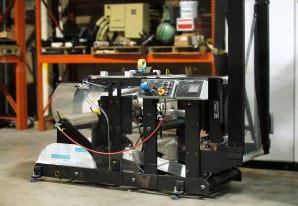 Interface (HMI). The first machine was required from DTS on a short time schedule for the customer’s showroom, and then the customer was providing a second machine along with its branded substrate materials to the initial end user. Long-range plans call for this machine to be implemented into a worldwide marketing effort by the DTS customer.
Based on previous experience with Siemens, the DTS engineering team looked to integrate electronic line shafting and process control functions that could be achieved with standard component architecture. Having a local and experienced distributor of Siemens components, Richard Equipment Company (RECO) in Cincinnati, the investigation into a process solution began. As Joe Drilling further noted, “The worldwide support of Siemens was an additional factor in our decision and really gave us that comfort zone in selecting them for this project. Our customer is itself a world player and so we felt confident in Siemens’ ability to provide components and service, wherever needed.”
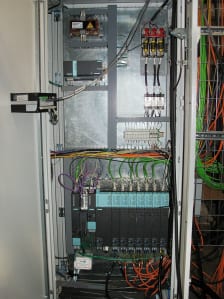
To achieve the desired accuracies in every machine function, DTS utilized the Siemens Simotion D435 motion controller, a compact, drive-based platform that incorporates motion control, logic control and drive control in a single hardware unit for drive mounting. In this manner, the drive became the control for the entire machine’s functionality. Feeding off this platform are the multi-axis control drives of the Siemens Sinamics family, as well as Simatic I/O components and runtime software, plus the related HMI hardware, as supplied by RECO.
Components were selected by the DTS engineers using the unique Siemens Converting Toolbox, a suite of product specifications and application software that allows an engineer the flexibility to customize portions of a machine build, then recall and reuse them or make modifications for subsequent builds. The reduction in subsequent machine design engineering time, according to Joe Drilling, reached approximately 80 percent on the second machine and he anticipates a repeat of that scenario, every time.
These factors were found most satisfying for DTS and especially their customer, who had previously used a vendor for machine upgrades who typically took months, even years, to research, develop and implement design changes in the customer’s machine lines, according to Drilling. “With our more simplified layout of components and the flexibility we enjoyed with the Converting Toolbox, the learning curve shortened tremendously. Product and Matrix winder modules were able to be configured to allow the diverse web tension ranges and accuracy required. And, most of all, the shaftless drive system we implemented allowed our web transport roll design on the individual machine sections to become much easier, faster and completely repeatable.” The end result is very accurate web control and re registration capability.
 Joe Drilling concludes, “The marriage of Siemens motion control technology, their overall expertise in the converting industry, plus our engineering and build talents really worked to benefit our customer, who has been quite satisfied with machine performance to date.”
Siemens system training and project development took place on-site at DTS.
Other recent projects accomplished by DTS engineers include an air-to-air heat exchanger for dryer efficiency, a dryer system upgrade for water-based inks, a unique accumulator stacker specially designed for thin substrate processing, a near-zero defect RFID system and various anilox system upgrades to integrate more advanced motion control technology. The company also performs considerable process layout and process improvement consulting to its customers throughout the industry.
For more information on this story, please contact:
DRILLING TECHNICAL SERVICES INC.
6062 Kells Lane
Milford, OH 45150
Phone: 513-831-2952
Fax: 513-831-4825
Web: www.drillingtechservices.com
Email: jdrilling@drillingtechservices.com
Attention: Joe Drilling, President
Or
SIEMENS INDUSTRY, INC.
Drive Technologies — Motion Control
390 Kent Avenue
Elk Grove Village, IL 60007
Phone: 847-640-1595 Fax: 847-437-0784
Web: www.usa.siemens.com/motioncontrol
Email: SiemensMTBUMarCom.industry@siemens.com
Attention: John Meyer, Manager, Marketing Communications
—
Drilling Technical Services Inc. in Milford, Ohio is machine builder specializing in the mid-width and narrow web press market. Its sister company, Pre-Owned Press & Parts Solutions, offers full reconfiguration engineering and remanufacturing services, plus full installation and commissioning on pre-owned presses.
Through the use of the Siemens Converting Toolbox and Simotion selection of drive/control technologies, all the motion control drive-based components and logic software were selected from a suite of available options. A reduction of over 80 percent in engineering time has been reported by the machine builder.
Continue reading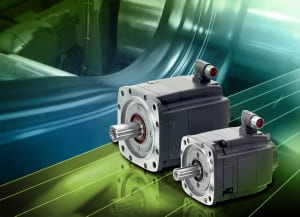 ATLANTA — Siemens Industry, Inc. announced today that it is expanding its popular 1FK7 servomotor family, with the introduction of a new high-inertia style. The higher rotor inertia of this design makes the control response of the new 1FK7-HI servomotors highly robust and suitable for high- and variable-load inertia applications, including the feed and auxiliary axes on machine tools, as well as winders and unwinders on converting, packaging and printing equipment.
These self-cooled 1FK7-HI servomotors provide stall torque in the 3 Nm to 20 Nm range and are offered in IP64 or IP65 with IP67 flange degree of protection, with selectable options for plain or keyed shaft, holding brake, 22-bit incremental or absolute encoders, as well as 18 color options.
A mechanical decoupler between the motor and encoder shaft protects the encoder from mechanical vibrations, providing a long service life. In cases where the encoder needs to be exchanged, the device automatically aligns the encoder signal to the rotor pole position, enabling feedbacks to be changed in the field in less than five minutes.
These new Siemens 1FK7-HI servomotors also feature the unique Drive-Cliq® serial bus and electronic nameplate recognition, allowing virtual plug-n-play operation when paired to the Sinamics® S drive platform. All servomotors in this new line are also configured to interface with Siemens Sinumerik® CNC technology for machine tool applications and the motion controller Simotion® for general motion control use.
Selecting the proper motor to suit the application is facilitated by the Siemens Sizer® toolbox and compatible 3D CAD model-generating CAD-Creator package. For more information, visit www.usa.siemens.com/motioncontrol.
For specific product information and inquiries, call (800) 879-8079 ext. Marketing Communications or send an e-mail to: SiemensMTBUMarCom.industry@siemens.com.
Continue reading
 Permanent magnet synchronous torque motors offer significant advantages on high energy consuming and high dynamic applications
by Harald Poesch, Product Marketing Manager, Servomotors
Today’s machine designer must evaluate more factors than ever in approaching a new project. Likewise, the integrator and retrofit engineer has expanded options, not only as a result of new technologies, but also because of critical areas of focus such as reduced 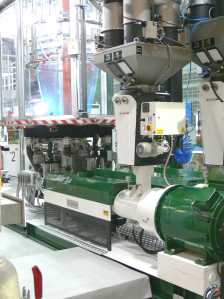 energy consumption, faster assembly time, vendor reduction and smaller footprint achievement.
In the realm of motion control, one type of motor with a relatively short history has made significant advancements that necessitate a new look at its potential in many application areas. These applications range from machine tool rotary tables to various packaging, printing, converting, extruding, papermaking, plastic film and materials handling machinery, anywhere direction must be reversed with a very high degree of accuracy, no backlash (hysteresis) and the maintaining of motion control, contrasting the necessary decoupling of a conventional motor and gearbox.
Enter the often-overlooked permanent magnet, synchronous torque motor.
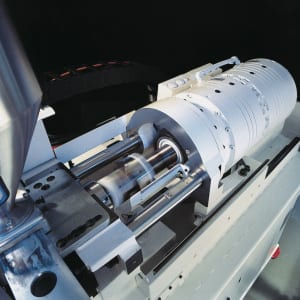
 Torque motors are direct drives built for rotary axes where high torque and high precision are required at relatively low speeds. With significantly lower installation time, maintenance requirements, component part count and space allowance, these motor types are frequently viable alternatives to geared motors.
Two popular varieties of torque motors exist today. They are the complete torque motor, requiring only direct flange-mounting to the machine and connection of the rotor to the machine shaft, and the built-in torque motor, where the stator and rotor are supplied as individual components that are directly integrated into the machine mechanics.
Complete torque motors are often found on extruder main drives, feed heads on injection molding machines, roller drives on papermaking machines, wire drawing devices, textile machine web stretching and winders/cross cutters on packaging equipment.
Built-in torque motors are typically used on machine tool rotary tables, swivel axes, dynamic tool turrets and turning spindles, as well as printing press cylinders, chill rolls in cast film and foil stretching machines, indexing tables in metalforming presses and all other types of 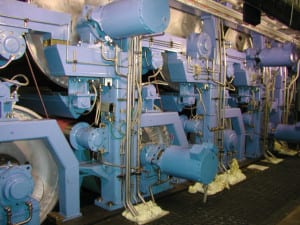 high-dynamic, high-precision path and speed control applications.
Both types of torque motors feature a hollow shaft, which allows media or mechanical components to be guided through the rotor cavity.
Torque motors are multiple pair pole synchronous motors, similar in operation to rotary synchronous servo motors. The rotor is equipped with permanent magnets, while the stator contains the motor windings. The high number of pole pairs leads to a design generating high maximum torque at low speeds. In the past, since eddy current losses increase with the number of pole pairs and the running speed of the motor, torque motors were considered applicable only at relatively low speeds. New water-cooled designs have countered this principle, allowing a high power density. Today’s torque motors can accommodate speeds of 1000 rpm or higher.
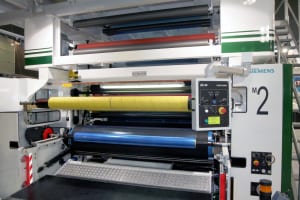
As a result of these higher pole pair designs and because many mechanical power transmission components that generate backlash, heat, friction and noise are eliminated, torque motors offer these benefits to designers:
While higher in cost than geared motors, it is currently estimated that torque motors offer the designer a payback of three to four years in energy savings alone, which does not include the immediate increased performance and upfront cost savings, both in installation and maintenance. Obvious vendor reduction and inventory advantages are also realized through the use of these motors.
On a typical multi-layer blown film line, for example, the use of torque motors can reduce the footprint of the extrusion section by half and the consumed production space decreases accordingly, leading to an increase in production rates per square foot. 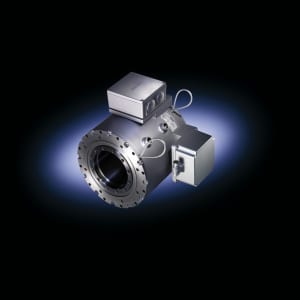
Torque motors were also long thought to be susceptible to chemical and other ambient atmospheric contamination, but new designs have been adapted to withstand corrosive atmospheres such as a paper mill dry hood and, being water-cooled, are performing satisfactorily in many harsh environments without heat damage. Enclosures are available up to an IP54 rating with overload capability up to 2.5 times the rated torque.
Torque motors reduce mechanical efficiency losses to an absolute minimum because they eliminate mechanical transmission in the drive train. Compared to geared motor solutions, the efficiency gain is typically in the range of 10 percent, while the gain is closer to 70 percent when hydraulic motors are replaced in applications such as injection molding machines. Further, due to the direct and constant control of the load shaft on torque motors, with no backlash or decoupling occurring, a significantly higher precision in motion is achieved, which is not possible in a geared or belt-driven solution.
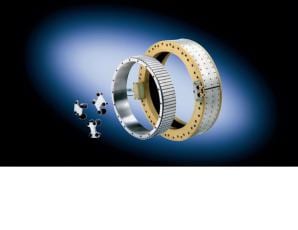 For example, in the production of stretched film, the application of torque motors on chill rolls, pull rolls, stretch rolls and winders has resulted in a dramatic improvement in production quality. The more accurate speed control of the direct driven rolls results in faster start-ups during the changeover from one film product to another, because the likelihood of cracks in the web is minimized. In addition, the higher control accuracy enables the production of a thinner film that is 10 times more consistent in its thickness. Likewise, the stiff drive train configuration achieved with torque motors allows faster ramping up and down in cyclic applications, leading to shorter cycles and increased product output in the same time period. In many applications with very short cyclic times, such as indexing tables or injection molding machines, the changeover from conventional drives to direct driven solutions has resulted in production increases of 25-30 percent typically. These results indicate that a lower component count now means a lower product lifecycle cost, as well as reduced potential failure rates in the field.
Other features on today’s torque motors that make them more appealing for the machine designer include:
The emerging science of mechatronics is also critical for direct drives such as torque and linear motors in the integration process because the electronic machine control protocols are so crucial in monitoring and executing the electromechanical motions. A keen knowledge of three 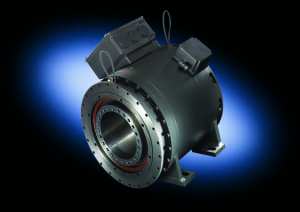 disciplines (mechanical, electrical and electronic engineering) is fundamental in determining the proper unit to suit the load. Mechatronics addresses such topics for the machine builder as proper encoder location, reaction vs. dynamic force calculations and how best to integrate a high dynamic direct drive mechanically into the machine.
Additionally, through various advanced computerized simulation techniques, mechatronic performance can be validated and troubleshooting on the design can be accomplished before the first machine is ever built. Even in the field, before and after a retrofit or rebuild, the mechatronic services currently available can be used for product application determination, full performance analysis and controls compatibility. While the performance of a new motor or drive might be deemed satisfactory by mechatronic analysis, other mechanical, electrical or electronic components might be found lacking. It is precisely this comprehensive, integrated approach that is fast earning mechatronics its place in the overall scheme of machine development and utilization.
In conclusion, with today’s emphasis on cost containment, energy efficiency and higher productivity on every type of machine design, it is imperative that all viable options be explored. In designing the drive train on many machines, the advantages of torque motors described in this paper will have a positive impact on the overall project results. Torque motors can offer great flexibility in design, retrofit and rebuild applications, plus they have expanded capabilities that lobby for their implementation on more types of machines.
For further information on torque motors, please contact:
SIEMENS INDUSTRY, INC.
Drive Technologies — Motion Control
390 Kent Avenue
Elk Grove Village, IL 60007
Phone: 847-640-1595 Fax: 847-437-0784
Web: www.usa.siemens.com/motioncontrol
Email: SiemensMTBUMarCom.industry@siemens.com
Attention: John Meyer, Manager, Marketing Communications
Gear manufacturer supplying various defense sector customers completed registration process on March 31, 2010
Roscoe, IL-Forest City Gear supplies some of the world’s leading companies with high-precision gear work. These include products for various defense sector contractors, which would be subject to the strict guidelines of the International Traffic in Arms Regulations (ITAR). This standard is designed to “establish and maintain a procedure for identifying and complying with export authorization requirements for the sale and shipment of defense articles, the performance of defense services and the transfer of technical data” by the companies involved, pursuant to the Arms Export Control Act. Applicable products include those on the United States Munitions List (USML).
Specifically, ITAR requires that Forest City Gear maintain a strict record of all manufacturing procedures and defense articles produced, as well as visitor records and the tracking of all potentially sensitive documents such as engineering data and shipping logs. Under the guidelines, only U.S. citizens may visit the facility, where no cameras or laptops are permitted and only citizens may work for the company, during the design, engineering, manufacture, production and handling of products and all relevant data related to defense projects. Exchange of data, especially via the Internet, is highly restricted, plus no non-citizen may access data in any way, without authorization from the State Department or a specially issued exemption. A non-citizen may also visit the plant, but only with a previously completed letter of authorization, stating they understand and comply with all relevant ITAR standards. And any non-citizen must be accompanied by a company official at all times.
The registration process was completed on March 31, 2010, after over a year’s effort to comply with all applicable standards, procedures and paperwork.
Overseeing the registration process and executing all documents for Forest City Gear was the company’s CEO, Fred Young. Quality Manager Joe Luy will oversee the internal process and procedure.
Forest City Gear supplies gears and gearwork for all types of military ordnance, as well as numerous military aircraft, vehicles, instrumentation and other defense devices. The company has also supplied gears on Jeep’s for decades, long before they became consumer items.
The company recently celebrated its 55th anniversary. Forest City Gear was founded in 1955 by Fred Young’s parents, Stetler and Evelyn Young, in Rockford, Illinois, near the company’s current facility in Roscoe.
ITAR is managed by the Department of Homeland Security, the Directorate of Defense Trade Controls and other government agencies, at this time. Only vendors listed on the Approved ITAR Vendor List are sent quote requests on ITAR-restricted materials and products.
For more information on the company, please contact: FOREST CITY GEAR CO., INC. 11715 Main Street Roscoe, IL 61073-0080 Phone: 815-623-2168 Fax: 815-623-6620 Web: www.forestcitygear.com Email: sales@forestcitygear.com Attention: Fred Young or Joe Luy
PR agency contact for Forest City Gear: Tim Daro Bernard & Company 847-934-4500 tdaro@bernardandcompany.com
Continue reading
Joe Luy
Gear manufacturer on the grow, says President Wendy Young

Paul Lindquist
Roscoe, IL-Forest City Gear (FCG), a precision gear manufacturer here, today announces the hiring of four new employees and the promotion of two longtime employees. “We’ve been growing steadily in the last two years, despite the economic conditions, and this news reflects that situation,” comments company President Wendy Young, who runs the business alongside her husband, CEO Fred Young.
Effective immediately, the following new individuals have been retained in the roles indicated:
Joe Luy-Quality Manager
Bruce Haxton-Gear Processing Engineer
Paul Lindquist-Process Engineer
Jim Cagle-Cost Estimator

Andrea Bagwell
Also, these longtime employees have been promoted:

Krista King
Krista King-Order Processing
Andrea Bagwell-Estimating/Quoting Assistant
Briefly, Joe’s role will be the supervision of the company’s quality lab, acknowledged as one of the finest metrology centers in the gear industry. Over a third of Forest City Gear’s current customers are other gear companies around the world, who bring FCG work they cannot do themselves, either on tolerance or consistency. Joe will also manage the company’s ISO and ITAR registered programs, the latter having been secured this past March.
Bruce will be responsible for the transitions from design to manufacturing protocols at FCG. He brings an impressive background in gearmaking to the task.
Paul oversees the utilization of the companies 80+ machine tools to streamline production workflow through the shop, again considered one of the world’s leading gearmaking facilities.

Jim Cagle
Jim will help keep pace with the hundreds of RFQ’s received each week at FCG, a daunting task, to say the least.

Bruce Haxton
Krista moves into an expanded role in purchasing, working with numerous vendors and the strict guidelines of the many government, aerospace and defense contractors served by FCG. Her primary role will be processing purchase orders for the company.
Andrea will be responsible for the preparation of quotes, serving the now larger department of inside sales engineers and others, including Fred Young, who continues in his longtime role of reviewing and estimating particularly challenging gearmaking jobs at the company.
The company recently celebrated its 55th anniversary. Forest City Gear was founded in 1955 by Fred Young’s parents, Stetler and Evelyn Young, in Rockford, Illinois, near the company’s current facility in Roscoe, approximately 90 miles northwest of Chicago.
For more information on the company, please contact:
FOREST CITY GEAR CO., INC. 11715 Main Street Roscoe, IL 61073-0080 Phone: 815-623-2168 Fax: 815-623-6620 Web: www.forestcitygear.com Email: sales@forestcitygear.com
Attention: Wendy Young or Fred Young
PR agency contact for Forest City Gear:
Tim Daro
Bernard & Company
847-934-4500
tdaro@bernardandcompany.com
 No. 862 is a gas-heated 2000°F(~1093.3°C) furnace from Grieve, currently used for preheating molds. 750,000 BTU/HR are installed in four modulating natural gas burners with a floor- mounted combustion air blower. Workspace dimensions are 36” wide x 48” deep x 36” high.
The unit has 7” thick insulated walls, comprising 5” of 2300°F ceramic fiber and 2” of block insulation. The 7” floor insulation contains 4 1/2” of 2300°F firebrick and 2-1/2” of block insulation.
Controls onboard No. 862 include an automatic door switch to drive burners to low fire when the door is opened and an air-operated vertical lift door. All safety equipment required by the IRI, FM and the National Fire Protection Association Standard 86 for gas-heated furnaces is also included.
For more information, please contact:
THE GRIEVE CORPORATION
500 Hart Road
Round Lake, IL 60073-2898
Phone: (847) 546-8225
Fax: (847) 546-9210
Web: www.grievecorp.com
Email: sales@grievecorp.com
Attention: Frank Calabrese, VP
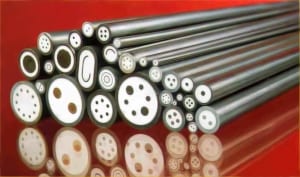
Mineral-insulated thermocouple and conductor cable from ARi Industries
AerOpak® cable for myriad temperature measurement and signal-sending applications in harsh environments; wide assortment of sizes and sheath materials available for immediate shipment
ARi Industries, Inc., a longtime market leader in temperature measurement, announces immediate availability of its AerOpak mineral-insulated (MI) thermocouple cable in an expanded assortment of sizes and sheath materials. MI cable offers thermocouple fabricators, instruments designers, process engineers and various equipment builders a unique solution to the challenges of temperature measurement and electrical signal-sending in harsh, corrosive and other hazardous environments.
Offered as thermocouple and conductor cable, AerOpak products comprise thermocouple or conductor wires insulated with compacted ceramic powder, drawn and encased in a seamless metallic sheath material. Standard thermocouple or conductor cables up to 10-wire configurations are available in various stainless steel, Hastelloy and Inconel sheath materials in OD sizes ranging from 0.020” to 0.750” diameter. Cable can be supplied for temperatures up to metal melt points of 2600ºF and over 1000 ft. in length, making these products suitable for all types of process operations and very large equipment. Owing to the strict manufacturing and production standards of ARi, MI cable signal integrity is consistent over the longest length applications.
Thermocouple cables in Types K, E, J, T, N, R, S, and B are stocked in calibration tolerances to meet all applicable ASTM, IEC and ANSI standards.
MI cable from ARi can be welded, brazed or soldered in the field, relative to the application and techniques used. Please consult the manufacturer for details or installation assistance. Custom wire configurations, other sheath materials and assorted insulation ingredients are also available on request, to suit virtually all applications.
For full details and specifications on this line of products, please request Bulletin 4.0.
For more information, please contact: ARi Industries, Inc. 381 ARi Court Addison, IL 60101 Toll-Free: 800-237-6725 Phone: 630-953-9100 Fax: 630-953-0590 Web: www.ariindustries.com
Email: sales@ariindustries.com
ARi Industries, Inc. is a division of Okazaki Manufacturing Company (Japan).
ARi Industries is a manufacturer of mineral-insulated wire and cable, thermocouples, RTD’s, thermowells and temperature transmitters, as well as conductor cable assemblies, neutron detectors, electric heating elements of various types and related hardware. The company is ISO-9001-2000 Certified and performs X-ray inspection, helium leak testing, temperature calibration traceable to NIST and other analytical services. The company is a worldwide supplier to instrument, power generation, aircraft and other equipment builders, as well as all process industries, serving the most demanding environments.
Continue reading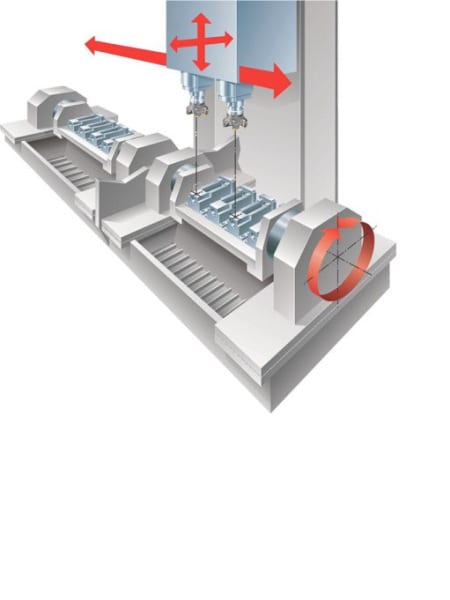 STAMA WILL BE AT IMTS BOOTH 8966
STAMA unveils a new concept in multi-spindle machining
The “2 Plus 4” principle has represented the most economical and efficient means of multi-spindle machining in manufacturing. STAMA has implemented this principle, with 2 spindles and 4 clamped workpieces, in hundreds of existing projects worldwide, resulting in radically reduced cost per part scenarios for its customers. In today’s highly competitive market, however, STAMA has recently conducted discussions with its customers concerning greater factory floor utilization and “non-productive” capacity, leading to the question, are more than 2 spindles – perhaps even 4 – for the simultaneous machining of workpieces, economically more reasonable? This challenge has sparked an interesting development at STAMA, the 4-spindle TWIN2 concept that’s now being introduced to the world market for multi-spindle machining applications.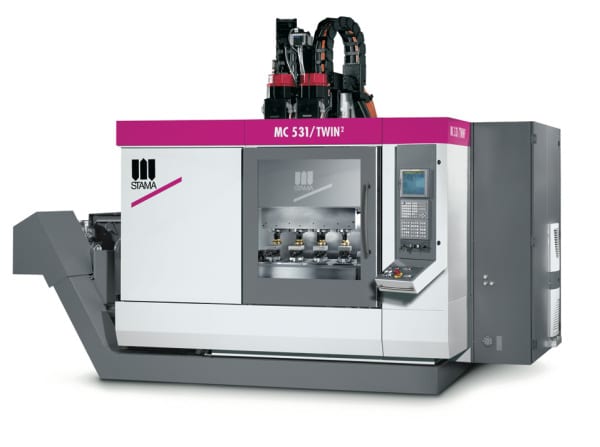
In answering this 2 vs. 4 question, a shop must first verify which productivity upsides will be realized by this concept. Figure 1 below shows the productivity benefits with a 4-spindle solution on completely different manufacturing processes with different primary machining times. Contrary to the “logical” expectations, the 4-spindle solution with 4 clamped workpieces doesn’t result in double the output, compared to a 2-spindle production with 4 clamped workpieces. In the relationship between the primary machining time and the overall cycle time of the process, the actual output will usually increase by 60% to 70% by adding 2 more spindles. Individual exceptions with short time-consuming machining operations can reflect an increase of more then 80%, according to STAMA research.
While twin spindle machining needs to double the capacity of the tool magazine, the four spindle solution requires a tool magazine to handle four times as many tools. The STAMA MC 531/TWIN² is equipped with 56 tool places in the standard version, for example, with options for magazines up to 120 tools.
One major key in four spindle machining, with short tool-to-part contact times, is the load and unload sequences of the workpieces. In such cases, as long as the machine isn’t equipped with a quick automatic loading/unloading system, pendulum machining is more advisable. This ensures parallel machining time while loading new workpieces. Time for loading and unloading can then be as long as the actual cycle time of the machine. This will also result in less time when the operator is interacting with the machine, thereby allowing the operator to run multiple stations in a work cell set-up, while keeping a constant touch time protocol on each machine.
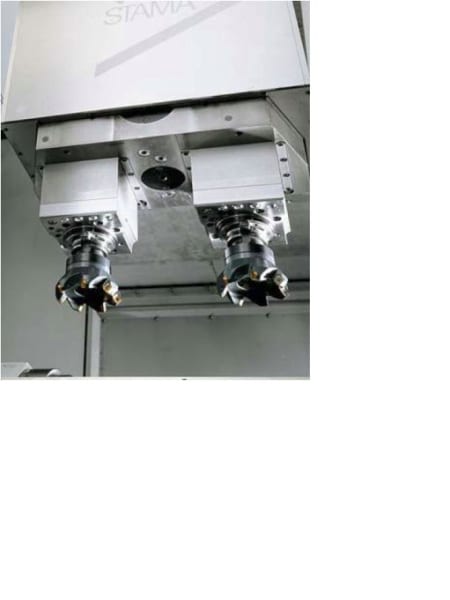
Under these conditions, for many workpieces studied by STAMA and its customers, the “4 Plus 4” solution can result in major cost per part reduction. With over 25 years’ experience in TWIN spindle technology, the simplicity of a common Z-headstock for twin spindles from STAMA is well accepted and proven technology worldwide. The simplicity of this system is also used throughout this new TWIN² technology. Incorporating a state-of-the-art tool presetter, even single spindle manufacturing challenges with high accuracy demands can be realized with multi-spindle technology. The outstanding productivity and high workpiece quality achievable are the benchmarks by which STAMA TWIN spindle centers are known. The expansion to this 4-spindle TWIN2 machining center technology is the logical consequence of the company’s latest research and machine development strategies.
Already in full production use at a STAMA customer in one of the BRIC markets is a new four-spindle TWIN2 machining center, currently doing ABS housing manufacturing and connecting rod machining. This success for STAMA evidences the simplicity and practical application of the company’s highly productive manufacturing equipment.
Excellence in Manufacturing…the keystone of STAMA
STAMA America is the U.S. subsidiary of STAMA Maschinenfabrik GmbH in Germany.
For more information or to arrange a demonstration, please contact:
STAMA America 1063 Hawthorne Drive Itasca, IL 60143 Phone: (630) 233-8101 www.stama-america.com simon.knecht@stama-america.com
Simon Knecht, Director of Sales
PR agency contact: Tim Daro Bernard & Company 847-934-4500 tdaro@bernardandcompany.com
Continue reading