
Contact us today:
(847) 934-4500
tdaro@bernardandcompany.com
Contact us today:
(847) 934-4500
tdaro@bernardandcompany.com
 FRED YOUNG, CEO OF FOREST CITY GEAR, SPOKE AT THE NCMA SYMPOSIUM 2010 ABOUT “GROWING GLOBAL MARKETS”
Roscoe, IL-Forest City Gear’s CEO Fred Young spoke on “Growing Global Markets” at the National Contract Manufacturers Association (NCMA) Symposium 2010 held at NIU Conference Center in Rockford, IL on Tuesday, March 23, 2010. This year’s symposium focused on “International Contracting: Winning Business In Emerging Global Markets.”
With the use of the internet and social media, we have access to businesses and products without the limitation of boarders and time-zones. More and more companies, even small, family owned businesses like Forest City Gear, find themselves very active in the global market. During his speech. Fred stated that “although the title suggests I deliberately set out to grow global exports, in reality, we fell into it accidentally.” He explained it was his customer’s desire for cheaper production and assembly, along with their unwillingness to lose Forest City Gear’s quality and service, that initially brought FCG into foreign markets. Once recognized in these new markets, Forest City Gear’s unwavering belief in concentrating on high quality, doing what others cannot do expediently and having the most up-to-date gearmaking equipment brought them additional business in these countries. As a result, staying true to these principles has established FCG as a leader in the world market for high-precision gears.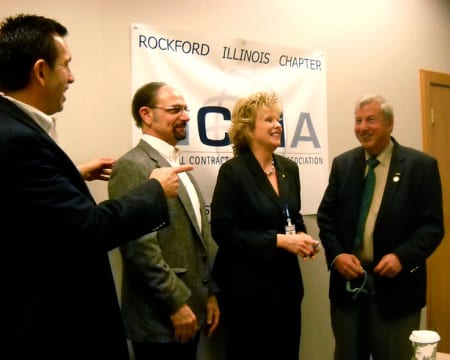
As Fred briefly described the history of Forest City Gear, founded in 1955 by his parents, he stressed that quality and on-time delivery have been essential in proving and maintaining the company’s reputation of excellence since its inception. Fred believes the greatest lesson his father taught him was to reinvest every last dollar. He further believes reinvesting has been a key factor in their success on the global market. Over the past 30 years, FCG has reinvested 25%-40% of gross sales each year into new equipment. FCG’s philosophy is: when you are competing with other gear companies all over the world, it is important to be on the cutting edge. “Others have primarily shot themselves in the foot with the lack of reinvestment. Those who would had been considered leaders 50 years ago didn’t reinvest to update and bring their machines current and, as a result, they cannot compete in today’s global market.”
FCG believes it is a serious error if you don’t know your competition, know what they are delivering and how they do it. In addition to keeping his facility focused on quality and excellence, Fred visits gear companies and machine builders all over the world. Seeing how others run their facilities is “critically important”, as it provides knowledge and insight in offer something better than what the competition is producing.
“The future of exporting manufacturing is critical to the health of our country, we need to educate our youth, keeping that notion going is important to our future.” FCG continues to have a strong presence in the world marketplace by keeping their facility current, educating their employees with top-notch trainers who have global experience and by cultivating a reputation of excellence and helping others, even their competitors.
“Our clients are now all around the world and they found us in Roscoe, IL. Who has ever heard of Roscoe, IL? But we have developed a reputation for gearmaking excellence… Forest City Gear is always seeking, always exploring and always learning.”
Forest City Gear was founded in Rockford, IL in 1955 by Evelyn and Stetler Young, parents of Fred Young.
To watch the full video presentation of Fred’s speech, go to: http://vimeo.com/10460533.
For more information on this announcement, please contact: FOREST CITY GEAR CO., INC. 11715 Main Street Roscoe, IL 61073-0080 Phone: 815-623-2168 Fax: 815-623-6620 Web: www.forestcitygear.com Email: sales@forestcitygear.com Attention: Fred Young
Agency contact: Tim Daro Bernard & Company 847-934-4500 tdaro@bernardandcompany.com
Release: FOREST CITY GEAR CO., INC.
Date: March 29, 2010
Continue reading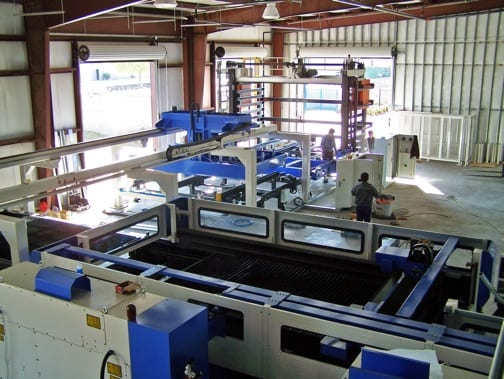 WEST-MARK MAKING BIG MARK IN SEVERAL MARKETS By bringing laser and tower automation in-house, California fluid transport, fire apparatus, display builder sees the light!
West-Mark is literally a tale of many chapters, especially when it comes to laser fabrication. Started originally in 1967 as a manufacturing and repair facility for dairy transport tankers, it quickly expanded to become a leading West Coast builder of fluid transport vehicles for many industries, including petroleum, firefighting, military, construction, food, liquid sanitation, even arctic equipment, through its branch in Anchorage, Alaska. Today, the company enjoys a diversified customer base and, in addition to the Alaskan location, operates manufacturing, fabrication, assembly and repair facilities in Ceres, Atwater and Bakersfield, California. Over 150 employees provide West-Mark customers a broad range of vehicles for sale or rent, plus the company maintains full service and repair operations.
In the late 1990’s, another market sprung up for the company, namely, the fabrication of display enclosures for entertainment venues, kiosks, elevators, airports, shopping malls and other retail/commercial establishments. Using the engineering and manufacturing skills that had proven successful in the industrial markets, the company opened its “Digital Factory” in Atwater, where today it produces an assortment of enclosures and freestanding kiosks, under the Perfected Protection™ brand name.
West-Mark had long been an integrated design, fabrication and assembly company, according to Fabrication Director, Chris Portmann, “…but we saw one area that needed better control and cost containment, namely, the laser cutting of the various stainless steel, carbon steel and aluminum materials we processed.” The company was utilizing the services of three local laser job shops and occasional bottlenecks would occur, in addition to the cost factors involved. As the company was continuing to grow, these production challenges grew, as well. West-Mark knew a change was in the wind.
At a meeting with one of their trusted machine/equipment dealers, Metal Process Engineering, West-Mark was introduced to the Han-Kwang plate laser with integrated material tower automation. In one of those classic “light bulb” moments, a decision was formulated and the sale proceeded. The company also hired an experienced laser operator from a local shop. The benefits soon became apparent.
As Portmann explains, “Very quickly, we realized we could run a lot faster to save time and money. Beyond that, we could be more responsive to the one-off and short run job requirements we get, all the time, in our operation. Because of the software we use and the products Han-Kwang provided us, we were able to integrate those short runs into the nesting strategies with our longer run jobs.” The tower automation provided West-Mark the flexibility to do several more things in its production. They could stack frequently-used materials on pallets into the tower for quick access and start-up, owing to the powerful CNC onboard the Han-Kwang laser, while the fully automated cycle capability allowed West-Mark to quickly move into a lights-out manufacturing strategy, thereby providing additional cost containment in personnel and power consumption.
 The machine configuration utilized here is Han-Kwang’s Model FS 4020, a long bed gantry style, flying optic plate laser with twin 6’ x 12’ shuttle pallets and an 8-high materials tower, all controlled by the industry’s most powerful CNC, a Siemens Sinumerik 840D. Materials processed at West-Mark on this laser include 304 and 316 SS, plus A36 and 570 carbon steel as well as 3003 and 5054 aluminum. Portmann pointed out that the company uses Masonite® blanks to protect the high quality surfaces of materials during unload sequences and that this extra protection step has not slowed the laser’s production in any substantial way.
West-Mark utilizes Inventor® CAD and Radan® CAM systems, typically, plus the proprietary nesting software provided by Han-Kwang. Since West-Mark launched its 3D software use at approximately the same time as they purchased the laser, the company’s programmers and operators shared a learning curve, but Chris Portmann noted, “It was a ‘law of unintended consequences’ situation, because the market slowed at the same time we were acquiring the new machine and software packages, so our guys were able to learn in the slow times.” He further observed the company has enjoyed an ability to be more responsive to customer needs and that has led directly to more new business for West-Mark, including doing laser processing for other local firms in the area.
A particular benefit of the Han-Kwang laser, according to West-Mark personnel, is its ability to process aluminum tread plate with the diamond side up, so the dross falls onto the back side of the material, compared to the typical laser cutting diamond side down, where the dross falls on the visible side of the material.
A rather direct fellow, Portmann sums up by saying, “When we need another laser, there will be no question about getting another Han-Kwang. Their machine quality, application assistance, operator and programmer training, plus the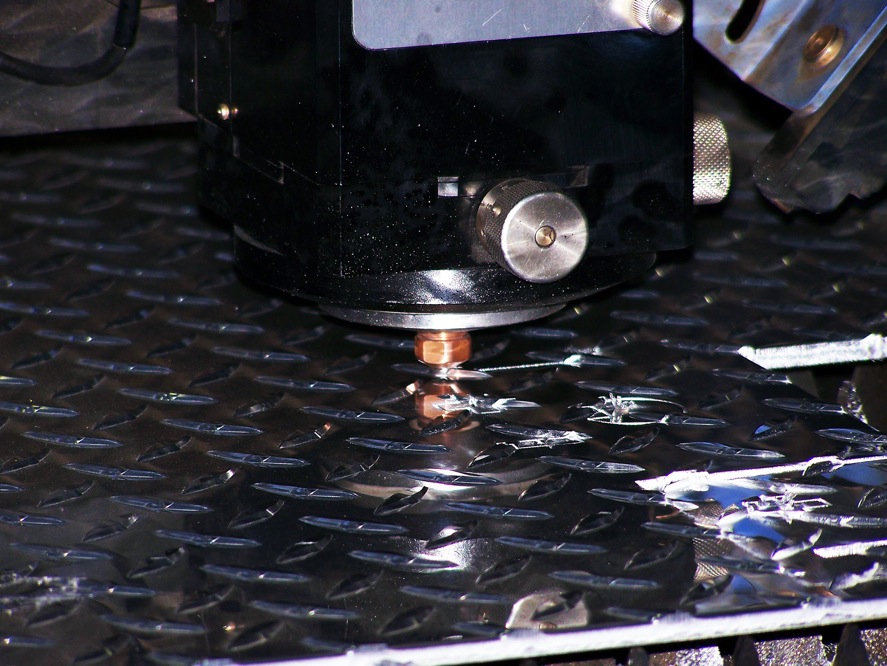 overall improvement they made in our company’s production makes that decision an easy one.” Portmann called out Eric Kim at Han-Kwang as having been particularly helpful in the start-up and application of the laser and tower automation at his company.
West-Mark, in addition to the Digital Factory production of enclosures and kiosks, builds fuel tankers, buffaloes and bowsers, water tenders, firefighting apparatus, grease trap and septic tank vacuum trucks, DOT Code tanks, even aircraft refuelers, working in a variety of industries, as well as for the Department of Defense, National Park Service, Department of Interior, U.S. Army, Navy, Air Force and the civilian supply chain.
In the production of its high-precision metal parts, assemblies and fabrications, the company operates a full complement of laser, shearing, rollforming, head forming and flanging, brake forming, punching, milling, welding and quality inspection equipment.
West-Mark service operations range from leak repair and testing to full retrofit and field replacement.
For more information, please contact: WEST-MARK 2704 Railroad Avenue Ceres, CA 95307 Phone: 209-537-4747 Fax: 209-537-1753 Toll-Free: 800-692-5844 www.west-mark.com www.digitalfactory.com Chris Portmann, Fabrication Director cportmann@west-mark.com
HAN-KWANG USA INC. 1120 Garfield Street Lombard, IL 60148 Phone: 630-916-0200 Fax: 630-916-0300 Web: www.hankwangus.com Email: mailto:salesusa@hankwang.co.kr Attention: Robert Won, Eric Kim or Jane Lee
Agency contact: Tim Daro Bernard & Company tdaro@bernardandcompany.com 847-934-4500
Release: HAN-KWANG USA INC.
Date: March 8, 2010
Continue reading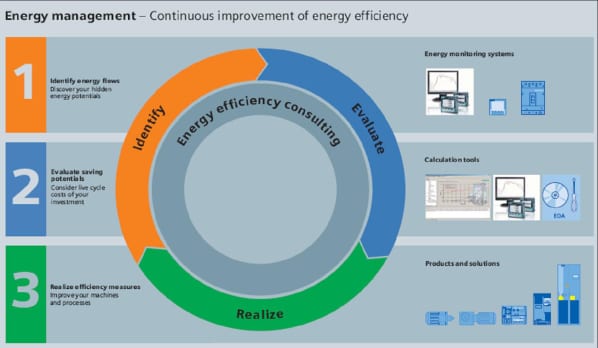 Energy Management with Drives
The key is a process, not a product, with many factors contributing to energy efficiency.
What is the key to more energy efficient motion control?
While it is valid to state that energy efficiency is defined as the same level of production being achieved at an overall lower energy cost, it is equally important for today’s machine builders and automation engineers alike to remember than an energy-efficient system can actually translate into higher productivity. This is achievable through a comprehensive approach to energy management. Energy management is a process, rather than a product or series of products installed on a machine, or inline, to achieve a basic energy saving of kW hour consumption.
What are the essential elements and basis of the process?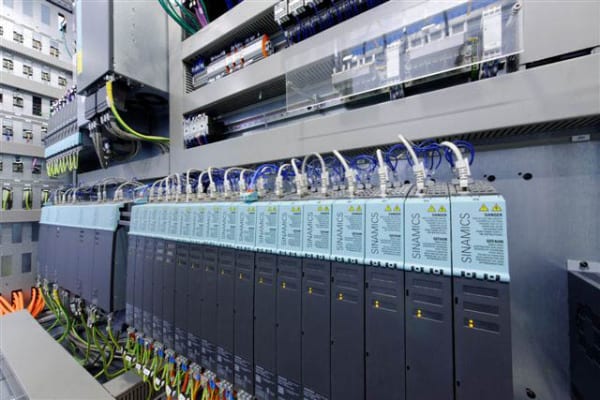
First, energy monitoring systems must be in place to effectively determine the current consumption. These can include, but are certainly not limited to, energy consumption displays, infeed/supply monitoring devices, power factor meters and more. Next, the proper calculation tools are needed to properly evaluate the life cycle costs of any investment. These tools can be as simple as a motor sizing chart or the software programs used to parameterize drives. However, a more formal mechatronics protocol may be beneficial. In this scenario, a thorough evaluation of both mechanical and electrical/electronic influences on a system, machine or process line is conducted. The results can often open the eyes of machine designers, process engineers and system integrators alike.
What is the general approach to a mechatronics analysis?
This is where a competent supplier can be an effective partner. For example, a solution might involve a vector drive that utilizes an energy optimization function to enhance the efficiency of the motor during partial load operations. In a system with multiple motors, energy savings might be realized to a substantial degree by the use of a drive unit with a common DC bus. The designer can also select the most appropriate infeed solution for the machine, pump or process operation, given the particulars of performance and required output. This may include an appropriately sized infeed unit with regenerative capability, the ability to put unused or braking energy back on the incoming power line.
 What are realistic goals for energy savings?
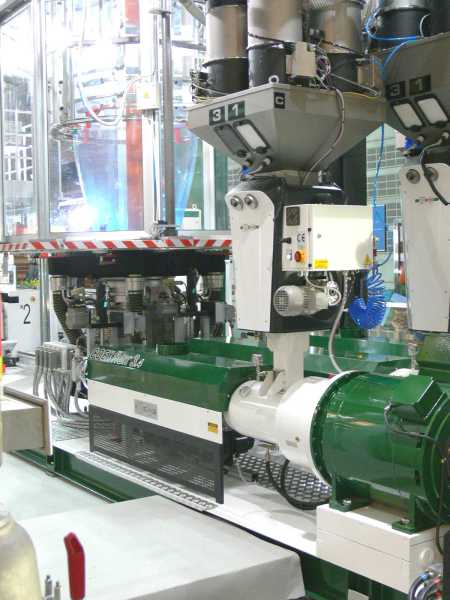
Some applications may allow the use of high efficiency standard induction motors and, in the process, realize a potential savings of 1-3%. The use of frequency converters (VFD) for speed control might raise this to an 8-10% savings.
Optimizing an entire system through mechatronic analysis of the machine or process design, can result in a potential savings of 15-20% by the avoidance of over dimensioning of motors, plus partial load optimization by means of energy-related flow control. This analysis may also point to the ability to use controlled energy infeed and recovery.
What technologies should be evaluated?
A corollary to this discussion should also include a review of potential hydraulic and pneumatic component change outs in certain applications where replacement with an integrated package of motion control and PLC technology might better resolve closed loop pressure control of axes, for example. Fewer components and their related power consumption can lead to overall system productivity improvements, as well as ongoing enhanced energy efficiencies.
As the emergence of new technologies has impacted many of the products used in energy-efficient systems, it is equally important to take a more holistic look at operational sequences and the overall integration scheme when designing, retrofitting or rebuilding for improved energy utilization.
Michael Perlman is the Marketing Programs Manager for the Motion Control business of Siemens Industry, Inc.
For specific product information and inquiries, call (800) 879-8079 ext. Marketing Communications or send an e-mail to: SiemensMTBUMarCom.industry@siemens.com.
Continue reading REP Corporation, the longtime leader in injection presses for rubber and TPE molding, announces the start of a new credit program, effective immediately and running through July 31, 2010. Molders who validate the scrapping of their older presses can earn up to $40,000 in credit against the purchase of any new REP machine, during this period. The announcement was made today by REP President Tim Graham, at the company’s Bartlett, Illinois headquarters, near Chicago.
Graham detailed the offer, saying it would apply to any make or model of rubber or TPE injection press. REP requires the molder to validate the scrapping of their old machine, thereby earning a predetermined credit, based on the old machine’s age and condition. The credit, up to $40,000, can then be applied to the purchase of any new REP injection press in the G9 series.
He further noted the advantages of a new machine. “Besides the higher quality parts a molder can produce, owing to the level of mold mechanics, material flow and control sophistication, a new press consumes less energy, has less downtime and less maintenance requirements, so it stays in production. Even REP presses from our earlier generations cannot match the productivity and resulting profitability of a new G9 machine. That’s not a brag, it’s a fact and it’s one we can document,” he said, noting the new machines offer better molding strategies, improved ergonomics and faster payback for the customer.
“It’s an offer you can’t refuse,” Graham joked.
REP Corporation is responsible for all sales and service in North America. However, this offer is being made to rubber molders worldwide by REP, based in Lyon, France.
For more information, please contact: REP CORPORATION 8N470 Tameling Court Bartlett, IL 60103-8146 Phone: 847-697-7210 Fax: 847-697-6829 Web: www.repinjection.com Email: tgraham@repcorp.com Attention: Tim Graham, President
PR agency contact: Tim Daro Bernard & Company 847-934-4500 tdaro@bernardandcompany.com
Continue reading No. 945 is an electrically-heated 500°F(~260°C) universal oven from Grieve, currently used for various curing tasks at the customer’s facility. Workspace dimensions are 54” wide x 36” deep x 36” high. 6.6 KW are installed in Nichrome wire heating elements to heat the load, while a 600 CFM, 1/2-HP recirculating blower provides horizontal front to rear airflow.
The unit has 4” insulated walls, an aluminized steel exterior and Type 430 stainless steel interior. It is also equipped with an integral leg stand with casters and leveling pads.
Controls onboard No. 945 include a digital indicating temperature controller, manual reset excess temperature controller with separate contactors, recirculating blower airflow safety switch and SCR power controller.
For more information, please contact: THE GRIEVE CORPORATION, 500 Hart Road, Round Lake, Illinois 60073-2835 USA. Phone: (847) 546-8225. Fax: (847) 546-9210. Web: www.grievecorp.com. Email: sales@grievecorp.com. Attention: FrankCalabrese.
NEWS RELEASE: THE GRIEVE CORPORATION Agency contact: Tim Daro 847-934-4500
DATE: March 22, 2010
Continue reading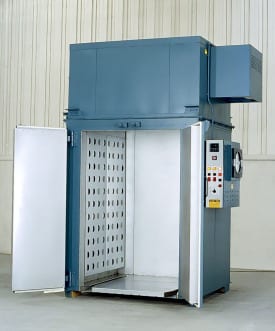 No. 813 is a gas-heated 500°F(~260°C) walk-in oven from Grieve, currently used for curing printed circuit boards. 350,000 BTU/HR is installed in a modulating natural gas burner and workspace dimensions are 48” wide x 48” deep x 72” high.
The unit has 4” insulated walls and an aluminized stainless steel interior and exterior. A 3300 CFM, 2-HP recirculating blower provides horizontal airflow to the oven. Safety equipment, such as a 325 CFM 1/3 powered force exhauster, is included as required by the IRI, FM and the National Fire Protection Association Standard 86 for gas-fired equipment. The oven also features a 2” insulated floor with truck wheel guide tracks and a removable top-mounted heat chamber.
Controls onboard No. 813 include a recirculating blower airflow safety switch, circular chart temperature controller and a manual reset excess temperature controller.
For more information, please contact:
THE GRIEVE CORPORATION
500 Hart Road
Round Lake, Illinois 60073-2835
USA
Phone: (847) 546-8225
Fax: (847) 546-9210
Web: www.grievecorp.com
Email: sales@grievecorp.com
Attention: Frank Calabrese
When the Las Vegas based Cirque de Soleil show, “KA” was looking to maximize motion control and improve the reliability of their stage’s movements, they turned to Siemens. Siemens drives and controls create the automation needed to provide the safety and reliability that is required for a performance of this caliber.
For three years, a Siemens engineering team worked to make this $220 million dollar show and theatre at the Las Vegas MGM Grand spectacular. Visually, the show is like nothing you have ever seen before but reliability, flawless motion and safety was Siemens’ main objective.
The Cirque de Soleil show “KA” requires a 25 x 50 ft section of the floor to rise out of the main portion of the stage. This 6 ft thick, 80 thousand pound
section of the stage provides full motion that rotates 360º and tilts 100º to become a sheer vertical, ultimately lining up perpendicular to the stationary part of the stage… with the performers still on it! I’ll keep my job, thank you. I think Bernard & Company needs to take a field trip to Vegas to see this in person.Check out this video and see how Siemens’ contribution makes this stage show possible.
This article details Siemens’ part in the three year process to get the “KA” stage operating flawlessly.
Complete Set of Application-Ready “Tools” for Converting Applications
ATLANTA — Siemens Industry, Inc. announced today the introduction of the Converting Toolbox, a set of standardized automation tools for the integration of various machine components that previously had to be performed individually. It simplifies web processing applications and offers greater flexibility for machine designers and builders of paper, film, foil and other converting machinery. It is completely scalable and is provided at no cost to qualified machine designers, builders and integrators.
The Converting Toolbox enables machine builders to achieve considerably faster time to market by reducing the time required for engineering, programming, commissioning and documentation, as much as 80 percent in some cases. It offers modular open functions, for items such as: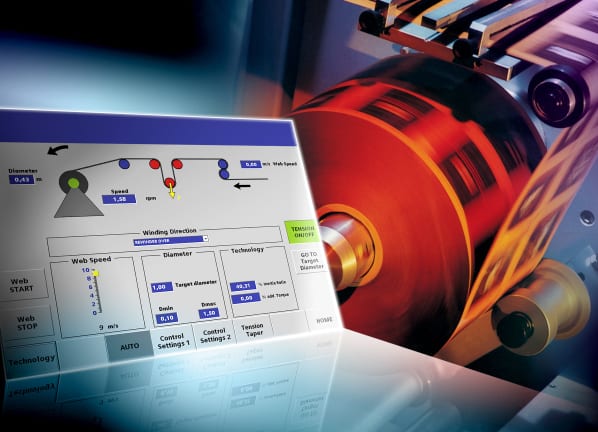
The Converting Toolbox components take the form of pre-programmed functions. Sample applications demonstrate how each function can be efficiently and effectively implemented into a machine design. Such sample applications are ready-to-use after only minor modifications and include basic HMI functionality. This enables the machine function to be tested and optimized in a very short time frame.
When a functionality module needs to be modified, extended or changed, the Converting Toolbox’s completely open source code provides a wide and solid basis from which even the most specialized functions can be implemented quickly and easily.
Simotion®, the Siemens motion control system, is ideally suited as an operating platform for the Converting Toolbox because applications can be operated directly on an intelligent drive, very compactly and without need of an additional PLC. Simotion offers drive, controller and PC-based topologies. The Converting Toolbox also includes drives-based solutions using Siemens Sinamics® Drive Control Chart (DCC) graphical programming language.
For specific product information and inquiries, call (800) 879-8079 ext. Marketing Communications or send an e-mail to: SiemensMTBUMarCom.industry@siemens.com.
Continue reading
 ATLANTA — Siemens Industry, Inc. announced today a new service for its popular line of 1FK7 servomotors. Using a configurable options menu to build exactly the motor required, customers can now place an order for any Siemens 1FK7 servomotor and have it drop-shipped in three weeks. Thanks to the diverse range of options available, this new service applies to over 100,000 possible configurations. All compact (CT) and high-dynamic (HD) servomotors in the 1FK7 family are included.
With a total of 6150 option pairings and 18 color choices, servomotors in the 1FK7 family can be configured to 110,700 possible designs. Options include stall torque and RPM rating, encoder style and bit resolution, holding brake functionality, shaft style, IP rating, AC line supply voltage and electronic nameplate recognition via Drive-Cliq®. 1FK7 geared motor options are not included in this program.
Siemens is making this service available to customers in the U.S. market. With the motion controller Simotion® and the drive system Sinamics® S stocked in the United States, Siemens is now able to supply complete motion control systems in three weeks’ lead time.
According to Arun Jain, general manager, Siemens Motion Control Business, “We have made the commitment to significantly shorten servomotor delivery times. The 1FK7 family has a wide user base for motion control applications, so we have selected this very important line for this major customer service initiative. We have devised and implemented an entirely new protocol for motor manufacturing and production at our factories.”
For more information, visit www.usa.siemens.com/motioncontrol.
For specific product information and inquiries, call (800) 879-8079 ext. Marketing Communications or send an e-mail to: SiemensMTBUMarCom.industry@siemens.com.
Continue reading

Zimmermann FZ42 portal milling machine with five-axis, five-sided cutting capability
By using a Zimmermann FZ42 portal milling center, Volvo gets the power and torque needed to cut engine fan cases plus the accuracy to turn the machine tool into a coordinate measuring machine for inspection of finished parts
Located near Hartford, Conn., Volvo Aero Connecticut specializes in the machining of large components: fan cases for aircraft engines and gas turbines, fan and compressor structures, compressor rotors, low-pressure turbine cases (LPT) and military parts, usually from aluminum and titanium, as well as Inconel and Waspaloy. It currently manufactures the largest fan casing in the world, at 3.5 meters (11.5 feet) in diameter, for the massive GE90, the only aircraft engine in existence providing 127,900 pounds of thrust, to power the Boeing 777 line. Volvo Aerospace also produces numerous titanium fan cases for Rolls Royce engines.
With the large workpieces, high material removal rates and challenging geometries inherent in aerospace metals manufacturing, coupled with substrates that are often difficult to machine, such as titanium, there is always a need for powerful machining with superior accuracy. Such conditions present substantial hurdles at aerospace supply companies, as they seek to maintain that delicate balance between these seemingly opposing concepts.
As part of its program for the GEnx engine, to be used on the Boeing 787 Dreamliner, Volvo Aero Connecticut recently added a Zimmermann FZ42 machine tool, a five-axis, five-side portal milling center, to its already impressive manufacturing cells at the Hartford facility. The new machine joins other five-axis mills, vertical turning machines, four-axis machining centers and a deburring robot.
Key features on the FZ42 that led Volvo Aero Connecticut to make this acquisition included:

GE90 engine; Volvo Aero Connecticut made the fan casing, currently the largest of its kind at 3.5m (11.5 foot) diameter
In addition, this FZ42 carries a high accuracy package that provides optimum temperature control of the structural machine parts through the use of a special fiber-reinforced compound in the massive side columns. Also facilitating this process are built-in cooling ducts in the portal and Z-axis slide, independent cooling circuits for the A-axis, C-axis and spindle, ground surfaces on the guideways for the Z-axis and side columns, plus a double-pitch measuring system on the A-axis and C-axis.
During the course of manufacturing, thermal expansion of both machine components and workpieces can substantially impact the positioning accuracy of the machine, the stability of the workpiece and the resulting effect on the finished part dimensions. This unique combination of temperature control and mechanical accuracy in the machine construction were an important deciding factor for Volvo Aerospace in acquiring the FZ42.
According to Martin Thorden, engineering manager at Volvo Aero Connecticut, “These features, combined with the onsite machine set-up provided by Zimmermann, were very important to us, especially on this new GEnx project.” Thorden further noted the importance of the control on the machine, a Sinumerik 840D CNC from Siemens. “We see a very big benefit in how well we are able to control the tool with the CNC. We have been able to use the control to take on additional tasks that were previously handled by our CAD/CAM system.” Specifically, he cited the unconventional approach Volvo Aerospace took in machining the big fan cases. They installed the machine without a rotary table, thus realizing over $500,000 in direct cost savings plus material handling time. As a result of that decision, they believed they needed a top-of-the-line control to probe and accurately machine all the features on the part.

Volvo Aero Connecticut, located near Hartford, comprises three buildings, the largest being 40,000 square feet, where various aerospace and military aircraft components are typically produced from aluminum, titanium, Inconel and Waspaloy.
After machining, Volvo Aero Connecticut can actually transition the machine tool into a coordinate measuring machine for inspection, according to Thorden, owing to the superior accuracy provided by the CNC, as well as the special 90 degree angle heads supplied with the machine, part of the MuST® spindle technology from Zimmermann.
Onboard the machine tool, a massive 120-position tool carriage holds various HSK63 and HSK100 tools that are used to machine the substrates worked here. Inside a series of four side stations, within the machine workspace, four additional specialty tools are stored and used for various operations in the machining and measuring process.
All motors and the drive package onboard the Zimmermann FZ42 at this Volvo Aero Connecticut facility are also made by Siemens.
In a typical machining sequence, the milling head on this machine, equipped with the Zimmermann MuST® spindle system, provides Volvo Aerospace numerous other advantages, according to Martin Thorden. All roughing and subsequent finish passes on any material can be achieved in one set-up, which reduces the preparation time and overall production costs by as much as 10%. There is also no need for additional machines and the corresponding materials handling time. The head design further enables Volvo Aero Connecticut to perform tasks other than milling, using the specialty heads stored on the side stations. Changing the spindle, instead of the milling head, enhances repeatability and further reduces the company’s spindle interface costs, according to Thorden.
The combination of increased accuracies, reduced equipment needs and faster throughput has highlighted this Zimmermann machine installation at Volvo Aero Connecticut.
For additional product information and inquiries:
Zimmermann Inc.
Phone: 248-305-9707
Web: www.zimmermann-inc.com
Email: Matthias@zimmermann-inc.com
Attention: Matthias Tockook
Volvo Aero Connecticut
Phone: 860-667-8502
Web: www.volvoaero.com
Email: Martin.Thorden@volvo.com
Attention: Martin Thorden
Siemens Machine Tool Business
John Meyer
Manager, Marketing Communications
Siemens Industry, Inc.
(847) 640-1595
www.usa.siemens.com/cnc
SiemensMTBUMarCom.industry@siemens.com
Follow us on Facebook: www.facebook.com/SiemensCNC or Twitter: www.twitter.com/siemens_cnc_us.
—
Siemens Industry Sector is the world’s leading supplier of innovative and environmentally friendly products, solutions and services for industrial customers. With end-to-end automation technology and industrial software, solid vertical-market expertise, and technology-based services, the sector enhances its customers’ productivity, efficiency and flexibility. With a global workforce of more than 100,000 employees, the Industry Sector comprises the Industry Automation, Drive Technologies and Customer Services Divisions as well as the Metals Technologies Business Unit. For more information, visit http://www.usa.siemens.com/industry.
The Siemens Drive Technologies Division is the world’s leading supplier of products, systems, applications, solutions and services for the entire drive train, with electrical and mechanical components. Drive Technologies serves all vertical markets in the production and process industries as well as the infrastructure/energy segment. With its products and solutions, the division enables its customers to achieve productivity, energy efficiency and reliability. For more information, visit http://www.usa.siemens.com/drivetechnologies.
Continue reading